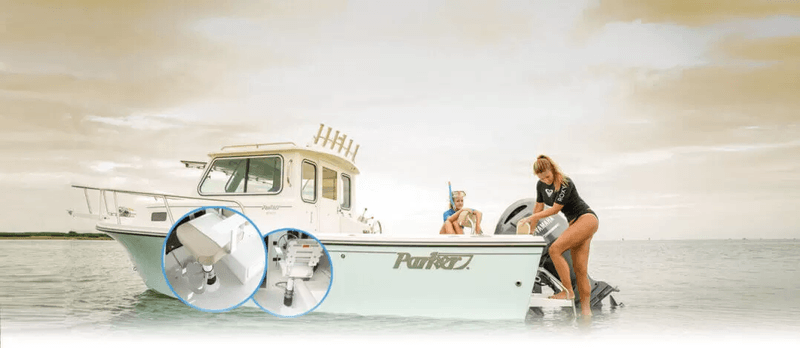
Running offshore in chop is still one of the fastest ways to turn a good day into a sore back, tight shoulders, and early fatigue. In 2026, the bigger shift is not a “softer cushion.” It’s a better suspension interface between the hull and the human—especially when waves stack up and conditions turn into true rough water.
Shock absorbing boat seats (more accurately, suspension seat systems) reduce the impact energy that reaches the operator and crew. Done right, they also reduce the constant jarring small vibration that quietly drains focus over long runs—whether you’re running to the grounds for fishing or heading home late with a full load of gear.
A hull impact is not a single straight-up hit. Real impacts include:
A standard rigid pedestal transfers that energy almost directly into your spine. A thick cushion helps comfort, but it does not manage impact. It compresses and rebounds, often too fast, and it cannot control the energy path.
The practical result is simple: operators brace, stand, or hover over the seat. That reduces control, increases fatigue, and makes injuries more likely over time—especially when the boat’s motion gets unpredictable in short, steep chop.
Many buyers shop by the word “seat,” but suspension performance usually comes from what’s under it—think shock absorbing pedestal (or pedestal + mount) rather than upholstery alone.
A fixed post is strong and simple, but it is also a direct mechanical link from deck to body. If you feel every hit, this is why.
Spring-based units can improve comfort, but if rebound control is weak, they can feel bouncy. That “pogo” effect is more than annoying; it can increase loss of contact and make it harder to stay planted when the boat lands. (seaspension.com)
Air systems can be comfortable, but they often introduce extra setup steps (pressure tuning) and more components that must stay healthy in a marine environment. If the tune is off, performance is off. In practice, an air ride boat seat pedestal often comes down to whether you’ll actually use the adjustable air pressure feature (and consistently fine tune it), and whether the internal air shock and black airbag components stay happy long-term.
Some systems are also marketed with brand- or model-specific phrasing (for example: airwave boat seat suspension system or airwave boat seat pedestal aides), but the real question is still the same: how well does it manage compression and rebound in real seas?
Hydraulic dampers manage both compression and rebound by forcing fluid through engineered passages. The goal is controlled deceleration, not a soft bounce. Sealed hydraulic designs also avoid the day-to-day personal comfort setting adjustment loop many operators dislike. (seaspension.com)
A good hydraulic suspension pedestal is doing three jobs every time you hit a wave:
This “velocity-sensitive” behavior is a key reason hydraulic suspension can feel stable in mixed conditions (small chop one minute, sharp slam the next). (seaspension.com)
Rough-water comfort claims only matter if the system performs in the conditions you actually run. When you evaluate suspension seats or pedestals, focus on test scenarios like:
For example, Seaspension references real-world rough conditions including days with 3–5 ft swells at 7 seconds in a field-use context, which is the kind of sea state that quickly exposes whether a setup is truly controlled or just “soft.” (seaspension.com)
Also consider durability evidence. Seaspension notes over 6,000 hours of duty with the New Jersey State Police, which is the type of operational use-case that tends to reveal corrosion, seal issues, and looseness problems early. (seaspension.com)
| Feature that matters offshore | Standard rigid pedestal | Basic spring suspension | Hydraulic suspension pedestal |
|---|---|---|---|
| Impact reduction on slams | Low | Medium (varies) | High potential (if well tuned) |
| Rebound control | N/A | Often inconsistent | Engineered and controlled (seaspension.com) |
| “Bouncy” feel risk | None | Higher (“pogo” effect) (seaspension.com) | Lower when properly damped (seaspension.com) |
| Adjustment burden | None | Low to medium | Typically low for sealed designs that self-manage damping response (seaspension.com) |
| Good fit for long hours | Limited by fatigue | Improved | Strong fit when matched to occupant weight and use-case (seaspension.com) |
Whole-body vibration and repetitive jolts force the operator to brace constantly. Over hours, that steals attention and reaction time. (seaspension.com)
When the ride is harsh, people stand to save their back. That can reduce fine control at the helm in the exact moments you need it most (crossing wakes, running inlets, navigating traffic).
Long-term, repetitive impacts are associated with chronic aches and spinal strain complaints among frequent boaters. A suspension pedestal adds a managed energy path so the body is not the “damper.” (seaspension.com)
A major buying trend is choosing retrofit suspension pedestals that fit under existing seats, rather than replacing the entire helm chair with a fully integrated (and often higher-cost) suspension seat system.
Retrofit matters because it lets you:
For many owners, the biggest appeal is the practical combination of an easy installation process and simple maintenance—especially if you already have a pre-installed helm seat you don’t want to replace.
Seaspension’s approach centers on sealed hydraulic pedestal systems engineered to automatically adjust damping response based on impact severity, minimizing the need for constant fiddling. (seaspension.com)
Suspension is not “one size fits all.” A pedestal that is not tuned to the primary occupant can ride too stiff (transmitting shock) or too soft (bottoming out).
If you’re cross-shopping across the market—everything from a shoxs suspension seat base style setup to a sealed pedestal—look for repeatable, measurable control rather than marketing-only claims of unparalleled innovation or exceptional performance.
A suspension pedestal is only as good as the hardware and deck structure supporting it. Use appropriate mounting practices (backing where needed, proper fasteners, vibration-resistant assembly) so the pedestal can do its job without loosening over time. (seaspension.com)
Also confirm whether the pedestal offers practical fit options like two different heights or an optional height adjust, since a comfortable helm position can be the difference between bracing all day and staying planted.
Rough water is not purely vertical. Designs that address side loads can feel more planted and reduce “wobble” sensations during turns and quartering seas. (seaspension.com)
A detail some designs emphasize is the mounting interface (for example, a movable mounting ring) to keep alignment tight under off-axis loads.
Shock absorbing boat seats are no longer a niche upgrade for a few extreme operators. In 2026, they’re a practical solution for anyone who runs offshore, crosses open bays regularly, or spends long hours on the water—whether that’s workboat duty, weekend aquatic adventures, or serious offshore fishing runs.
If you want the biggest improvement per dollar, look beyond cushions and focus on the suspension mechanism—especially how it controls both compression and rebound in real, messy sea states. When the system is hydraulic, sealed, and built for marine industry duty (and supported by real marine services), the result is typically what most boaters actually want: ride comfort that feels closer to smooth sailing, less fatigue, and a setup you can install and largely forget. (seaspension.com)
And if you’re the type who lives in boating how-tos, compares notes in a boating forum industry news maintenance thread, and plans upgrades around haul-outs, trailers, and seasonal refits (instead of, say, lawn care), a well-chosen ultimate boat seat pedestal upgrade can be one of the highest-impact changes you’ll make—especially if the design leans on proven patented technology rather than constant adjustment.
Running offshore in chop is still one of the fastest ways to turn a good day into a sore back, tight shoulders, and early fatigue. In 2026, the bigger shift is not a “softer cushion.” It’s a better suspension interface between the hull and the human—especially when waves stack up and conditions turn into true rough water.
Shock absorbing boat seats (more accurately, suspension seat systems) reduce the impact energy that reaches the operator and crew. Done right, they also reduce the constant jarring small vibration that quietly drains focus over long runs—whether you’re running to the grounds for fishing or heading home late with a full load of gear.
A hull impact is not a single straight-up hit. Real impacts include:
A standard rigid pedestal transfers that energy almost directly into your spine. A thick cushion helps comfort, but it does not manage impact. It compresses and rebounds, often too fast, and it cannot control the energy path.
The practical result is simple: operators brace, stand, or hover over the seat. That reduces control, increases fatigue, and makes injuries more likely over time—especially when the boat’s motion gets unpredictable in short, steep chop.
Many buyers shop by the word “seat,” but suspension performance usually comes from what’s under it—think shock absorbing pedestal (or pedestal + mount) rather than upholstery alone.
A fixed post is strong and simple, but it is also a direct mechanical link from deck to body. If you feel every hit, this is why.
Spring-based units can improve comfort, but if rebound control is weak, they can feel bouncy. That “pogo” effect is more than annoying; it can increase loss of contact and make it harder to stay planted when the boat lands. (seaspension.com)
Air systems can be comfortable, but they often introduce extra setup steps (pressure tuning) and more components that must stay healthy in a marine environment. If the tune is off, performance is off. In practice, an air ride boat seat pedestal often comes down to whether you’ll actually use the adjustable air pressure feature (and consistently fine tune it), and whether the internal air shock and black airbag components stay happy long-term.
Some systems are also marketed with brand- or model-specific phrasing (for example: airwave boat seat suspension system or airwave boat seat pedestal aides), but the real question is still the same: how well does it manage compression and rebound in real seas?
Hydraulic dampers manage both compression and rebound by forcing fluid through engineered passages. The goal is controlled deceleration, not a soft bounce. Sealed hydraulic designs also avoid the day-to-day personal comfort setting adjustment loop many operators dislike. (seaspension.com)
A good hydraulic suspension pedestal is doing three jobs every time you hit a wave:
This “velocity-sensitive” behavior is a key reason hydraulic suspension can feel stable in mixed conditions (small chop one minute, sharp slam the next). (seaspension.com)
Rough-water comfort claims only matter if the system performs in the conditions you actually run. When you evaluate suspension seats or pedestals, focus on test scenarios like:
For example, Seaspension references real-world rough conditions including days with 3–5 ft swells at 7 seconds in a field-use context, which is the kind of sea state that quickly exposes whether a setup is truly controlled or just “soft.” (seaspension.com)
Also consider durability evidence. Seaspension notes over 6,000 hours of duty with the New Jersey State Police, which is the type of operational use-case that tends to reveal corrosion, seal issues, and looseness problems early. (seaspension.com)
| Feature that matters offshore | Standard rigid pedestal | Basic spring suspension | Hydraulic suspension pedestal |
|---|---|---|---|
| Impact reduction on slams | Low | Medium (varies) | High potential (if well tuned) |
| Rebound control | N/A | Often inconsistent | Engineered and controlled (seaspension.com) |
| “Bouncy” feel risk | None | Higher (“pogo” effect) (seaspension.com) | Lower when properly damped (seaspension.com) |
| Adjustment burden | None | Low to medium | Typically low for sealed designs that self-manage damping response (seaspension.com) |
| Good fit for long hours | Limited by fatigue | Improved | Strong fit when matched to occupant weight and use-case (seaspension.com) |
Whole-body vibration and repetitive jolts force the operator to brace constantly. Over hours, that steals attention and reaction time. (seaspension.com)
When the ride is harsh, people stand to save their back. That can reduce fine control at the helm in the exact moments you need it most (crossing wakes, running inlets, navigating traffic).
Long-term, repetitive impacts are associated with chronic aches and spinal strain complaints among frequent boaters. A suspension pedestal adds a managed energy path so the body is not the “damper.” (seaspension.com)
A major buying trend is choosing retrofit suspension pedestals that fit under existing seats, rather than replacing the entire helm chair with a fully integrated (and often higher-cost) suspension seat system.
Retrofit matters because it lets you:
For many owners, the biggest appeal is the practical combination of an easy installation process and simple maintenance—especially if you already have a pre-installed helm seat you don’t want to replace.
Seaspension’s approach centers on sealed hydraulic pedestal systems engineered to automatically adjust damping response based on impact severity, minimizing the need for constant fiddling. (seaspension.com)
Suspension is not “one size fits all.” A pedestal that is not tuned to the primary occupant can ride too stiff (transmitting shock) or too soft (bottoming out).
If you’re cross-shopping across the market—everything from a shoxs suspension seat base style setup to a sealed pedestal—look for repeatable, measurable control rather than marketing-only claims of unparalleled innovation or exceptional performance.
A suspension pedestal is only as good as the hardware and deck structure supporting it. Use appropriate mounting practices (backing where needed, proper fasteners, vibration-resistant assembly) so the pedestal can do its job without loosening over time. (seaspension.com)
Also confirm whether the pedestal offers practical fit options like two different heights or an optional height adjust, since a comfortable helm position can be the difference between bracing all day and staying planted.
Rough water is not purely vertical. Designs that address side loads can feel more planted and reduce “wobble” sensations during turns and quartering seas. (seaspension.com)
A detail some designs emphasize is the mounting interface (for example, a movable mounting ring) to keep alignment tight under off-axis loads.
Shock absorbing boat seats are no longer a niche upgrade for a few extreme operators. In 2026, they’re a practical solution for anyone who runs offshore, crosses open bays regularly, or spends long hours on the water—whether that’s workboat duty, weekend aquatic adventures, or serious offshore fishing runs.
If you want the biggest improvement per dollar, look beyond cushions and focus on the suspension mechanism—especially how it controls both compression and rebound in real, messy sea states. When the system is hydraulic, sealed, and built for marine industry duty (and supported by real marine services), the result is typically what most boaters actually want: ride comfort that feels closer to smooth sailing, less fatigue, and a setup you can install and largely forget. (seaspension.com)
And if you’re the type who lives in boating how-tos, compares notes in a boating forum industry news maintenance thread, and plans upgrades around haul-outs, trailers, and seasonal refits (instead of, say, lawn care), a well-chosen ultimate boat seat pedestal upgrade can be one of the highest-impact changes you’ll make—especially if the design leans on proven patented technology rather than constant adjustment.


