What is an Air ride boat?
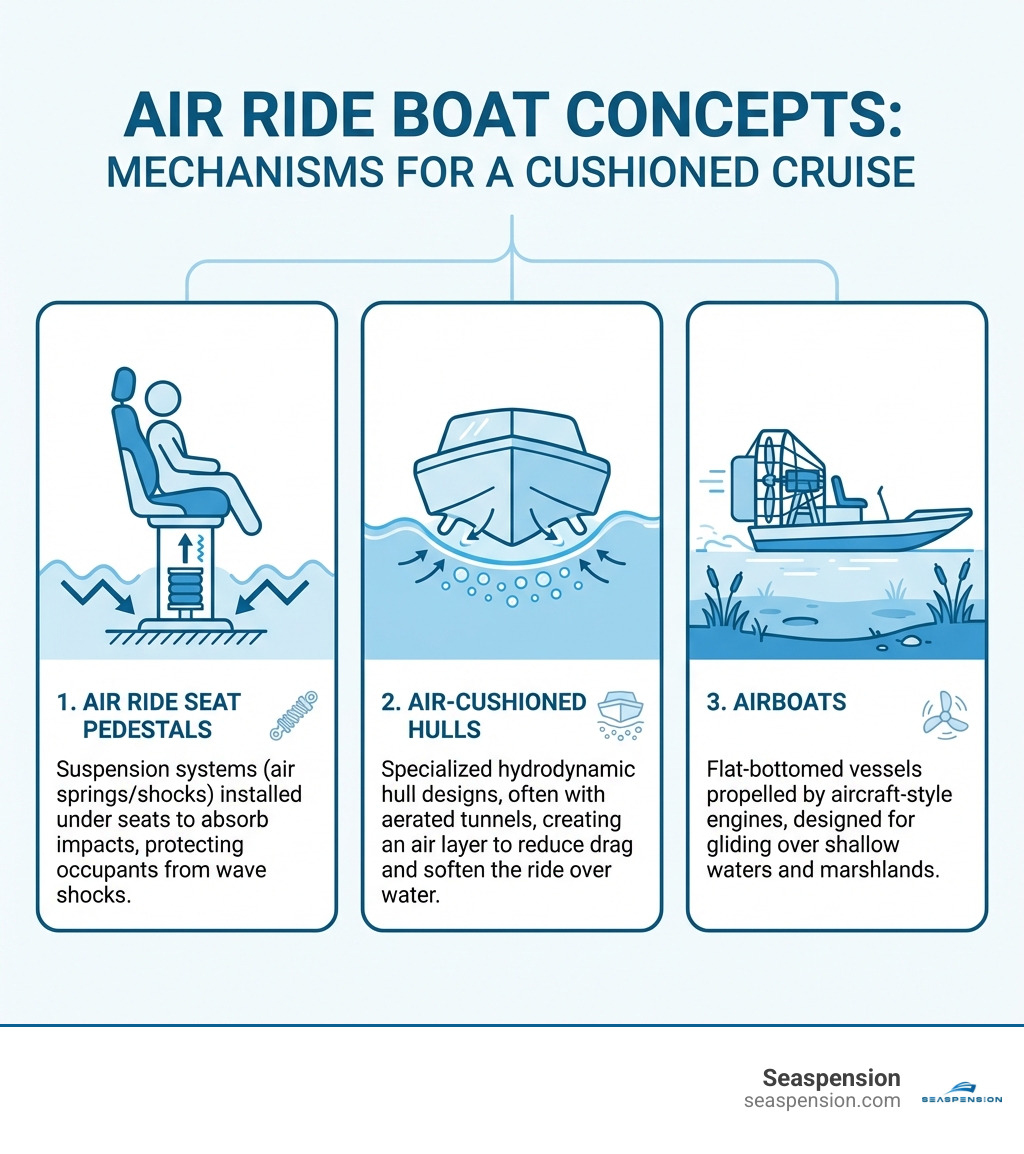
An Air ride boat refers to a vessel or its components designed to provide a smoother, more comfortable experience by mitigating impacts and vibrations. This can involve:
The relentless pounding of waves can turn a great day on the water into a painful experience. For many boaters, constant impacts lead to fatigue, back pain, and overall discomfort. This physical toll often cuts short trips and makes longer journeys undesirable.
The concept of an Air ride boat emerges from this challenge. It describes any boat, or more commonly, its seating system, engineered to soften the ride. The goal is simple: isolate you from the harsh realities of rough water. By doing so, an air ride system transforms your time on the water, allowing for longer, more comfortable, and safer trips.
I'm Ian Milligan, owner and managing principal of SeaSpension. My work focuses on developing durable, practical solutions that make time on the water more comfortable and productive by addressing the physical strain of rough conditions, ultimately enhancing the Air ride boat experience for all.
When we spend time on the water, especially in choppy conditions, our bodies are subjected to continuous impacts. These forces, often referred to as Whole Body Vibration (WBV), are not just uncomfortable; they can have significant long-term effects on our health. Imagine your spine absorbing hundreds, if not thousands, of jarring shocks over a day. This constant impact can lead to chronic back pain, joint issues, and increased muscle fatigue. It's the hidden force of boating, silently wearing down our bodies.
We understand this toll because we live it. It's why we're dedicated to finding solutions that soften the blow, allowing us to enjoy the water we love without paying a physical price. The goal isn't just comfort; it's about preserving our health and extending our time on the water. We believe that a truly comfortable ride is a safer ride, reducing fatigue and improving focus, which are critical for safe navigation. You can learn more about how these impacts affect you in our article, The Hidden Force of Boating: Why Your Body Feels the Impact and How SeaSension Softens the Blow.
The term "Air ride boat" can be a bit of a chameleon, meaning different things depending on who you ask. For some, it might conjure images of boats literally floating on a cushion of air, while for others, it's about a smooth, comfortable experience in rough seas. Let's clear up some common misconceptions and focus on what truly delivers an "air ride" experience for the boater.
As we discussed in the introduction, the term can broadly refer to airboats, air-cushioned hulls, or, most commonly and relevant to us, seat suspension systems. While airboats offer a unique experience in specific environments like the Florida Everglades, they are a niche application. Similarly, air-cushioned hulls employ advanced design principles to achieve a smoother ride for the entire vessel. However, for most boaters looking to improve their comfort and safety, the true "air ride boat" experience comes down to effective seat suspension.

Some boat designs aim to create an "air ride" effect through their hull shape. These are often referred to as air-cushioned or cathedral hulls. The idea is to reduce the wetted surface of the hull or to create a cushion of air between the hull and the water, reducing impact and drag.
Designs might incorporate features like twin aerated tunnels or specific hull bottom deadrise angles to achieve a softer, drier ride. These hydrodynamic principles allow the boat to glide more smoothly over the water, providing improved stability and performance, especially at higher speeds in varying sea conditions. While these hull designs can significantly improve the overall ride of the vessel, they are a fundamental part of the boat's design and cannot be retrofitted.
For most boat owners, achieving an "air ride boat" experience is about isolating the occupant from the impacts of the waves. This is where shock-mitigating seat pedestals come into play. Instead of the entire boat riding on air, you ride on air (or a hydraulic equivalent) within your seat. This approach offers a practical way to upgrade existing boats and directly addresses the physical jarring that causes discomfort and fatigue.
The difference between the boat's ride and your body's ride is crucial. A boat might handle rough seas well, but if your seat isn't absorbing the vertical impacts, your body still takes a beating. Shock-absorbing pedestals tackle this head-on, ensuring that even if the boat is pitching and rolling, you remain stable and comfortable. This is why we believe that the most impactful "air ride boat" upgrade for recreational and commercial boaters alike is through high-quality seat suspension. To understand the profound shift this makes, consider SeaSension vs. Conventional Boat Seating: Why Make the Switch?.
At its core, a shock-absorbing pedestal is designed to dampen the vertical motion caused by waves and impacts, preventing that energy from transferring directly to your body. Think of it like the suspension system in your car, but optimized for the unique forces encountered on the water.
The basic mechanics involve a shock absorber working in conjunction with a spring mechanism. When your boat hits a wave, the pedestal compresses, absorbing the upward force. The spring component (which can be a mechanical spring, an air spring, or a hydraulic system) then extends, returning the seat to its original position. Crucially, the shock absorber controls both the compression and rebound, preventing a bouncy or "catapult" feeling. This controlled vertical travel significantly reduces G-force impacts on your spine and joints. The science behind this is fascinating and critical to a truly comfortable experience; we dig deeper into it in The Science Behind Shock Absorption: Elevating Your Boating Experience with SeaSension.

When we talk about shock-absorbing pedestals for an Air ride boat, we're primarily looking at three main types of suspension technologies. Each has its own characteristics regarding performance, maintenance, adjustability, and cost.
| Suspension Type | Performance | Maintenance | Adjustability | Cost Range |
|---|---|---|---|---|
| Mechanical (Simple Springs) | Basic shock absorption, often bouncy rebound | Minimal, but springs can wear out | Limited, usually by spring stiffness | Low |
| Air-Dampened | Good shock absorption, adjustable for weight | Requires air pressure checks, seals | Highly adjustable via air pressure (0-200psi) | Medium |
| Hydraulic | Superior, controlled damping, consistent | Very low, sealed systems | Often self-adjusting or easily tuned | Medium-High |
We've observed that many systems on the market rely on simple springs or air-dampened designs. While these offer some improvement over rigid pedestals, they often lack the sophisticated damping control needed for truly smooth performance in varying conditions. For example, some air-dampened systems might use an air spring over a hydraulic shock absorber, allowing for weight adjustment. While effective, the focus on air often means a less refined damping mechanism compared to dedicated hydraulic systems.
Our experience and engineering have led us to focus on robust hydraulic suspension. Why? Because while air-dampened systems can be adjusted for weight, they sometimes struggle with consistent damping, leading to a bouncier ride or a feeling of being "ejected" in rough seas. Our independently operating hydraulic shock-absorbing system offers optimal comfort and safety for boaters, even with varying occupant weights, by providing a controlled and consistent response to impacts. We believe our patented technology truly leaves air-dampened seats in the wake, as explored in Patented in the USA: Why SeaSension’s Tech Leaves Air-Dampened Seats in the Wake. For a deeper dive into this comparison, see Hydraulic vs. Air Suspension for Boats: What Most Boaters Don't Know.
When evaluating an Air ride boat seat pedestal, we look for specific features that indicate durability, performance, and long-term value. These are the hallmarks of a system that truly improves your boating experience:
These features collectively contribute to what we consider the Best Shock Absorbing Boat Seat Pedestal.
Investing in an Air ride boat seat pedestal isn't just about comfort; it's about changing your entire boating experience. The benefits extend far beyond simply feeling less jarring.
An Air ride boat seat pedestal contributes to a safer and more comfortable boating experience by turning a punishing ride into a pleasure.
Choosing and installing the right Air ride boat seat pedestal requires careful consideration of your specific needs, your boat's characteristics, and the conditions you typically encounter. It's not a one-size-fits-all decision, but with a bit of planning, you can find the perfect fit.
First, assess your needs. What kind of boat do you have—a center console, a pilot house, a RIB, or something else? What are the typical water conditions you steer? Are you frequently in choppy offshore waters, or more often on calmer inland lakes? How heavy are the primary operators and passengers? These factors will influence the type and robustness of the suspension system you need. We've seen the importance of proper support firsthand, as highlighted in Anchoring Your Comfort: A Deep Dive into Boat Seat Pedestals and Bases.
When selecting an Air ride boat seat pedestal, several practical considerations come into play:
Installing an Air ride boat seat pedestal can often be a DIY project for those with basic mechanical skills, but it depends on the complexity of the system and your comfort level.
Most pedestals are designed to use standard mounting patterns, making them relatively straightforward to install. You'll typically need basic tools like wrenches, a drill, and marine-grade fasteners. The process generally involves:
Many manufacturers provide detailed installation guides and videos. For example, you can find helpful resources like How To Install a Pedestal on Vimeo, or our own guides on How to Install a SeaSension Shock Absorbing Pedestal and How to Install a Boat Seat Pedestal to Your Recreational Boat.
However, if your boat requires custom fabrication, complex wiring (for powered air-dampened systems), or if you're uncomfortable with drilling into your deck, it's always best to call a professional marine technician. We recommend ensuring the installation maintains the structural integrity of your boat and complies with all safety standards.
The typical cost range for Air ride boat seat pedestals varies significantly based on the technology, materials, features, and manufacturer. We've seen prices from around $800 to several thousand dollars per pedestal. For example, a basic air-dampened system might start around $895, while a more advanced hydraulic system with robust marine-grade construction could be considerably more. Full boat stabilization systems, like the Seakeeper Ride 600, which levels a 31-36-foot vessel by eliminating up to 70% pitch and roll, can retail for $10,500 or more, but it's important to remember these are whole-boat systems, not just seat pedestals.
While the initial investment might seem substantial, we view it as an investment in your safety, health, and overall enjoyment of boating. When you consider the cost of potential medical bills from back injuries, or simply the lost joy from cutting short trips due to discomfort, a high-quality shock-absorbing pedestal offers immense value. It's a long-term investment that pays dividends in comfort, well-being, and extended time on the water. You can explore our offerings in the Boat Suspension Pedestal category.
The problem of wave shock and its physical toll on boaters is a real and often unspoken challenge. But as we've explored, it's a solvable one. The concept of an Air ride boat, particularly through advanced seat suspension, offers a powerful solution to transform your boating experience.
We've seen how these systems work to isolate you from impacts, the critical differences between various suspension technologies, and the key features that define a high-quality product. The benefits—from reduced fatigue and improved safety to protecting your long-term health and simply extending your joy on the water—are undeniable. Leading manufacturers, including ourselves, are continuously innovating to provide robust and reliable solutions for every boater, whether recreational, commercial, or military. Our independently operating hydraulic shock-absorbing systems are designed for durability and consistent performance across various occupant weights and challenging conditions.
Choosing an Air ride boat seat pedestal is a decision to invest in your well-being. It's about making every moment on the water more comfortable, more enjoyable, and safer. It allows you to continue doing what you love, without the physical repercussions. We encourage you to explore the options available and consider how such an upgrade can revolutionize your time afloat.
View our complete line of boat pedestal seat posts to find the right fit for your vessel.
What is an Air ride boat?
An Air ride boat refers to a vessel or its components designed to provide a smoother, more comfortable experience by mitigating impacts and vibrations. This can involve:
The relentless pounding of waves can turn a great day on the water into a painful experience. For many boaters, constant impacts lead to fatigue, back pain, and overall discomfort. This physical toll often cuts short trips and makes longer journeys undesirable.
The concept of an Air ride boat emerges from this challenge. It describes any boat, or more commonly, its seating system, engineered to soften the ride. The goal is simple: isolate you from the harsh realities of rough water. By doing so, an air ride system transforms your time on the water, allowing for longer, more comfortable, and safer trips.
I'm Ian Milligan, owner and managing principal of SeaSpension. My work focuses on developing durable, practical solutions that make time on the water more comfortable and productive by addressing the physical strain of rough conditions, ultimately enhancing the Air ride boat experience for all.
When we spend time on the water, especially in choppy conditions, our bodies are subjected to continuous impacts. These forces, often referred to as Whole Body Vibration (WBV), are not just uncomfortable; they can have significant long-term effects on our health. Imagine your spine absorbing hundreds, if not thousands, of jarring shocks over a day. This constant impact can lead to chronic back pain, joint issues, and increased muscle fatigue. It's the hidden force of boating, silently wearing down our bodies.
We understand this toll because we live it. It's why we're dedicated to finding solutions that soften the blow, allowing us to enjoy the water we love without paying a physical price. The goal isn't just comfort; it's about preserving our health and extending our time on the water. We believe that a truly comfortable ride is a safer ride, reducing fatigue and improving focus, which are critical for safe navigation. You can learn more about how these impacts affect you in our article, The Hidden Force of Boating: Why Your Body Feels the Impact and How SeaSension Softens the Blow.
The term "Air ride boat" can be a bit of a chameleon, meaning different things depending on who you ask. For some, it might conjure images of boats literally floating on a cushion of air, while for others, it's about a smooth, comfortable experience in rough seas. Let's clear up some common misconceptions and focus on what truly delivers an "air ride" experience for the boater.
As we discussed in the introduction, the term can broadly refer to airboats, air-cushioned hulls, or, most commonly and relevant to us, seat suspension systems. While airboats offer a unique experience in specific environments like the Florida Everglades, they are a niche application. Similarly, air-cushioned hulls employ advanced design principles to achieve a smoother ride for the entire vessel. However, for most boaters looking to improve their comfort and safety, the true "air ride boat" experience comes down to effective seat suspension.
Some boat designs aim to create an "air ride" effect through their hull shape. These are often referred to as air-cushioned or cathedral hulls. The idea is to reduce the wetted surface of the hull or to create a cushion of air between the hull and the water, reducing impact and drag.
Designs might incorporate features like twin aerated tunnels or specific hull bottom deadrise angles to achieve a softer, drier ride. These hydrodynamic principles allow the boat to glide more smoothly over the water, providing improved stability and performance, especially at higher speeds in varying sea conditions. While these hull designs can significantly improve the overall ride of the vessel, they are a fundamental part of the boat's design and cannot be retrofitted.
For most boat owners, achieving an "air ride boat" experience is about isolating the occupant from the impacts of the waves. This is where shock-mitigating seat pedestals come into play. Instead of the entire boat riding on air, you ride on air (or a hydraulic equivalent) within your seat. This approach offers a practical way to upgrade existing boats and directly addresses the physical jarring that causes discomfort and fatigue.
The difference between the boat's ride and your body's ride is crucial. A boat might handle rough seas well, but if your seat isn't absorbing the vertical impacts, your body still takes a beating. Shock-absorbing pedestals tackle this head-on, ensuring that even if the boat is pitching and rolling, you remain stable and comfortable. This is why we believe that the most impactful "air ride boat" upgrade for recreational and commercial boaters alike is through high-quality seat suspension. To understand the profound shift this makes, consider SeaSension vs. Conventional Boat Seating: Why Make the Switch?.
At its core, a shock-absorbing pedestal is designed to dampen the vertical motion caused by waves and impacts, preventing that energy from transferring directly to your body. Think of it like the suspension system in your car, but optimized for the unique forces encountered on the water.
The basic mechanics involve a shock absorber working in conjunction with a spring mechanism. When your boat hits a wave, the pedestal compresses, absorbing the upward force. The spring component (which can be a mechanical spring, an air spring, or a hydraulic system) then extends, returning the seat to its original position. Crucially, the shock absorber controls both the compression and rebound, preventing a bouncy or "catapult" feeling. This controlled vertical travel significantly reduces G-force impacts on your spine and joints. The science behind this is fascinating and critical to a truly comfortable experience; we dig deeper into it in The Science Behind Shock Absorption: Elevating Your Boating Experience with SeaSension.
When we talk about shock-absorbing pedestals for an Air ride boat, we're primarily looking at three main types of suspension technologies. Each has its own characteristics regarding performance, maintenance, adjustability, and cost.
| Suspension Type | Performance | Maintenance | Adjustability | Cost Range |
|---|---|---|---|---|
| Mechanical (Simple Springs) | Basic shock absorption, often bouncy rebound | Minimal, but springs can wear out | Limited, usually by spring stiffness | Low |
| Air-Dampened | Good shock absorption, adjustable for weight | Requires air pressure checks, seals | Highly adjustable via air pressure (0-200psi) | Medium |
| Hydraulic | Superior, controlled damping, consistent | Very low, sealed systems | Often self-adjusting or easily tuned | Medium-High |
We've observed that many systems on the market rely on simple springs or air-dampened designs. While these offer some improvement over rigid pedestals, they often lack the sophisticated damping control needed for truly smooth performance in varying conditions. For example, some air-dampened systems might use an air spring over a hydraulic shock absorber, allowing for weight adjustment. While effective, the focus on air often means a less refined damping mechanism compared to dedicated hydraulic systems.
Our experience and engineering have led us to focus on robust hydraulic suspension. Why? Because while air-dampened systems can be adjusted for weight, they sometimes struggle with consistent damping, leading to a bouncier ride or a feeling of being "ejected" in rough seas. Our independently operating hydraulic shock-absorbing system offers optimal comfort and safety for boaters, even with varying occupant weights, by providing a controlled and consistent response to impacts. We believe our patented technology truly leaves air-dampened seats in the wake, as explored in Patented in the USA: Why SeaSension’s Tech Leaves Air-Dampened Seats in the Wake. For a deeper dive into this comparison, see Hydraulic vs. Air Suspension for Boats: What Most Boaters Don't Know.
When evaluating an Air ride boat seat pedestal, we look for specific features that indicate durability, performance, and long-term value. These are the hallmarks of a system that truly improves your boating experience:
These features collectively contribute to what we consider the Best Shock Absorbing Boat Seat Pedestal.
Investing in an Air ride boat seat pedestal isn't just about comfort; it's about changing your entire boating experience. The benefits extend far beyond simply feeling less jarring.
An Air ride boat seat pedestal contributes to a safer and more comfortable boating experience by turning a punishing ride into a pleasure.
Choosing and installing the right Air ride boat seat pedestal requires careful consideration of your specific needs, your boat's characteristics, and the conditions you typically encounter. It's not a one-size-fits-all decision, but with a bit of planning, you can find the perfect fit.
First, assess your needs. What kind of boat do you have—a center console, a pilot house, a RIB, or something else? What are the typical water conditions you steer? Are you frequently in choppy offshore waters, or more often on calmer inland lakes? How heavy are the primary operators and passengers? These factors will influence the type and robustness of the suspension system you need. We've seen the importance of proper support firsthand, as highlighted in Anchoring Your Comfort: A Deep Dive into Boat Seat Pedestals and Bases.
When selecting an Air ride boat seat pedestal, several practical considerations come into play:
Installing an Air ride boat seat pedestal can often be a DIY project for those with basic mechanical skills, but it depends on the complexity of the system and your comfort level.
Most pedestals are designed to use standard mounting patterns, making them relatively straightforward to install. You'll typically need basic tools like wrenches, a drill, and marine-grade fasteners. The process generally involves:
Many manufacturers provide detailed installation guides and videos. For example, you can find helpful resources like How To Install a Pedestal on Vimeo, or our own guides on How to Install a SeaSension Shock Absorbing Pedestal and How to Install a Boat Seat Pedestal to Your Recreational Boat.
However, if your boat requires custom fabrication, complex wiring (for powered air-dampened systems), or if you're uncomfortable with drilling into your deck, it's always best to call a professional marine technician. We recommend ensuring the installation maintains the structural integrity of your boat and complies with all safety standards.
The typical cost range for Air ride boat seat pedestals varies significantly based on the technology, materials, features, and manufacturer. We've seen prices from around $800 to several thousand dollars per pedestal. For example, a basic air-dampened system might start around $895, while a more advanced hydraulic system with robust marine-grade construction could be considerably more. Full boat stabilization systems, like the Seakeeper Ride 600, which levels a 31-36-foot vessel by eliminating up to 70% pitch and roll, can retail for $10,500 or more, but it's important to remember these are whole-boat systems, not just seat pedestals.
While the initial investment might seem substantial, we view it as an investment in your safety, health, and overall enjoyment of boating. When you consider the cost of potential medical bills from back injuries, or simply the lost joy from cutting short trips due to discomfort, a high-quality shock-absorbing pedestal offers immense value. It's a long-term investment that pays dividends in comfort, well-being, and extended time on the water. You can explore our offerings in the Boat Suspension Pedestal category.
The problem of wave shock and its physical toll on boaters is a real and often unspoken challenge. But as we've explored, it's a solvable one. The concept of an Air ride boat, particularly through advanced seat suspension, offers a powerful solution to transform your boating experience.
We've seen how these systems work to isolate you from impacts, the critical differences between various suspension technologies, and the key features that define a high-quality product. The benefits—from reduced fatigue and improved safety to protecting your long-term health and simply extending your joy on the water—are undeniable. Leading manufacturers, including ourselves, are continuously innovating to provide robust and reliable solutions for every boater, whether recreational, commercial, or military. Our independently operating hydraulic shock-absorbing systems are designed for durability and consistent performance across various occupant weights and challenging conditions.
Choosing an Air ride boat seat pedestal is a decision to invest in your well-being. It's about making every moment on the water more comfortable, more enjoyable, and safer. It allows you to continue doing what you love, without the physical repercussions. We encourage you to explore the options available and consider how such an upgrade can revolutionize your time afloat.
View our complete line of boat pedestal seat posts to find the right fit for your vessel.


