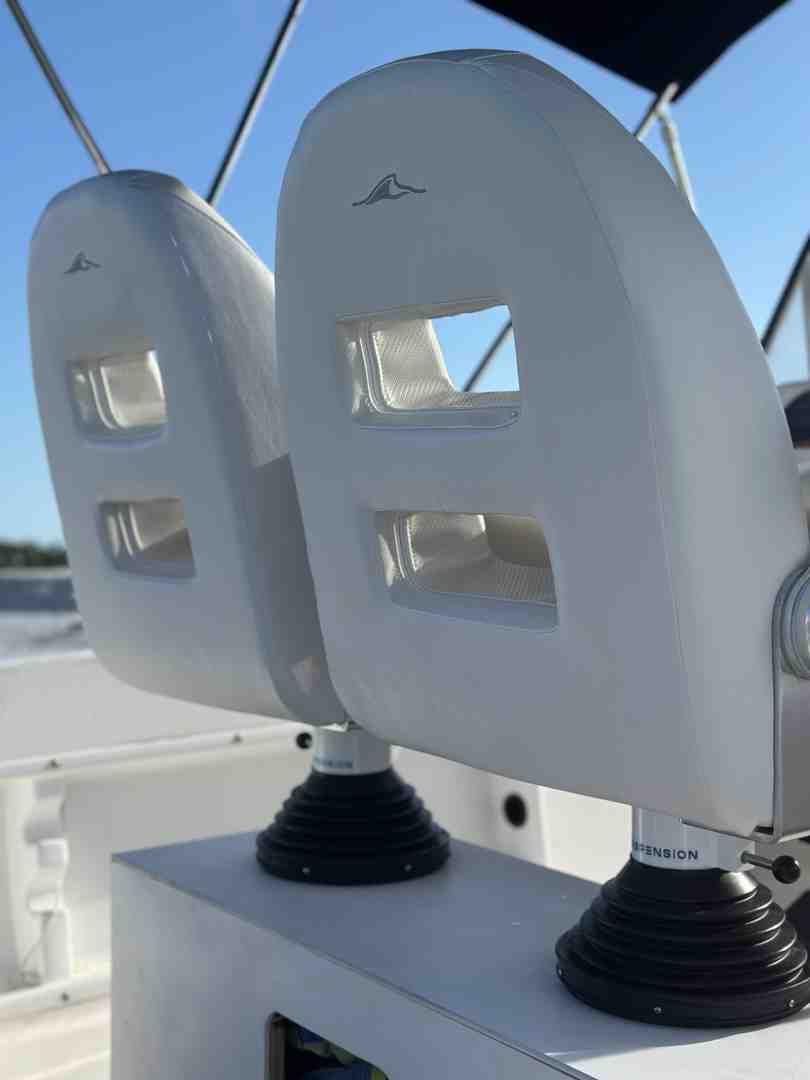
A boat seat pedestal and base is the mechanical assembly that connects your seat to the deck, consisting of a vertical post (pedestal) and a mounting platform (base) that secures it to the hull. While often overlooked, this system determines how much wave shock reaches your body—and how comfortable or painful your time on the water becomes.
Key Components:
Common Types:
If you spend hours on the water and notice back pain, neck strain, or exhaustion after rough conditions, the issue likely starts where your seat meets the deck. Most boat seat pedestal and base systems are rigid—designed only to hold you upright, not to protect you from repeated impacts. Every wave that hits the hull sends energy straight through a standard pedestal into your spine.
The Real Cost of Rigid Mounting:
Tournament anglers on Lake Erie have reported spinal compression fractures from bottoming out in rough water. Commercial operators cut trips short due to fatigue. Recreational boaters avoid their favorite fishing spots when conditions turn choppy—not because their boat can't handle it, but because their body can't.
As Ian Milligan, owner of Seaspension, I've worked with boaters across recreational and commercial sectors to address the physical toll of wave impacts through engineered boat seat pedestal and base solutions designed for real-world marine conditions. Our focus is helping operators stay comfortable and safe on the water longer—without the wear and tear that cuts boating careers short.
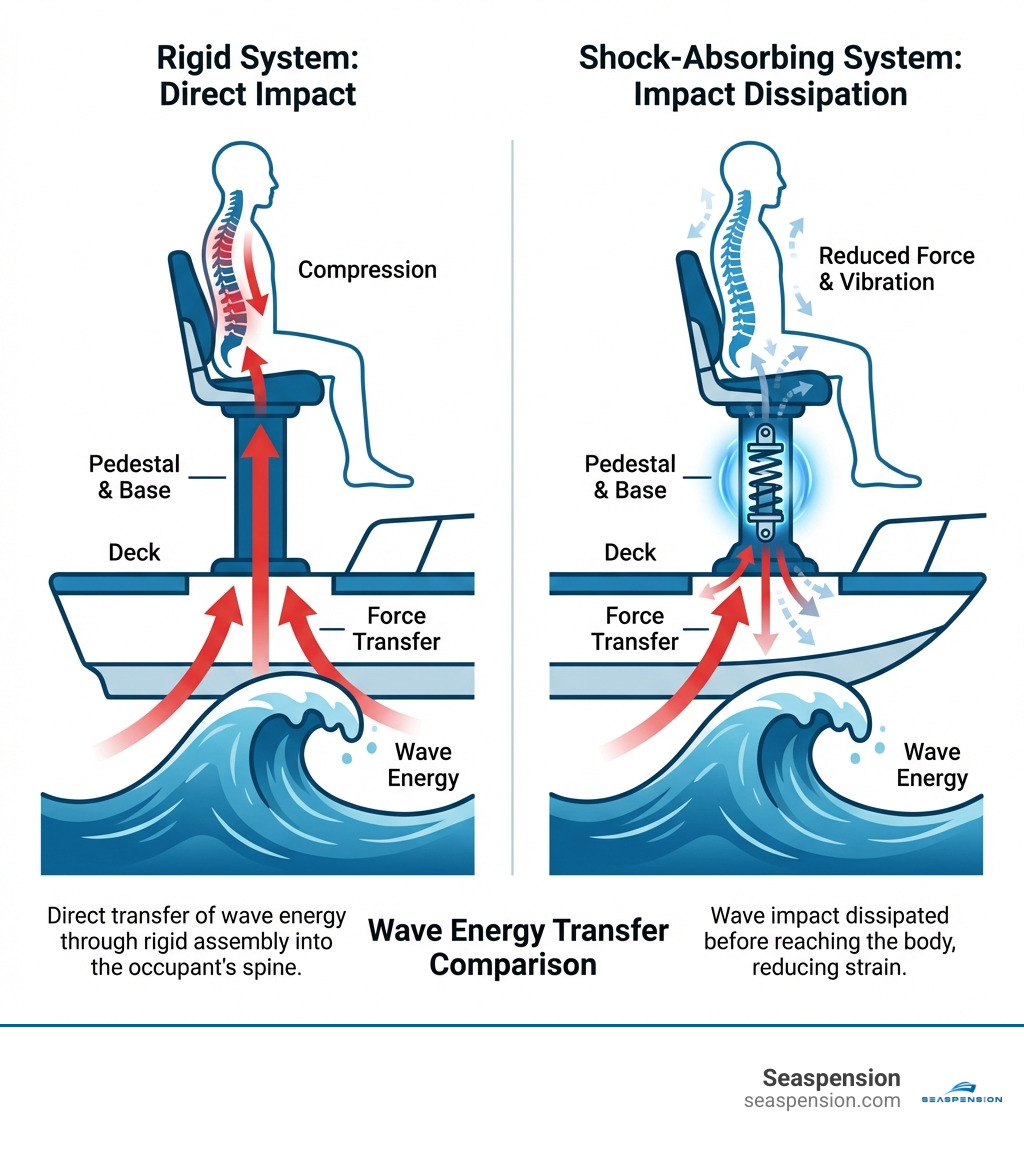
When we're out on the water, especially in rough conditions, our boats are constantly interacting with waves. This interaction generates significant forces. With a standard, rigid boat seat pedestal and base system, these forces transmit directly from the hull, through the deck, up the pedestal, and into our bodies. It's a direct, unmitigated transfer of energy.
Imagine hitting a pothole in your car without shock absorbers—that's what a rigid pedestal system does to your body with every chop and swell. This constant jarring leads to what is known as whole-body vibration. Over time, this cumulative impact can cause chronic back pain, neck issues, and general fatigue. We've seen how this affects boaters, from recreational enthusiasts enjoying the waters off Florida to commercial operators navigating the challenging conditions of Alaska. These rigid mounting points offer no relief, acting as direct conduits for wave shock. The lack of energy absorption means our bodies become the primary shock absorbers, which is not what we're designed for.

Many boat owners approach their seating systems with a few common misconceptions that can ultimately compromise their comfort and safety. One of the biggest mistakes we see is assuming all boat seat pedestal and base components are essentially the same. While they might look similar, the materials, design, and internal mechanisms can vastly differ, leading to entirely different experiences on the water.
Another frequent oversight is relying solely on thick cushions for shock absorption. While a plush seat can provide initial comfort, it does little to mitigate the deep, jarring impacts that travel up from the hull. Cushions primarily address surface comfort; they don't absorb the significant vertical forces that lead to spinal compression and fatigue during prolonged exposure to rough seas. We often hear boaters say they've "upgraded" their seating by simply swapping out the seat itself, only to find the core problem of discomfort remains because the underlying pedestal and base—the real culprits for impact transmission—haven't changed.
Furthermore, boaters sometimes overlook the critical importance of pedestal and base compatibility. Not all seats fit all pedestals, and not all pedestals fit all bases or deck mounting patterns. This can lead to improper installations, instability, or a compromise in the system's intended function. Underestimating the role of quality mounting hardware is also a mistake. Using inadequate fasteners or neglecting proper backing plates can lead to structural failures, especially in high-stress marine environments. When we consider the forces involved in boating, every component, down to the bolts, plays a crucial role in the overall integrity and performance of your seating system.
Let's explore the fundamental components that make up your boat's seating structure. Understanding these parts and their variations is key to making informed decisions about your comfort and safety.
The pedestal is the vertical support that lifts your seat, connecting it to the base on the deck. Its primary functions are to provide adequate height for visibility and comfort, and to securely hold the seat in place. However, not all pedestals are created equal.
We typically categorize pedestals into a few types:
More info about Boat Pedestal Seat Posts
The base is the critical component that secures the entire boat seat pedestal and base assembly to the deck of your boat. It's the anchor that keeps your seat stable, even in choppy waters.
Bases come in several forms:
Choosing the right boat seat pedestal and base isn't a one-size-fits-all decision. It requires careful consideration of your specific boat, how you use it, and your personal comfort needs.
For instance, a bass boat designed for active fishing might prioritize a casting seat pedestal that allows quick movement and stability while standing, whereas a pilothouse boat used for long-distance cruising would demand a robust helm chair pedestal focused on ergonomic support and shock absorption for extended periods.

When selecting your system, consider these factors:
The choice between an adjustable and fixed height pedestal hinges on versatility and specific ergonomic needs.
The materials used in your boat seat pedestal and base system are paramount for its performance and lifespan in the marine environment.
For boaters who regularly encounter rough water, or those simply seeking a more comfortable and safer experience, traditional rigid pedestals simply won't cut it. What truly works is a shock-absorbing boat seat pedestal and base system. These engineered solutions are designed to actively mitigate wave shock, changing a jarring ride into a smooth glide.
The benefits extend far beyond mere comfort. By significantly reducing spinal compression, these systems protect our bodies from the cumulative trauma of repeated impacts. This means less back pain, less fatigue, and the ability to maintain better control of the vessel, even in challenging conditions. A quality shock-absorbing pedestal allows us to enjoy our time on the water longer and more safely, extending our years of boating enjoyment. It's about making rough water an enjoyable ride, turning all weather into fair weather for the operator.
The magic of a shock-absorbing boat seat pedestal and base lies in its ability to dissipate kinetic energy before it reaches your body. While there are different approaches, the core principles revolve around controlled compression and rebound, preventing the harsh "bottoming out" or "topping out" sensations common with rigid systems.
Our hydraulic suspension systems are engineered for this precise purpose. They use a sophisticated mechanism that absorbs the upward force of an impact through controlled compression. This isn't just a simple spring; it's a velocity-sensitive system with precision-engineered dampening. When a wave hits, the hydraulic system compresses smoothly, absorbing the energy. Then, it controls the rebound, ensuring you don't get launched upwards, maintaining constant contact with the seat. This controlled movement is crucial for stability and comfort.
Some other systems might use an air spring over a hydraulic shock absorber, where an air spring handles the primary impact, pushing air into a manifold and accumulator tube for controlled up and down motion. Regardless of the specific mechanism (air or hydraulic), the goal is the same: to prevent the direct transmission of impact forces. The system is designed to be easily adjustable to accommodate a wide range of rider weights, often with an air spring preload ranging from 0-200psi. This adjustability ensures optimal performance for different occupants. The key is the ability of the system to take the hit for you when you are on rough water, offering pure smoothness without an eject or catapult feeling.
The Science Behind Shock Absorption: Elevating Your Boating Experience with Seaspension
The advantages of upgrading to a shock-absorbing boat seat pedestal and base are tangible and transformative for anyone who spends significant time on the water.
At Seaspension, we've dedicated ourselves to developing boat seat pedestal and base solutions that meet the demanding realities of marine environments. Our focus is on practical, effective shock mitigation that truly makes a difference for boaters.
We specialize in hydraulic suspension pedestals, designed and engineered specifically for marine use. Our independently operating shock-absorbing system is our unique selling proposition, ensuring optimal comfort and safety for boaters, even with varying occupant weights. This means that whether you're a lean angler or a heavier commercial operator, our system adjusts to provide consistent, reliable shock absorption.
Our commitment is to durability and simplicity. We understand that marine equipment needs to be robust, reliable, and easy to maintain. Our pedestals are built to withstand the harsh conditions of saltwater exposure and constant use, from the fishing grounds off California to the commercial waters of Massachusetts. They are proven to reduce operator fatigue and impact, allowing you to focus on the water ahead, not the discomfort beneath you. Furthermore, our systems are designed to be compatible with a wide range of existing seat and base types, making an upgrade accessible for many boat owners.
View our full range of boat suspension pedestals
Proper installation and consistent maintenance are crucial for maximizing the benefits and longevity of your boat seat pedestal and base system, especially a shock-absorbing one. Even the best equipment needs to be correctly fitted and cared for.
Before you begin, gather the necessary tools, which typically include a drill, appropriate drill bits, marine-grade sealant, a screwdriver or wrench set, and a measuring tape. Securing the base correctly is paramount to safety and performance. This often involves using backing plates to reinforce the deck, distributing the load and preventing stress cracks. Always use marine-grade stainless steel fasteners to resist corrosion in saltwater environments.
While specific instructions may vary slightly by model, the general steps for installing a boat seat pedestal and base are as follows:
How to Install a Boat Seat Pedestal to Your Recreational Boat
Regular maintenance will ensure your boat seat pedestal and base continues to perform optimally and lasts for many seasons.
A boat seat pedestal and base is more than just a mounting point; it's a critical component that dictates your comfort, endurance, and safety on the water. We've explored how rigid systems transmit every jolt and impact directly to your body, leading to fatigue, pain, and potentially long-term health issues. This isn't just about luxury; it's about making comfort a fundamental safety feature.
Investing in a quality pedestal and base system, particularly one with effective shock absorption, is an investment in your well-being and the longevity of your boating lifestyle. Hydraulic shock mitigation, as we've discussed, offers a proven solution for serious boaters, reducing the physical toll of rough seas and allowing you to enjoy more time doing what you love. It's about protecting your body, enhancing your experience, and ensuring that every voyage is as comfortable and safe as possible.
A boat seat pedestal and base is the mechanical assembly that connects your seat to the deck, consisting of a vertical post (pedestal) and a mounting platform (base) that secures it to the hull. While often overlooked, this system determines how much wave shock reaches your body—and how comfortable or painful your time on the water becomes.
Key Components:
Common Types:
If you spend hours on the water and notice back pain, neck strain, or exhaustion after rough conditions, the issue likely starts where your seat meets the deck. Most boat seat pedestal and base systems are rigid—designed only to hold you upright, not to protect you from repeated impacts. Every wave that hits the hull sends energy straight through a standard pedestal into your spine.
The Real Cost of Rigid Mounting:
Tournament anglers on Lake Erie have reported spinal compression fractures from bottoming out in rough water. Commercial operators cut trips short due to fatigue. Recreational boaters avoid their favorite fishing spots when conditions turn choppy—not because their boat can't handle it, but because their body can't.
As Ian Milligan, owner of Seaspension, I've worked with boaters across recreational and commercial sectors to address the physical toll of wave impacts through engineered boat seat pedestal and base solutions designed for real-world marine conditions. Our focus is helping operators stay comfortable and safe on the water longer—without the wear and tear that cuts boating careers short.
When we're out on the water, especially in rough conditions, our boats are constantly interacting with waves. This interaction generates significant forces. With a standard, rigid boat seat pedestal and base system, these forces transmit directly from the hull, through the deck, up the pedestal, and into our bodies. It's a direct, unmitigated transfer of energy.
Imagine hitting a pothole in your car without shock absorbers—that's what a rigid pedestal system does to your body with every chop and swell. This constant jarring leads to what is known as whole-body vibration. Over time, this cumulative impact can cause chronic back pain, neck issues, and general fatigue. We've seen how this affects boaters, from recreational enthusiasts enjoying the waters off Florida to commercial operators navigating the challenging conditions of Alaska. These rigid mounting points offer no relief, acting as direct conduits for wave shock. The lack of energy absorption means our bodies become the primary shock absorbers, which is not what we're designed for.
Many boat owners approach their seating systems with a few common misconceptions that can ultimately compromise their comfort and safety. One of the biggest mistakes we see is assuming all boat seat pedestal and base components are essentially the same. While they might look similar, the materials, design, and internal mechanisms can vastly differ, leading to entirely different experiences on the water.
Another frequent oversight is relying solely on thick cushions for shock absorption. While a plush seat can provide initial comfort, it does little to mitigate the deep, jarring impacts that travel up from the hull. Cushions primarily address surface comfort; they don't absorb the significant vertical forces that lead to spinal compression and fatigue during prolonged exposure to rough seas. We often hear boaters say they've "upgraded" their seating by simply swapping out the seat itself, only to find the core problem of discomfort remains because the underlying pedestal and base—the real culprits for impact transmission—haven't changed.
Furthermore, boaters sometimes overlook the critical importance of pedestal and base compatibility. Not all seats fit all pedestals, and not all pedestals fit all bases or deck mounting patterns. This can lead to improper installations, instability, or a compromise in the system's intended function. Underestimating the role of quality mounting hardware is also a mistake. Using inadequate fasteners or neglecting proper backing plates can lead to structural failures, especially in high-stress marine environments. When we consider the forces involved in boating, every component, down to the bolts, plays a crucial role in the overall integrity and performance of your seating system.
Let's explore the fundamental components that make up your boat's seating structure. Understanding these parts and their variations is key to making informed decisions about your comfort and safety.
The pedestal is the vertical support that lifts your seat, connecting it to the base on the deck. Its primary functions are to provide adequate height for visibility and comfort, and to securely hold the seat in place. However, not all pedestals are created equal.
We typically categorize pedestals into a few types:
More info about Boat Pedestal Seat Posts
The base is the critical component that secures the entire boat seat pedestal and base assembly to the deck of your boat. It's the anchor that keeps your seat stable, even in choppy waters.
Bases come in several forms:
Choosing the right boat seat pedestal and base isn't a one-size-fits-all decision. It requires careful consideration of your specific boat, how you use it, and your personal comfort needs.
For instance, a bass boat designed for active fishing might prioritize a casting seat pedestal that allows quick movement and stability while standing, whereas a pilothouse boat used for long-distance cruising would demand a robust helm chair pedestal focused on ergonomic support and shock absorption for extended periods.
When selecting your system, consider these factors:
The choice between an adjustable and fixed height pedestal hinges on versatility and specific ergonomic needs.
The materials used in your boat seat pedestal and base system are paramount for its performance and lifespan in the marine environment.
For boaters who regularly encounter rough water, or those simply seeking a more comfortable and safer experience, traditional rigid pedestals simply won't cut it. What truly works is a shock-absorbing boat seat pedestal and base system. These engineered solutions are designed to actively mitigate wave shock, changing a jarring ride into a smooth glide.
The benefits extend far beyond mere comfort. By significantly reducing spinal compression, these systems protect our bodies from the cumulative trauma of repeated impacts. This means less back pain, less fatigue, and the ability to maintain better control of the vessel, even in challenging conditions. A quality shock-absorbing pedestal allows us to enjoy our time on the water longer and more safely, extending our years of boating enjoyment. It's about making rough water an enjoyable ride, turning all weather into fair weather for the operator.
The magic of a shock-absorbing boat seat pedestal and base lies in its ability to dissipate kinetic energy before it reaches your body. While there are different approaches, the core principles revolve around controlled compression and rebound, preventing the harsh "bottoming out" or "topping out" sensations common with rigid systems.
Our hydraulic suspension systems are engineered for this precise purpose. They use a sophisticated mechanism that absorbs the upward force of an impact through controlled compression. This isn't just a simple spring; it's a velocity-sensitive system with precision-engineered dampening. When a wave hits, the hydraulic system compresses smoothly, absorbing the energy. Then, it controls the rebound, ensuring you don't get launched upwards, maintaining constant contact with the seat. This controlled movement is crucial for stability and comfort.
Some other systems might use an air spring over a hydraulic shock absorber, where an air spring handles the primary impact, pushing air into a manifold and accumulator tube for controlled up and down motion. Regardless of the specific mechanism (air or hydraulic), the goal is the same: to prevent the direct transmission of impact forces. The system is designed to be easily adjustable to accommodate a wide range of rider weights, often with an air spring preload ranging from 0-200psi. This adjustability ensures optimal performance for different occupants. The key is the ability of the system to take the hit for you when you are on rough water, offering pure smoothness without an eject or catapult feeling.
The Science Behind Shock Absorption: Elevating Your Boating Experience with Seaspension
The advantages of upgrading to a shock-absorbing boat seat pedestal and base are tangible and transformative for anyone who spends significant time on the water.
At Seaspension, we've dedicated ourselves to developing boat seat pedestal and base solutions that meet the demanding realities of marine environments. Our focus is on practical, effective shock mitigation that truly makes a difference for boaters.
We specialize in hydraulic suspension pedestals, designed and engineered specifically for marine use. Our independently operating shock-absorbing system is our unique selling proposition, ensuring optimal comfort and safety for boaters, even with varying occupant weights. This means that whether you're a lean angler or a heavier commercial operator, our system adjusts to provide consistent, reliable shock absorption.
Our commitment is to durability and simplicity. We understand that marine equipment needs to be robust, reliable, and easy to maintain. Our pedestals are built to withstand the harsh conditions of saltwater exposure and constant use, from the fishing grounds off California to the commercial waters of Massachusetts. They are proven to reduce operator fatigue and impact, allowing you to focus on the water ahead, not the discomfort beneath you. Furthermore, our systems are designed to be compatible with a wide range of existing seat and base types, making an upgrade accessible for many boat owners.
View our full range of boat suspension pedestals
Proper installation and consistent maintenance are crucial for maximizing the benefits and longevity of your boat seat pedestal and base system, especially a shock-absorbing one. Even the best equipment needs to be correctly fitted and cared for.
Before you begin, gather the necessary tools, which typically include a drill, appropriate drill bits, marine-grade sealant, a screwdriver or wrench set, and a measuring tape. Securing the base correctly is paramount to safety and performance. This often involves using backing plates to reinforce the deck, distributing the load and preventing stress cracks. Always use marine-grade stainless steel fasteners to resist corrosion in saltwater environments.
While specific instructions may vary slightly by model, the general steps for installing a boat seat pedestal and base are as follows:
How to Install a Boat Seat Pedestal to Your Recreational Boat
Regular maintenance will ensure your boat seat pedestal and base continues to perform optimally and lasts for many seasons.
A boat seat pedestal and base is more than just a mounting point; it's a critical component that dictates your comfort, endurance, and safety on the water. We've explored how rigid systems transmit every jolt and impact directly to your body, leading to fatigue, pain, and potentially long-term health issues. This isn't just about luxury; it's about making comfort a fundamental safety feature.
Investing in a quality pedestal and base system, particularly one with effective shock absorption, is an investment in your well-being and the longevity of your boating lifestyle. Hydraulic shock mitigation, as we've discussed, offers a proven solution for serious boaters, reducing the physical toll of rough seas and allowing you to enjoy more time doing what you love. It's about protecting your body, enhancing your experience, and ensuring that every voyage is as comfortable and safe as possible.


