A Marine suspension pedestal is a shock-absorbing boat seat base that uses hydraulic technology to isolate the occupant from hull impacts, significantly reducing fatigue and spinal strain during rough water operation.
Key Benefits of Marine Suspension Pedestals:
If you've ever finished a day on the water with a sore back, tight shoulders, or that bone-tired feeling that comes from constant jarring, you already understand the problem. Every wave slap travels directly from the hull through a rigid seat post and into your body. Over time, that adds up.
Most boaters try thicker cushions or just accept the discomfort. But those approaches don't address the root cause: rigid pedestals transfer impact directly to the occupant.
Marine suspension pedestals solve this by introducing a hydraulic shock absorber between the deck and the seat. The pedestal compresses and rebounds in a controlled way, dissipating energy that would otherwise travel straight into your spine.
This isn't about luxury. It's about staying in control, reducing injury risk, and making time on the water sustainable — especially for operators who spend hours at the helm.
I'm Ian Milligan, owner of Seaspension, where we design hydraulic Marine suspension pedestal systems for recreational and commercial vessels. Since 2021, we've focused on building durable, retrofit-capable solutions that address the real physical strain boaters face in rough water.
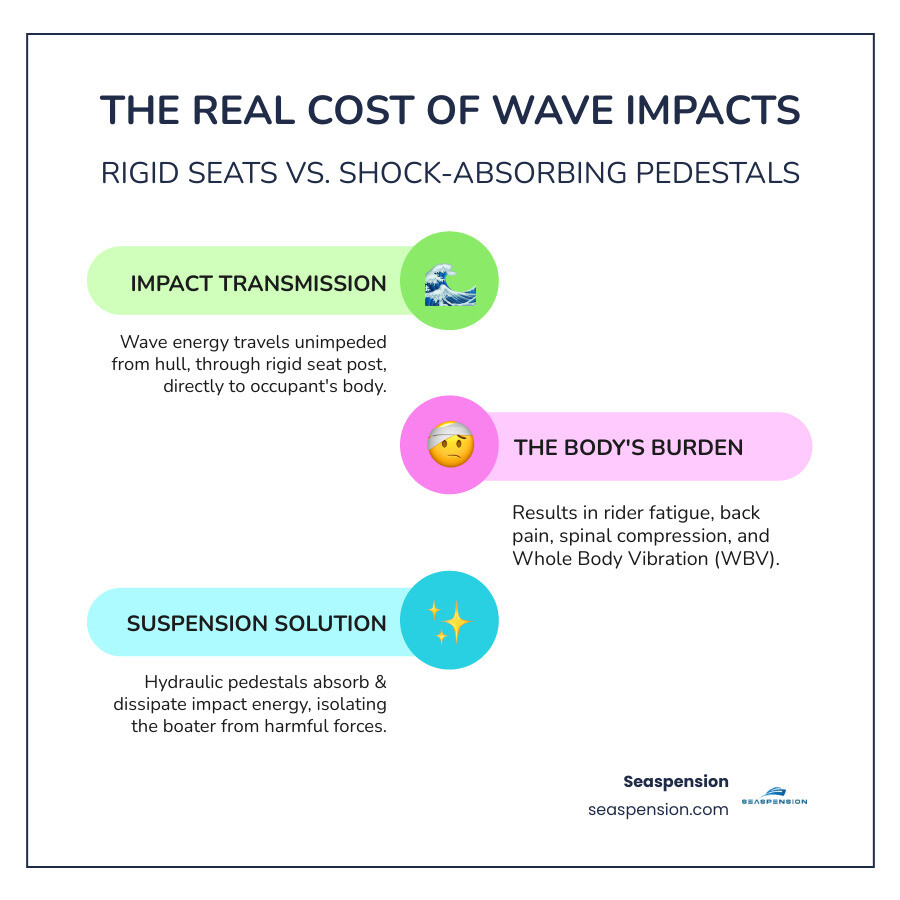
When we talk about the "cost" of a rough ride, we're not just referring to wear and tear on the boat. The most significant cost is often paid by the people on board. Repeated impacts from waves, even seemingly minor ones, accumulate over a day or a season. This constant jarring leads to what we call Whole Body Vibration (WBV).
WBV can manifest in several ways:
We've all heard the stories, or experienced it ourselves: the 'eject or catapult feeling' that comes from hitting a wave unprepared. Or the need to 'hold on for dear life' when the water gets rough. This isn't how boating should feel. It affects your ability to concentrate, your reaction time, and your overall safety. For those of us in Pinellas Park, FL, or along the coasts of Washington and Massachusetts, encountering choppy conditions is a regular part of boating, and these impacts are a constant reality.
To understand why a Marine suspension pedestal is so effective, we first need to understand the limitations of a standard boat seat pedestal. Most traditional pedestals are essentially rigid posts. They connect your seat directly to the boat's deck. While they provide a stable mounting point, they offer no mechanism for absorbing energy.
When your boat encounters a wave, especially during what we call "hull slap," a significant amount of force is generated. This force, or G-force, travels directly from the hull, through the deck, up the rigid pedestal, and into the seat. From there, it's transferred straight into the occupant's body. There's no buffer, no dampening, just a direct transmission of shock.
This is the essence of Whole Body Vibration (WBV). It's not just a gentle rocking; it's a series of sharp, sudden movements that the body has to contend with. The impact differs significantly from simple vibration. Vibration might be a continuous, low-amplitude movement. Impact, however, is a sudden, high-amplitude, high-force event. Imagine the difference between driving on a gravel road (vibration) and hitting a pothole (impact). A standard pedestal handles neither well, but it's the impacts that cause the most physical strain and discomfort.
Many boat owners, faced with the discomfort of a rough ride, often turn to what seem like logical solutions. However, these rarely address the root cause of impact transmission.
One common approach is to add thicker seat cushions. While a plush cushion might feel good at the dock, it offers minimal protection against significant wave impacts. A cushion primarily distributes pressure; it doesn't absorb the kinetic energy of a sharp jolt. The force still travels through the cushion, albeit slightly softened, and into your body. It's like putting a pillow on a concrete slab – it's still a concrete slab underneath.
Another strategy is standing while operating the boat in rough water. This allows your legs to act as natural shock absorbers. While effective for short bursts, it's not sustainable for long periods. Standing reduces stability, increases fatigue in your legs and back, and compromises your ability to maintain full control of the helm, especially in unpredictable conditions. The safety risk of not being securely seated at the helm is considerable; a sudden, unexpected wave could throw you off balance or even overboard.
Similarly, padded upholstery might improve the aesthetic appeal and initial comfort of a seat, but it offers no real shock-absorbing capabilities. The underlying structure remains rigid, and the impacts are still transmitted. These methods fail to absorb significant shock because they don't introduce a mechanism for energy dissipation. They're cosmetic or superficial fixes to a fundamental mechanical problem. For serious boaters, especially those navigating the challenging waters off Alaska or the Pacific Northwest, these stop-gap measures simply don't cut it.
A Marine suspension pedestal fundamentally changes the interaction between the boat's deck and the occupant. Instead of a rigid connection, it introduces a sophisticated mechanism designed to absorb and dissipate the kinetic energy of wave impacts. This is achieved through a controlled system of compression and rebound.

At its core, a suspension pedestal works by isolating the occupant from the deck. When the boat hits a wave, the impact force is no longer directly transferred. Instead, the pedestal's internal components, primarily a hydraulic shock absorber, move to absorb that energy. The pedestal compresses, taking the brunt of the upward force, and then rebounds in a controlled manner, preventing the "eject" sensation. This controlled movement is crucial for maintaining comfort and stability.
The key here is energy dissipation. Rather than the energy of the impact being transmitted to your body, it's converted and released within the hydraulic system. This process is far more effective than any amount of padding. We're talking about up to 8 inches of suspension travel in some systems, specifically designed to absorb significant wave impacts. This is a crucial difference from a simple spring, which might absorb some energy but often lacks the controlled dampening necessary to prevent a harsh rebound. A spring alone can still lead to a bouncy, uncontrolled ride. Hydraulic systems, however, offer precise control over both compression and rebound.
Our focus at Seaspension is on hydraulic suspension technology, and for good reason. These systems are inherently robust and reliable, making them ideal for the harsh marine environment. Unlike other systems, hydraulic components are less susceptible to the corrosive effects of saltwater and constant exposure to the elements.
A hydraulic system works by forcing fluid through a series of valves and orifices. When an impact occurs, the fluid resists rapid movement, converting kinetic energy into heat, which is then safely dissipated. This is the essence of shock absorption and dampening.
In a marine environment, performance is paramount. Hydraulic systems maintain consistent performance across a wide range of temperatures and conditions, from the cold waters of Alaska to the warm currents off Florida. They are self-contained, meaning less fuss and fewer external components that can fail.
Maintenance for hydraulic systems is typically minimal. We design our pedestals for durability and longevity, requiring only basic care like freshwater rinsing after use and periodic inspection. Their robust construction and sealed components protect against the ingress of salt and contaminants, contributing to a longer service life. This reliability is a major advantage for both recreational boaters and commercial operators.
The true advantage of a high-quality Marine suspension pedestal lies in its tuned hydraulic system. This isn't just about having a hydraulic component; it's about how that system is engineered to respond to varying forces and conditions. We use principles of hydraulic fluid dynamics and velocity-sensitive dampening to achieve optimal performance.
What does "velocity-sensitive dampening" mean in practical terms? It means the hydraulic system automatically adjusts its resistance based on how quickly an impact occurs. A slow, gentle roll will meet less resistance, allowing for comfortable movement. A sharp, fast impact, like hitting a large wave, will encounter greater resistance, effectively absorbing the shock and preventing a harsh bottoming out or a jarring rebound. This intelligent response is key to a smooth and controlled ride.
A self-contained hydraulic unit is a significant benefit. It eliminates the need for external pumps, air lines, or complex adjustments typically associated with other suspension types. This simplifies installation, reduces potential points of failure, and ensures consistent performance without constant fiddling. Once installed and properly tuned for the occupant's weight, the system largely takes care of itself.
Our Seaspension pedestals are a prime example of a purpose-built, weight-tuned hydraulic system. Each pedestal is engineered to provide optimal comfort and safety, even with varying occupant weights. We ask for the general weight of the primary seat occupant because each pedestal is tuned for ideal performance based on that information. This ensures that the system provides the right amount of dampening and travel for the specific user, leading to a truly refined experience. This tuning is critical for achieving that "nice smooth ride" that prevents the constant jarring of the spine.
Choosing the right Marine suspension pedestal is a decision that impacts your comfort, safety, and overall enjoyment on the water. It's not a one-size-fits-all product, and several factors should guide your selection.

(Image of a marine suspension pedestal installed on a boat's deck, viewed from the side)
We've learned a lot about what boaters need from our experiences serving customers from the family-owned Fisheries Supply in Seattle to individual boaters worldwide.
The first step is always to consider the occupant and the boat itself.
The marine environment is notoriously harsh. Saltwater, UV exposure, and constant motion demand materials and construction techniques that can withstand these challenges.
Integrating a Marine suspension pedestal into your boat should be a straightforward process. We design our systems for ease of installation.
While recreational boaters gain immense benefits from Marine suspension pedestals, their utility extends far beyond leisure. These systems are a critical component in enhancing safety and performance across various marine sectors.
A Marine suspension pedestal is not just a comfort item; it's a fundamental safety and operational improvement for anyone spending significant time on the water, especially in challenging conditions.
We often hear similar questions from boaters considering a suspension upgrade. Here are some of the most common ones:
The price of a Marine suspension pedestal can vary based on technology, materials, and specific features. You'll find a range of options on the market, but as a general guideline, Seaspension hydraulic shock-absorbing pedestals start at $825. This price reflects the robust construction, advanced hydraulic technology, and marine-grade materials required for reliable performance in harsh conditions. When you're investing in your comfort and safety, considering the build quality and the type of shock absorption is crucial.
The core difference between a Marine suspension pedestal and a standard pedestal is simple: one is rigid, and the other is active. A standard pedestal is a fixed, rigid post that directly transmits every jolt and impact from the boat's hull to the occupant. There's no mechanism to absorb or dissipate energy.
In contrast, a suspension pedestal incorporates an active shock absorber, typically a hydraulic mechanism. This internal system acts as a buffer. When the boat hits a wave, the suspension pedestal compresses, absorbing the impact force before it reaches your body. It then rebounds in a controlled manner, preventing you from being thrown upwards. This process effectively isolates the occupant from the deck, turning a jarring impact into a smooth, controlled movement. The role of an internal hydraulic mechanism is to manage this energy transfer efficiently and consistently.
A Marine suspension pedestal significantly reduces fatigue on long trips by absorbing repetitive shock. Every time your boat encounters a wave, your body, if seated on a rigid pedestal, has to absorb that impact. This means your muscles constantly tense and relax, your spine compresses, and your joints take a beating. Over hours, this cumulative strain leads to physical exhaustion, muscle soreness, and mental fatigue.
A suspension pedestal intervenes in this process. By actively absorbing and dampening these impacts, it prevents the majority of that shock from reaching your body. This means your muscles don't have to work as hard to brace yourself, your spine isn't subjected to constant compression, and your overall physical system experiences less stress. The result is a dramatic reduction in cumulative strain on the spine and muscles. You arrive at your destination feeling much fresher and more relaxed, able to enjoy the post-boating activities. This also allows operators to remain seated and in control longer, which is vital for safety and effective navigation on extended journeys.
The decision to install a Marine suspension pedestal is more than just an upgrade; it's an investment in your health, safety, and the longevity of your passion for boating. We've seen how these systems transform the boating experience, turning bone-jarring rides into smooth, comfortable journeys.
By providing superior shock absorption and isolating you from the harsh realities of rough waters, a hydraulic suspension pedestal significantly reduces fatigue and discomfort. This means more time on the water, more enjoyment, and a greater ability to remain focused and in control, which is a fundamental safety upgrade.
Don't let the bounce dictate your time on the water. Experience the difference a properly engineered hydraulic system can make. We invite you to explore our shock-absorbing boat suspension pedestals and redefine your boating experience.
A Marine suspension pedestal is a shock-absorbing boat seat base that uses hydraulic technology to isolate the occupant from hull impacts, significantly reducing fatigue and spinal strain during rough water operation.
Key Benefits of Marine Suspension Pedestals:
If you've ever finished a day on the water with a sore back, tight shoulders, or that bone-tired feeling that comes from constant jarring, you already understand the problem. Every wave slap travels directly from the hull through a rigid seat post and into your body. Over time, that adds up.
Most boaters try thicker cushions or just accept the discomfort. But those approaches don't address the root cause: rigid pedestals transfer impact directly to the occupant.
Marine suspension pedestals solve this by introducing a hydraulic shock absorber between the deck and the seat. The pedestal compresses and rebounds in a controlled way, dissipating energy that would otherwise travel straight into your spine.
This isn't about luxury. It's about staying in control, reducing injury risk, and making time on the water sustainable — especially for operators who spend hours at the helm.
I'm Ian Milligan, owner of Seaspension, where we design hydraulic Marine suspension pedestal systems for recreational and commercial vessels. Since 2021, we've focused on building durable, retrofit-capable solutions that address the real physical strain boaters face in rough water.
When we talk about the "cost" of a rough ride, we're not just referring to wear and tear on the boat. The most significant cost is often paid by the people on board. Repeated impacts from waves, even seemingly minor ones, accumulate over a day or a season. This constant jarring leads to what we call Whole Body Vibration (WBV).
WBV can manifest in several ways:
We've all heard the stories, or experienced it ourselves: the 'eject or catapult feeling' that comes from hitting a wave unprepared. Or the need to 'hold on for dear life' when the water gets rough. This isn't how boating should feel. It affects your ability to concentrate, your reaction time, and your overall safety. For those of us in Pinellas Park, FL, or along the coasts of Washington and Massachusetts, encountering choppy conditions is a regular part of boating, and these impacts are a constant reality.
To understand why a Marine suspension pedestal is so effective, we first need to understand the limitations of a standard boat seat pedestal. Most traditional pedestals are essentially rigid posts. They connect your seat directly to the boat's deck. While they provide a stable mounting point, they offer no mechanism for absorbing energy.
When your boat encounters a wave, especially during what we call "hull slap," a significant amount of force is generated. This force, or G-force, travels directly from the hull, through the deck, up the rigid pedestal, and into the seat. From there, it's transferred straight into the occupant's body. There's no buffer, no dampening, just a direct transmission of shock.
This is the essence of Whole Body Vibration (WBV). It's not just a gentle rocking; it's a series of sharp, sudden movements that the body has to contend with. The impact differs significantly from simple vibration. Vibration might be a continuous, low-amplitude movement. Impact, however, is a sudden, high-amplitude, high-force event. Imagine the difference between driving on a gravel road (vibration) and hitting a pothole (impact). A standard pedestal handles neither well, but it's the impacts that cause the most physical strain and discomfort.
Many boat owners, faced with the discomfort of a rough ride, often turn to what seem like logical solutions. However, these rarely address the root cause of impact transmission.
One common approach is to add thicker seat cushions. While a plush cushion might feel good at the dock, it offers minimal protection against significant wave impacts. A cushion primarily distributes pressure; it doesn't absorb the kinetic energy of a sharp jolt. The force still travels through the cushion, albeit slightly softened, and into your body. It's like putting a pillow on a concrete slab – it's still a concrete slab underneath.
Another strategy is standing while operating the boat in rough water. This allows your legs to act as natural shock absorbers. While effective for short bursts, it's not sustainable for long periods. Standing reduces stability, increases fatigue in your legs and back, and compromises your ability to maintain full control of the helm, especially in unpredictable conditions. The safety risk of not being securely seated at the helm is considerable; a sudden, unexpected wave could throw you off balance or even overboard.
Similarly, padded upholstery might improve the aesthetic appeal and initial comfort of a seat, but it offers no real shock-absorbing capabilities. The underlying structure remains rigid, and the impacts are still transmitted. These methods fail to absorb significant shock because they don't introduce a mechanism for energy dissipation. They're cosmetic or superficial fixes to a fundamental mechanical problem. For serious boaters, especially those navigating the challenging waters off Alaska or the Pacific Northwest, these stop-gap measures simply don't cut it.
A Marine suspension pedestal fundamentally changes the interaction between the boat's deck and the occupant. Instead of a rigid connection, it introduces a sophisticated mechanism designed to absorb and dissipate the kinetic energy of wave impacts. This is achieved through a controlled system of compression and rebound.
At its core, a suspension pedestal works by isolating the occupant from the deck. When the boat hits a wave, the impact force is no longer directly transferred. Instead, the pedestal's internal components, primarily a hydraulic shock absorber, move to absorb that energy. The pedestal compresses, taking the brunt of the upward force, and then rebounds in a controlled manner, preventing the "eject" sensation. This controlled movement is crucial for maintaining comfort and stability.
The key here is energy dissipation. Rather than the energy of the impact being transmitted to your body, it's converted and released within the hydraulic system. This process is far more effective than any amount of padding. We're talking about up to 8 inches of suspension travel in some systems, specifically designed to absorb significant wave impacts. This is a crucial difference from a simple spring, which might absorb some energy but often lacks the controlled dampening necessary to prevent a harsh rebound. A spring alone can still lead to a bouncy, uncontrolled ride. Hydraulic systems, however, offer precise control over both compression and rebound.
Our focus at Seaspension is on hydraulic suspension technology, and for good reason. These systems are inherently robust and reliable, making them ideal for the harsh marine environment. Unlike other systems, hydraulic components are less susceptible to the corrosive effects of saltwater and constant exposure to the elements.
A hydraulic system works by forcing fluid through a series of valves and orifices. When an impact occurs, the fluid resists rapid movement, converting kinetic energy into heat, which is then safely dissipated. This is the essence of shock absorption and dampening.
In a marine environment, performance is paramount. Hydraulic systems maintain consistent performance across a wide range of temperatures and conditions, from the cold waters of Alaska to the warm currents off Florida. They are self-contained, meaning less fuss and fewer external components that can fail.
Maintenance for hydraulic systems is typically minimal. We design our pedestals for durability and longevity, requiring only basic care like freshwater rinsing after use and periodic inspection. Their robust construction and sealed components protect against the ingress of salt and contaminants, contributing to a longer service life. This reliability is a major advantage for both recreational boaters and commercial operators.
The true advantage of a high-quality Marine suspension pedestal lies in its tuned hydraulic system. This isn't just about having a hydraulic component; it's about how that system is engineered to respond to varying forces and conditions. We use principles of hydraulic fluid dynamics and velocity-sensitive dampening to achieve optimal performance.
What does "velocity-sensitive dampening" mean in practical terms? It means the hydraulic system automatically adjusts its resistance based on how quickly an impact occurs. A slow, gentle roll will meet less resistance, allowing for comfortable movement. A sharp, fast impact, like hitting a large wave, will encounter greater resistance, effectively absorbing the shock and preventing a harsh bottoming out or a jarring rebound. This intelligent response is key to a smooth and controlled ride.
A self-contained hydraulic unit is a significant benefit. It eliminates the need for external pumps, air lines, or complex adjustments typically associated with other suspension types. This simplifies installation, reduces potential points of failure, and ensures consistent performance without constant fiddling. Once installed and properly tuned for the occupant's weight, the system largely takes care of itself.
Our Seaspension pedestals are a prime example of a purpose-built, weight-tuned hydraulic system. Each pedestal is engineered to provide optimal comfort and safety, even with varying occupant weights. We ask for the general weight of the primary seat occupant because each pedestal is tuned for ideal performance based on that information. This ensures that the system provides the right amount of dampening and travel for the specific user, leading to a truly refined experience. This tuning is critical for achieving that "nice smooth ride" that prevents the constant jarring of the spine.
Choosing the right Marine suspension pedestal is a decision that impacts your comfort, safety, and overall enjoyment on the water. It's not a one-size-fits-all product, and several factors should guide your selection.
(Image of a marine suspension pedestal installed on a boat's deck, viewed from the side)
We've learned a lot about what boaters need from our experiences serving customers from the family-owned Fisheries Supply in Seattle to individual boaters worldwide.
The first step is always to consider the occupant and the boat itself.
The marine environment is notoriously harsh. Saltwater, UV exposure, and constant motion demand materials and construction techniques that can withstand these challenges.
Integrating a Marine suspension pedestal into your boat should be a straightforward process. We design our systems for ease of installation.
While recreational boaters gain immense benefits from Marine suspension pedestals, their utility extends far beyond leisure. These systems are a critical component in enhancing safety and performance across various marine sectors.
A Marine suspension pedestal is not just a comfort item; it's a fundamental safety and operational improvement for anyone spending significant time on the water, especially in challenging conditions.
We often hear similar questions from boaters considering a suspension upgrade. Here are some of the most common ones:
The price of a Marine suspension pedestal can vary based on technology, materials, and specific features. You'll find a range of options on the market, but as a general guideline, Seaspension hydraulic shock-absorbing pedestals start at $825. This price reflects the robust construction, advanced hydraulic technology, and marine-grade materials required for reliable performance in harsh conditions. When you're investing in your comfort and safety, considering the build quality and the type of shock absorption is crucial.
The core difference between a Marine suspension pedestal and a standard pedestal is simple: one is rigid, and the other is active. A standard pedestal is a fixed, rigid post that directly transmits every jolt and impact from the boat's hull to the occupant. There's no mechanism to absorb or dissipate energy.
In contrast, a suspension pedestal incorporates an active shock absorber, typically a hydraulic mechanism. This internal system acts as a buffer. When the boat hits a wave, the suspension pedestal compresses, absorbing the impact force before it reaches your body. It then rebounds in a controlled manner, preventing you from being thrown upwards. This process effectively isolates the occupant from the deck, turning a jarring impact into a smooth, controlled movement. The role of an internal hydraulic mechanism is to manage this energy transfer efficiently and consistently.
A Marine suspension pedestal significantly reduces fatigue on long trips by absorbing repetitive shock. Every time your boat encounters a wave, your body, if seated on a rigid pedestal, has to absorb that impact. This means your muscles constantly tense and relax, your spine compresses, and your joints take a beating. Over hours, this cumulative strain leads to physical exhaustion, muscle soreness, and mental fatigue.
A suspension pedestal intervenes in this process. By actively absorbing and dampening these impacts, it prevents the majority of that shock from reaching your body. This means your muscles don't have to work as hard to brace yourself, your spine isn't subjected to constant compression, and your overall physical system experiences less stress. The result is a dramatic reduction in cumulative strain on the spine and muscles. You arrive at your destination feeling much fresher and more relaxed, able to enjoy the post-boating activities. This also allows operators to remain seated and in control longer, which is vital for safety and effective navigation on extended journeys.
The decision to install a Marine suspension pedestal is more than just an upgrade; it's an investment in your health, safety, and the longevity of your passion for boating. We've seen how these systems transform the boating experience, turning bone-jarring rides into smooth, comfortable journeys.
By providing superior shock absorption and isolating you from the harsh realities of rough waters, a hydraulic suspension pedestal significantly reduces fatigue and discomfort. This means more time on the water, more enjoyment, and a greater ability to remain focused and in control, which is a fundamental safety upgrade.
Don't let the bounce dictate your time on the water. Experience the difference a properly engineered hydraulic system can make. We invite you to explore our shock-absorbing boat suspension pedestals and redefine your boating experience.


