A boat seat suspension system is an engineered pedestal that absorbs wave impacts before they reach your body, using internal shock absorbers and springs to isolate you from the harsh vertical movements of the hull. Unlike static pedestals or foam cushions, these systems actively dissipate energy, reducing spinal compression and whole-body fatigue during extended time on the water.
Top Boat Seat Suspension Technologies:
| Technology | How It Works | Best For |
|---|---|---|
| Hydraulic | Uses fluid-filled dampers with progressive springs for controlled compression and rebound | Long-term durability, minimal maintenance, consistent performance |
| Air-Ride | Air chamber with accumulator tube provides adjustable cushioning | Fine-tuning comfort for varying rider weights |
| Mechanical Spring | Coil spring with basic shock absorber | Budget-conscious buyers, light chop conditions |
If you've ever finished a day on the water feeling like you've been in a fight, you already know the problem. The constant pounding through waves doesn't just wear on your boat—it wears on your body. Each impact travels up through the hull, through the seat, and directly into your spine.
Most boaters accept this as part of the experience. They add cushions, adjust their stance, or simply grit their teeth and push through. But there's a better approach.
A genuine suspension system doesn't just make the ride more comfortable. It fundamentally changes how your body interacts with the forces of rough water. Instead of absorbing every shock yourself, the system does the work—dissipating energy through engineered damping and spring action before it reaches you.
The difference isn't subtle. Operators report significantly less fatigue, better vessel control, and the ability to stay on the water longer without the physical toll. For anyone who spends serious time at the helm, especially in challenging conditions, this isn't about luxury. It's about operating smarter and protecting your body from cumulative damage.
I'm Ian Milligan, owner of SeaSpension, where we've specialized in shock-absorbing boat seat suspension system solutions since 2021, working with recreational and commercial operators to reduce impact fatigue in real-world marine conditions. This guide will help you understand what actually works and how to choose the right system for your boat.
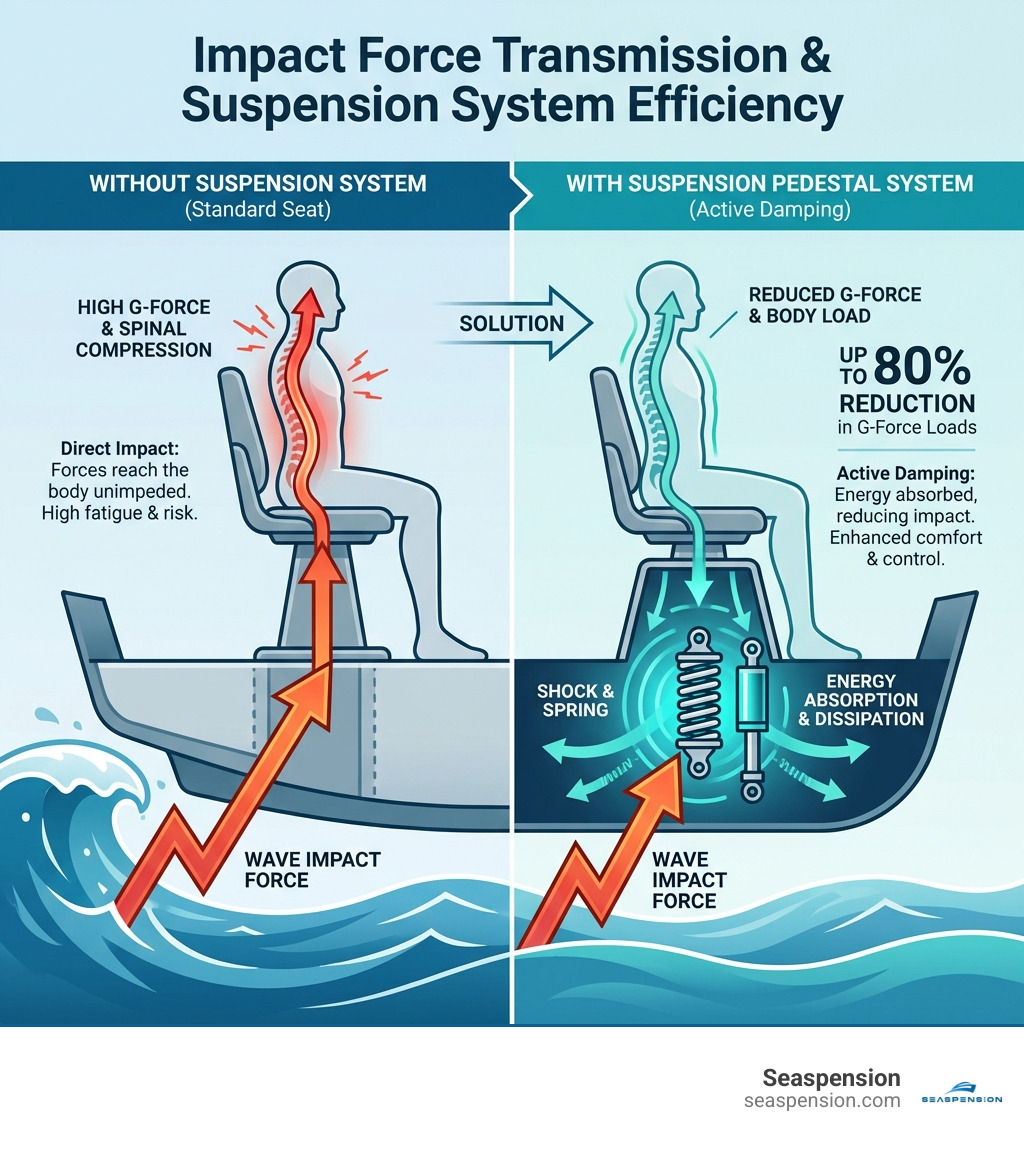
Why does a day on the water sometimes feel like a full-body workout? The answer lies in the repetitive shocks your body absorbs. It's not just about comfort; it's about physics and physiology.
When your boat hits a wave, the impact generates G-forces that are transmitted directly through the hull and into your seat. Without a proper boat seat suspension system, your body becomes the primary shock absorber. This constant jarring leads to whole-body vibration, repetitive shock impacts, and significant spinal compression. Over time, these forces contribute to operator fatigue, reduced focus, and can even lead to chronic back and joint pain. It's a hidden force that silently chips away at your endurance and enjoyment on the water.
We understand these challenges firsthand. The marine environment is unforgiving, and the human body is not designed to withstand constant, unpredictable impacts. Protecting yourself from these forces is crucial for both immediate comfort and long-term health. The goal is to isolate your body from the boat's motion, allowing you to maintain a stable, comfortable posture regardless of the conditions.
Whole-body vibration, repetitive shock impacts, operator fatigue, and spinal compression are all too common for boaters. This is why understanding the mechanics of a good suspension system is vital. It's about changing the fundamental interaction between you and the sea. For a deeper dive into the mechanics of these forces, we recommend reading The Hidden Force of Boating: Why Your Body Feels the Impact and How SeaSpension Softens the Blow.
Many boaters try to mitigate the impact with simple fixes. While well-intentioned, these common approaches are temporary patches that fail to address the root cause of shock and vibration.
We often see boaters resort to solutions that, while providing a perception of comfort, don't actually absorb the kinetic energy of wave impacts.
These methods don't absorb energy; they only slightly dampen it, leaving your body to do the rest of the work. They fail to isolate the occupant from the boat's motion, meaning the physical toll, though perhaps delayed, is still incurred. For a comprehensive look at why conventional seating falls short, check out SeaSpension vs Conventional Boat Seating: Why Make the Switch?.
A genuine boat seat suspension system is an engineered solution designed to isolate you from the harsh movements of the hull. It works by actively absorbing and damping the energy from wave impacts before it reaches your body.
At its core, a suspension system for a boat seat functions much like the suspension in a vehicle. When the boat encounters a wave, the system compresses, absorbing the upward force. This compression is then controlled by a damping mechanism, which prevents a rapid rebound or a "catapult" effect. The goal is to provide a smooth, controlled vertical travel that keeps the occupant relatively stable while the boat moves beneath them. This process involves:
This intelligent engineering is what makes a true boat seat suspension system so effective. It’s not just about adding a spring; it's about a carefully calibrated interaction between springs and dampers to provide a smooth, controlled ride. To learn more about the engineering specifics, explore The Science Behind Shock Absorption: Elevating Your Boating Experience with SeaSpension.
Not all suspension is created equal. The technology inside the pedestal determines its performance, maintenance needs, and effectiveness in real-world conditions. Understanding these differences is key to choosing the right boat seat suspension system for your vessel and your usage.
Here's a breakdown of the primary types you'll encounter:
| Technology | How It Works | Performance in Chop | Adjustability | Maintenance | Durability | Cost |
|---|---|---|---|---|---|---|
| Mechanical (Spring-Only) | Uses a simple coil spring, sometimes with a basic friction damper. | Offers some relief in light chop, but can bottom out or rebound harshly in heavier seas. | Limited, typically pre-set for a weight range. | Generally low, but springs can fatigue. | Moderate. | Lower. |
| Air-Ride | Employs an air bag or air chamber, often with a manifold and accumulator tube, to absorb impacts. Air pressure can be adjusted. | Provides good shock absorption and a "bottomless" feel when properly tuned. Can offer a very smooth ride. | High, air pressure can be fine-tuned for individual rider weight and preference. | Requires checking and adjusting air pressure, seals can degrade over time. | Good, depends heavily on seal quality. | Medium to High. |
| Hydraulic | Combines a progressively rated coil-over spring with a hydraulic shock absorber (damper) that uses proprietary valving. | Excellent performance in varied conditions, providing controlled compression and rebound without harsh bottoming out or catapulting. | Moderate, often tuned for an optimal operating weight range, but some systems allow for spring preload adjustments. | Minimal, generally sealed units designed for long life. | High, known for robust construction and consistent performance. | Medium to High. |
At SeaSpension, our systems are built on a hydraulic principle, incorporating a stainless steel progressively rated coil-over spring and proprietary valving. This design allows the damper to sense the speed of compression, providing custom resistance for optimal performance. This results in a consistently smooth ride without the need for constant air pressure adjustments, making it a practical choice for serious boaters who value reliability and minimal fuss. For more insights into these technologies, particularly the nuances between hydraulic and air systems, refer to Hydraulic vs. Air Suspension for Boats: What Most Boaters Don't Know.
When evaluating options, look past the marketing and focus on the core components and features that deliver real performance and longevity. A quality boat seat suspension system isn't just about absorbing impacts; it's about doing so consistently, reliably, and with minimal maintenance in the harsh marine environment.
Here are the essential features we consider critical:
These features collectively contribute to a boat seat suspension system that not only provides comfort but also improves safety and protects your body over years of use. For more details on what makes a suspension pedestal truly stand out, explore Best Shock Absorbing Boat Seat Pedestal.
Selecting the correct system requires a practical assessment of your boat, your seating setup, and how you use it. It's not a one-size-fits-all decision; a thoughtful approach will ensure you get the most out of your investment.
We offer various models, including Standard Solo Posts, Non-Swivel Solo Posts, Spider Posts, Bench Posts, and Low Profile options, to accommodate different setups. Our Low Profile models, for example, are designed to offer the lowest heights above the deck or mounted atop a box while maintaining full travel stroke and strength. To help guide your decision-making process, we've put together a comprehensive guide: Choosing the Right SeaSpension Model for Your Boat: A Comprehensive Guide.
The demands of an offshore angler are different from those of a coastal cruiser. Your primary boating activity should guide your choice. A boat seat suspension system should complement your boating lifestyle, not complicate it.
For example, a sealed hydraulic system, like the one we offer, is designed for durability and minimal maintenance, making it a practical choice for operators who spend long hours in demanding conditions. Its consistent damping performance across varying impacts means you can focus on navigation and enjoying the water, rather than bracing for the next wave. We've seen our systems improve experiences across all these activities. Learn more about how our solutions benefit different boating activities, from fishing to cruising, at How SeaSpension Benefits Different Boating Activities: Fishing, Cruising, and More.
A good system should be as straightforward to own as it is effective. Look for standard bolt patterns and low-maintenance designs. The best boat seat suspension system should integrate seamlessly into your boat and require minimal fuss once installed.
Installation:
Maintenance:
We provide clear instructions and support for installation. Our goal is to make the upgrade as easy as possible so you can get back on the water quickly and comfortably. For detailed instructions on how to install our pedestals, refer to How to Install a SeaSpension Shock Absorbing Pedestal.
The ultimate goal of a suspension system isn't just a softer ride. It's about enhancing safety, reducing fatigue, and extending your ability to do what you love on the water. A boat seat suspension system transforms the entire boating experience.
These benefits are why marine equipment suppliers, like those found at Fisheries Supply in Seattle, or yacht systems providers such as S3 Maritime also in Seattle, recognize the value of quality marine components. Even local providers like Beach Marine in Virginia emphasize high-quality products that improve the boating experience. For a closer look at how a suspension system improves safety by reducing fatigue and enhancing focus, visit SeaSpension and Safety: Elevating Your Boating Experience by Reducing Fatigue and Improving Focus on the Water.
Upgrading to a high-quality boat seat suspension system is not a luxury; it's a practical investment in your health, safety, and long-term enjoyment of boating. By absorbing the punishing impacts of the sea, it allows you to operate with more confidence and less physical consequence, turning a white-knuckle race into a refined experience.
The costs associated with physical discomfort, fatigue-related errors, or even medical bills from back injuries far outweigh the investment in a quality suspension system. We've seen how boaters, from recreational enthusiasts in Florida to commercial operators in Alaska, transform their experience after installing our pedestals.
The long-term benefits extend to everyone on board:
Our boat seat suspension system pedestals are built with military-grade components and designed for durability and minimal maintenance. They are engineered to handle varying occupant weights with an independently operating shock-absorbing system, ensuring optimal comfort and safety in diverse marine conditions. This focus on robust engineering and real-world performance is why our customers, from Homer, Alaska, to Pinellas Park, Florida, trust our solutions.
To see how this technology can be applied to your vessel and revolutionize your time on the water, we invite you to explore the different models of shock-absorbing pedestals available. Make the smart investment in your boating future.
A boat seat suspension system is an engineered pedestal that absorbs wave impacts before they reach your body, using internal shock absorbers and springs to isolate you from the harsh vertical movements of the hull. Unlike static pedestals or foam cushions, these systems actively dissipate energy, reducing spinal compression and whole-body fatigue during extended time on the water.
Top Boat Seat Suspension Technologies:
| Technology | How It Works | Best For |
|---|---|---|
| Hydraulic | Uses fluid-filled dampers with progressive springs for controlled compression and rebound | Long-term durability, minimal maintenance, consistent performance |
| Air-Ride | Air chamber with accumulator tube provides adjustable cushioning | Fine-tuning comfort for varying rider weights |
| Mechanical Spring | Coil spring with basic shock absorber | Budget-conscious buyers, light chop conditions |
If you've ever finished a day on the water feeling like you've been in a fight, you already know the problem. The constant pounding through waves doesn't just wear on your boat—it wears on your body. Each impact travels up through the hull, through the seat, and directly into your spine.
Most boaters accept this as part of the experience. They add cushions, adjust their stance, or simply grit their teeth and push through. But there's a better approach.
A genuine suspension system doesn't just make the ride more comfortable. It fundamentally changes how your body interacts with the forces of rough water. Instead of absorbing every shock yourself, the system does the work—dissipating energy through engineered damping and spring action before it reaches you.
The difference isn't subtle. Operators report significantly less fatigue, better vessel control, and the ability to stay on the water longer without the physical toll. For anyone who spends serious time at the helm, especially in challenging conditions, this isn't about luxury. It's about operating smarter and protecting your body from cumulative damage.
I'm Ian Milligan, owner of SeaSpension, where we've specialized in shock-absorbing boat seat suspension system solutions since 2021, working with recreational and commercial operators to reduce impact fatigue in real-world marine conditions. This guide will help you understand what actually works and how to choose the right system for your boat.
Why does a day on the water sometimes feel like a full-body workout? The answer lies in the repetitive shocks your body absorbs. It's not just about comfort; it's about physics and physiology.
When your boat hits a wave, the impact generates G-forces that are transmitted directly through the hull and into your seat. Without a proper boat seat suspension system, your body becomes the primary shock absorber. This constant jarring leads to whole-body vibration, repetitive shock impacts, and significant spinal compression. Over time, these forces contribute to operator fatigue, reduced focus, and can even lead to chronic back and joint pain. It's a hidden force that silently chips away at your endurance and enjoyment on the water.
We understand these challenges firsthand. The marine environment is unforgiving, and the human body is not designed to withstand constant, unpredictable impacts. Protecting yourself from these forces is crucial for both immediate comfort and long-term health. The goal is to isolate your body from the boat's motion, allowing you to maintain a stable, comfortable posture regardless of the conditions.
Whole-body vibration, repetitive shock impacts, operator fatigue, and spinal compression are all too common for boaters. This is why understanding the mechanics of a good suspension system is vital. It's about changing the fundamental interaction between you and the sea. For a deeper dive into the mechanics of these forces, we recommend reading The Hidden Force of Boating: Why Your Body Feels the Impact and How SeaSpension Softens the Blow.
Many boaters try to mitigate the impact with simple fixes. While well-intentioned, these common approaches are temporary patches that fail to address the root cause of shock and vibration.
We often see boaters resort to solutions that, while providing a perception of comfort, don't actually absorb the kinetic energy of wave impacts.
These methods don't absorb energy; they only slightly dampen it, leaving your body to do the rest of the work. They fail to isolate the occupant from the boat's motion, meaning the physical toll, though perhaps delayed, is still incurred. For a comprehensive look at why conventional seating falls short, check out SeaSpension vs Conventional Boat Seating: Why Make the Switch?.
A genuine boat seat suspension system is an engineered solution designed to isolate you from the harsh movements of the hull. It works by actively absorbing and damping the energy from wave impacts before it reaches your body.
At its core, a suspension system for a boat seat functions much like the suspension in a vehicle. When the boat encounters a wave, the system compresses, absorbing the upward force. This compression is then controlled by a damping mechanism, which prevents a rapid rebound or a "catapult" effect. The goal is to provide a smooth, controlled vertical travel that keeps the occupant relatively stable while the boat moves beneath them. This process involves:
This intelligent engineering is what makes a true boat seat suspension system so effective. It’s not just about adding a spring; it's about a carefully calibrated interaction between springs and dampers to provide a smooth, controlled ride. To learn more about the engineering specifics, explore The Science Behind Shock Absorption: Elevating Your Boating Experience with SeaSpension.
Not all suspension is created equal. The technology inside the pedestal determines its performance, maintenance needs, and effectiveness in real-world conditions. Understanding these differences is key to choosing the right boat seat suspension system for your vessel and your usage.
Here's a breakdown of the primary types you'll encounter:
| Technology | How It Works | Performance in Chop | Adjustability | Maintenance | Durability | Cost |
|---|---|---|---|---|---|---|
| Mechanical (Spring-Only) | Uses a simple coil spring, sometimes with a basic friction damper. | Offers some relief in light chop, but can bottom out or rebound harshly in heavier seas. | Limited, typically pre-set for a weight range. | Generally low, but springs can fatigue. | Moderate. | Lower. |
| Air-Ride | Employs an air bag or air chamber, often with a manifold and accumulator tube, to absorb impacts. Air pressure can be adjusted. | Provides good shock absorption and a "bottomless" feel when properly tuned. Can offer a very smooth ride. | High, air pressure can be fine-tuned for individual rider weight and preference. | Requires checking and adjusting air pressure, seals can degrade over time. | Good, depends heavily on seal quality. | Medium to High. |
| Hydraulic | Combines a progressively rated coil-over spring with a hydraulic shock absorber (damper) that uses proprietary valving. | Excellent performance in varied conditions, providing controlled compression and rebound without harsh bottoming out or catapulting. | Moderate, often tuned for an optimal operating weight range, but some systems allow for spring preload adjustments. | Minimal, generally sealed units designed for long life. | High, known for robust construction and consistent performance. | Medium to High. |
At SeaSpension, our systems are built on a hydraulic principle, incorporating a stainless steel progressively rated coil-over spring and proprietary valving. This design allows the damper to sense the speed of compression, providing custom resistance for optimal performance. This results in a consistently smooth ride without the need for constant air pressure adjustments, making it a practical choice for serious boaters who value reliability and minimal fuss. For more insights into these technologies, particularly the nuances between hydraulic and air systems, refer to Hydraulic vs. Air Suspension for Boats: What Most Boaters Don't Know.
When evaluating options, look past the marketing and focus on the core components and features that deliver real performance and longevity. A quality boat seat suspension system isn't just about absorbing impacts; it's about doing so consistently, reliably, and with minimal maintenance in the harsh marine environment.
Here are the essential features we consider critical:
These features collectively contribute to a boat seat suspension system that not only provides comfort but also improves safety and protects your body over years of use. For more details on what makes a suspension pedestal truly stand out, explore Best Shock Absorbing Boat Seat Pedestal.
Selecting the correct system requires a practical assessment of your boat, your seating setup, and how you use it. It's not a one-size-fits-all decision; a thoughtful approach will ensure you get the most out of your investment.
We offer various models, including Standard Solo Posts, Non-Swivel Solo Posts, Spider Posts, Bench Posts, and Low Profile options, to accommodate different setups. Our Low Profile models, for example, are designed to offer the lowest heights above the deck or mounted atop a box while maintaining full travel stroke and strength. To help guide your decision-making process, we've put together a comprehensive guide: Choosing the Right SeaSpension Model for Your Boat: A Comprehensive Guide.
The demands of an offshore angler are different from those of a coastal cruiser. Your primary boating activity should guide your choice. A boat seat suspension system should complement your boating lifestyle, not complicate it.
For example, a sealed hydraulic system, like the one we offer, is designed for durability and minimal maintenance, making it a practical choice for operators who spend long hours in demanding conditions. Its consistent damping performance across varying impacts means you can focus on navigation and enjoying the water, rather than bracing for the next wave. We've seen our systems improve experiences across all these activities. Learn more about how our solutions benefit different boating activities, from fishing to cruising, at How SeaSpension Benefits Different Boating Activities: Fishing, Cruising, and More.
A good system should be as straightforward to own as it is effective. Look for standard bolt patterns and low-maintenance designs. The best boat seat suspension system should integrate seamlessly into your boat and require minimal fuss once installed.
Installation:
Maintenance:
We provide clear instructions and support for installation. Our goal is to make the upgrade as easy as possible so you can get back on the water quickly and comfortably. For detailed instructions on how to install our pedestals, refer to How to Install a SeaSpension Shock Absorbing Pedestal.
The ultimate goal of a suspension system isn't just a softer ride. It's about enhancing safety, reducing fatigue, and extending your ability to do what you love on the water. A boat seat suspension system transforms the entire boating experience.
These benefits are why marine equipment suppliers, like those found at Fisheries Supply in Seattle, or yacht systems providers such as S3 Maritime also in Seattle, recognize the value of quality marine components. Even local providers like Beach Marine in Virginia emphasize high-quality products that improve the boating experience. For a closer look at how a suspension system improves safety by reducing fatigue and enhancing focus, visit SeaSpension and Safety: Elevating Your Boating Experience by Reducing Fatigue and Improving Focus on the Water.
Upgrading to a high-quality boat seat suspension system is not a luxury; it's a practical investment in your health, safety, and long-term enjoyment of boating. By absorbing the punishing impacts of the sea, it allows you to operate with more confidence and less physical consequence, turning a white-knuckle race into a refined experience.
The costs associated with physical discomfort, fatigue-related errors, or even medical bills from back injuries far outweigh the investment in a quality suspension system. We've seen how boaters, from recreational enthusiasts in Florida to commercial operators in Alaska, transform their experience after installing our pedestals.
The long-term benefits extend to everyone on board:
Our boat seat suspension system pedestals are built with military-grade components and designed for durability and minimal maintenance. They are engineered to handle varying occupant weights with an independently operating shock-absorbing system, ensuring optimal comfort and safety in diverse marine conditions. This focus on robust engineering and real-world performance is why our customers, from Homer, Alaska, to Pinellas Park, Florida, trust our solutions.
To see how this technology can be applied to your vessel and revolutionize your time on the water, we invite you to explore the different models of shock-absorbing pedestals available. Make the smart investment in your boating future.


