An aluminum boat footrest is a marine-grade accessory designed to provide a stable bracing point for your feet while operating or sitting at the helm, reducing leg fatigue and improving posture during long hours on the water.
Key Benefits of Aluminum Boat Footrests:
Most boaters don't realize how much strain their legs and lower back endure without proper foot support. When your feet dangle or brace awkwardly against the deck, every wave impact transfers shock directly up through your knees, hips, and spine. This leads to numbness, fatigue, and the constant need to shift position - especially on longer trips or in rough conditions.
A quality footrest gives you a solid platform to distribute weight evenly and maintain better posture. But materials matter in the marine environment. Aluminum has become the standard for boat footrests because it resists corrosion in saltwater, stays light enough not to affect performance, and handles structural loads without flexing or cracking.
As Ian Milligan, owner of SeaSuspension, I've worked with boaters across recreational and commercial environments who understand that proper ergonomics start with where your feet rest - and that the right aluminum boat footrest is a foundational piece of a complete shock mitigation system.
Boating is exhilarating, but the physical demands can take a toll. Long hours at the helm, especially in choppy conditions, often lead to operator fatigue, poor posture, and reduced boat control. We've all experienced that nagging ache in the lower back, the stiffness in the knees, or the numbness in our legs after a few hours underway. This isn't just discomfort; it's a symptom of your body constantly bracing against impacts and vibrations.
Without a stable platform for your feet, your muscles are in a perpetual state of tension. Your legs might dangle, or you might find yourself awkwardly bracing them against the console or deck. This poor posture isn't just uncomfortable; it's inefficient and dangerous. Every time the boat hits a wave, that shock travels directly up your body, compressing your spine and straining your joints. Over time, this constant impact contributes to chronic pain and can even lead to injury.
The problem is compounded by the fact that your body becomes the primary shock absorber. This puts immense stress on your musculoskeletal system, leading to fatigue that can impair your judgment and reaction times. This is the "hidden force" of boating that we often overlook until the aches and pains set in. For a deeper dive into these impacts, you can read about The Hidden Force of Boating: Why Your Body Feels the Impact and How SeaSension Softens the Blow. An aluminum boat footrest provides a crucial bracing point, allowing your legs to support your weight properly and giving your core muscles a break.
When it comes to marine accessories, material selection is paramount. The harsh saltwater environment demands components that can withstand constant exposure to corrosive elements, UV radiation, and mechanical stress. This is precisely why aluminum has become the material of choice for an aluminum boat footrest and many other critical marine applications.
Aluminum's inherent corrosion resistance is its most significant advantage in marine settings. Unlike steel, which rusts quickly in saltwater, aluminum forms a protective oxide layer that shields it from further degradation. This natural passivation makes it incredibly durable, ensuring your footrest will last for years even in the most demanding conditions, whether you're fishing off the coast of Florida or navigating the waters of Alaska.
Beyond its resistance to corrosion, aluminum boasts an impressive strength-to-weight ratio. It's strong enough to provide robust support, yet significantly lighter than stainless steel. This lightweight property is crucial on a boat, where every pound counts towards fuel efficiency and overall performance. We don't want to add unnecessary weight to your vessel, and aluminum allows us to achieve strength without compromise. Many marine manufacturers, including those specializing in custom aluminum work, rely on this material for its versatility and resilience. For examples of custom marine aluminum applications, you can explore offerings from providers like Custom Marine Aluminum. Our expertise in Custom Aluminum Boat construction also highlights our confidence in this material.
To truly appreciate aluminum, let's compare it to other materials commonly found in marine footrests: 316 stainless steel and marine polymer.
| Feature | Aluminum | 316 Stainless Steel | Marine Polymer (HDPE) |
|---|---|---|---|
| Weight | Very Lightweight | Heavy | Lightweight |
| Corrosion Resistance | Excellent (forms protective oxide layer) | Excellent (high chromium content) | Excellent (inert to saltwater) |
| Strength | High (especially alloys like 6061-T6) | Very High | Moderate (can flex under heavy load) |
| Maintenance | Low (periodic cleaning) | Low (periodic cleaning, susceptible to tea staining) | Very Low (wipe clean) |
| Cost | Moderate | High | Low |
As the table illustrates, aluminum offers an excellent balance of properties. While 316 stainless steel is incredibly strong and corrosion-resistant, its weight and higher cost can be drawbacks. Marine polymers are lightweight and inexpensive but may lack the rigidity and structural integrity required for a truly stable footrest, especially under dynamic loads. Aluminum strikes that sweet spot, offering durability and performance without excessive weight or cost.
The durability of an aluminum boat footrest is further improved by its finish. Two common and highly effective finishes are brushed anodized aluminum and powder-coated aluminum.
Brushed anodized aluminum involves an electrochemical process that thickens the natural oxide layer on the aluminum's surface. This creates an extremely hard, scratch-resistant, and corrosion-proof finish that also looks sleek and professional. Many high-quality footrests, like the Folded Aluminum Footrest by Garelick (which offers a similar brushed anodized finish), use this treatment for both aesthetics and long-term protection.
Powder coating involves applying a dry powder (a mixture of finely ground particles of pigment and resin) to the aluminum surface, which is then cured under heat. This process creates a thick, durable, and aesthetically pleasing finish that offers excellent protection against corrosion, abrasion, and UV damage. Powder coating also allows for various color options, enabling customization to match your boat's aesthetic.
Regardless of the finish, the underlying strength of marine-grade aluminum, often alloys like 5052 or 6061-T6, ensures structural integrity. These materials are chosen for their specific properties that perform well in the marine environment, offering a robust solution that resists bending, cracking, and fatigue.
Selecting the perfect aluminum boat footrest involves more than just picking the first one you see. It requires careful consideration of mounting options, adjustability, price, and how well it integrates with your specific boat type. The right choice will significantly improve your comfort, control, and overall boating experience.
The market for marine seating accessories, including footrests, is growing as boat owners increasingly demand improved comfort and functionality. This means you have many options, ranging from basic models around $50 to more complex, adjustable, or integrated systems that can cost several hundred dollars. This wide price range reflects the diversity in features, materials, and mounting solutions available.
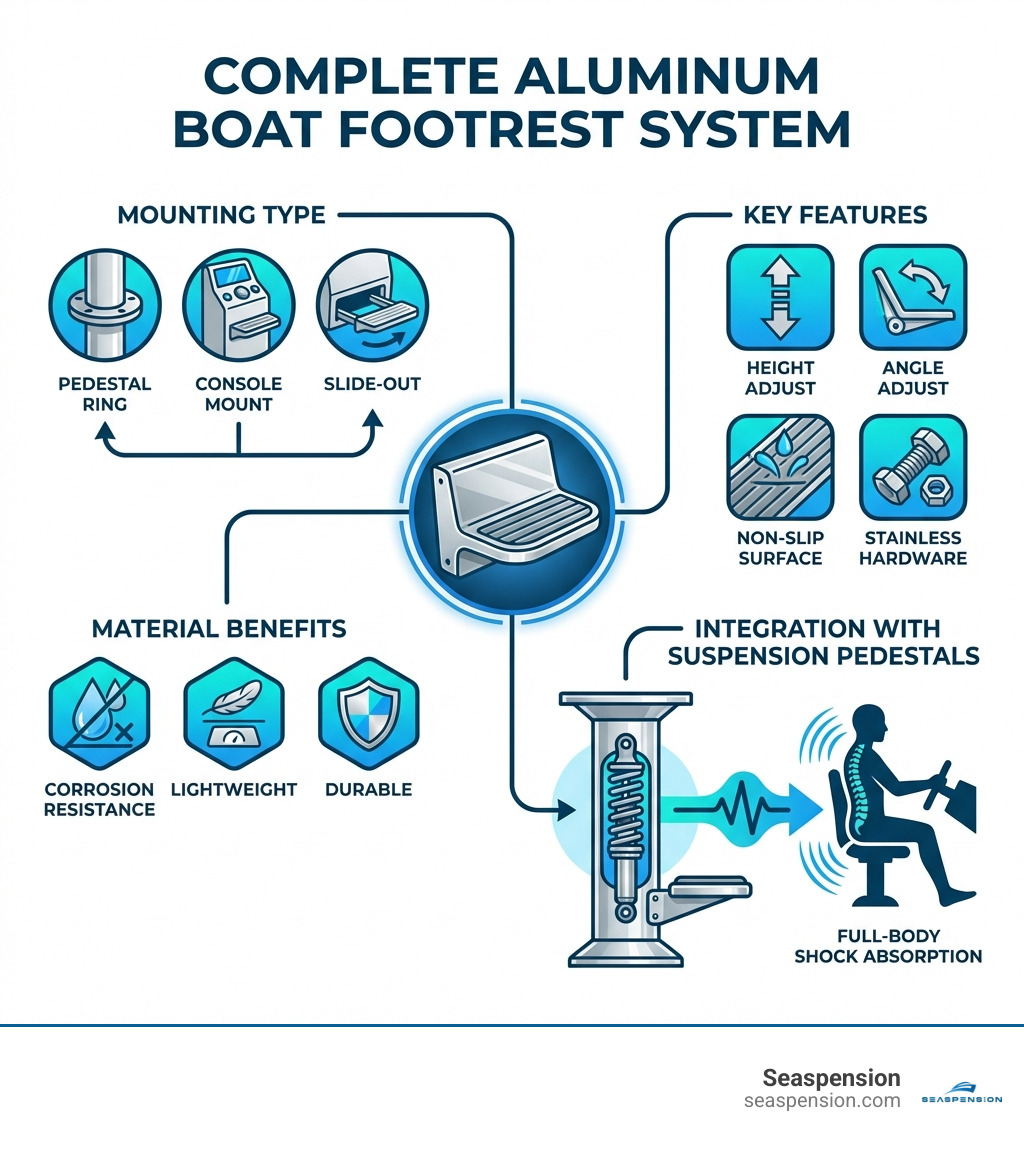
Understanding the different types of footrests will help you narrow down your options:

Once you've considered the basic type, look for these key features to maximize comfort and durability:
The best aluminum boat footrest for you will depend heavily on your boat's design and your primary use.
Carefully assessing your boat's layout and how you typically operate it will guide you to the most suitable aluminum boat footrest solution.
Installing an aluminum boat footrest correctly is just as important as choosing the right one. A poorly installed footrest can be unstable, unsafe, and lead to damage to your boat. While many footrests are designed for straightforward installation, understanding the key considerations will ensure a secure and long-lasting setup.
Mounting Options and Best Practices:
We always recommend taking the time to plan your installation, measure twice, and ensure you have the right tools and hardware. If you're unsure, consult a professional marine installer. A secure aluminum boat footrest is a safe and effective one.
While an aluminum boat footrest is a significant step towards improving comfort and ergonomics on your boat, understand that it's only one piece of the puzzle. The marine environment subjects us to constant motion, and even with a stable place for your feet, your body is still absorbing the relentless impact of waves and vibrations. This is where the concept of a complete ergonomic system, especially shock mitigation, becomes critical.
A footrest provides a crucial bracing point, allowing you to maintain better posture and reduce leg fatigue. It gives your feet a solid foundation, which is vital for control and comfort. However, it doesn't address the root cause of much of the discomfort and fatigue experienced by boaters: whole-body vibration and direct shock transfer from wave impacts.
We've observed that the demand for adjustable and ergonomic boat accessories, including footrests, is increasing as boaters seek to improve comfort and reduce fatigue during long periods on the water. This growing awareness highlights the need for more comprehensive solutions.
This is where a Seaspension Shock Absorbing Boat Seat Pedestal comes into play. While your aluminum boat footrest gives your feet a place to rest, our suspension pedestals actively absorb the impacts that cause fatigue and injury. We believe in an independently operating shock-absorbing system that offers optimal comfort and safety for boaters, even with varying occupant weights.
Imagine the difference: your feet are firmly planted on a stable footrest, and your seat is simultaneously absorbing up to 75% of the shock and vibration from the waves. This combination creates a truly ergonomic experience, reducing the strain on your entire body. The science behind this is clear: by mitigating shock at the source, we reduce the stress on your spine, joints, and muscles. To learn more about this, explore The Science Behind Shock Absorption: Elevating Your Boating Experience with SeaSension.
Many boat manufacturers are now integrating aluminum footrests as standard equipment in higher-end models, recognizing their contribution to overall boat design and comfort. This trend underscores the value of these accessories. However, to truly "feel better and travel farther," combining a quality aluminum boat footrest with a shock-absorbing seat pedestal is the ultimate solution. This system approach protects you from the continuous pounding of the sea, allowing you to enjoy your time on the water with less fatigue and greater control. Find the advantages of making the switch by reading SeaSension vs. Conventional Boat Seating: Why Make the Switch?.
Investing in an aluminum boat footrest is an investment in your comfort, safety, and enjoyment on the water. It's a foundational piece of marine ergonomics that provides immediate benefits by reducing leg fatigue, improving posture, and offering a stable bracing point. We've seen how crucial this seemingly simple accessory is for both recreational boaters and commercial operators across Florida, Alaska, Massachusetts, and beyond.
However, we also understand that true long-term comfort and protection come from a system approach. While a footrest anchors your feet, a quality shock-absorbing seat pedestal anchors your entire body against the relentless impacts of the sea. Together, they create an ergonomic environment that allows you to operate your vessel with greater control, reduced fatigue, and improved safety. This comprehensive approach is essential for anyone spending significant time on the water, ensuring that every trip is more enjoyable and less taxing on your body.
We encourage you to consider how an aluminum boat footrest fits into your overall strategy for comfort and control. By combining smart accessory choices with advanced shock mitigation technology, you can truly transform your boating experience. For more insights into optimizing your on-board comfort, dig into Anchoring Your Comfort: A Deep Dive into Boat Seat Pedestals and Bases.
Ready to improve your boating comfort? View pedestal footrest options and learn how SeaSension can further lift your experience by absorbing the impacts that lead to fatigue and discomfort.
An aluminum boat footrest is a marine-grade accessory designed to provide a stable bracing point for your feet while operating or sitting at the helm, reducing leg fatigue and improving posture during long hours on the water.
Key Benefits of Aluminum Boat Footrests:
Most boaters don't realize how much strain their legs and lower back endure without proper foot support. When your feet dangle or brace awkwardly against the deck, every wave impact transfers shock directly up through your knees, hips, and spine. This leads to numbness, fatigue, and the constant need to shift position - especially on longer trips or in rough conditions.
A quality footrest gives you a solid platform to distribute weight evenly and maintain better posture. But materials matter in the marine environment. Aluminum has become the standard for boat footrests because it resists corrosion in saltwater, stays light enough not to affect performance, and handles structural loads without flexing or cracking.
As Ian Milligan, owner of SeaSuspension, I've worked with boaters across recreational and commercial environments who understand that proper ergonomics start with where your feet rest - and that the right aluminum boat footrest is a foundational piece of a complete shock mitigation system.
Boating is exhilarating, but the physical demands can take a toll. Long hours at the helm, especially in choppy conditions, often lead to operator fatigue, poor posture, and reduced boat control. We've all experienced that nagging ache in the lower back, the stiffness in the knees, or the numbness in our legs after a few hours underway. This isn't just discomfort; it's a symptom of your body constantly bracing against impacts and vibrations.
Without a stable platform for your feet, your muscles are in a perpetual state of tension. Your legs might dangle, or you might find yourself awkwardly bracing them against the console or deck. This poor posture isn't just uncomfortable; it's inefficient and dangerous. Every time the boat hits a wave, that shock travels directly up your body, compressing your spine and straining your joints. Over time, this constant impact contributes to chronic pain and can even lead to injury.
The problem is compounded by the fact that your body becomes the primary shock absorber. This puts immense stress on your musculoskeletal system, leading to fatigue that can impair your judgment and reaction times. This is the "hidden force" of boating that we often overlook until the aches and pains set in. For a deeper dive into these impacts, you can read about The Hidden Force of Boating: Why Your Body Feels the Impact and How SeaSension Softens the Blow. An aluminum boat footrest provides a crucial bracing point, allowing your legs to support your weight properly and giving your core muscles a break.
When it comes to marine accessories, material selection is paramount. The harsh saltwater environment demands components that can withstand constant exposure to corrosive elements, UV radiation, and mechanical stress. This is precisely why aluminum has become the material of choice for an aluminum boat footrest and many other critical marine applications.
Aluminum's inherent corrosion resistance is its most significant advantage in marine settings. Unlike steel, which rusts quickly in saltwater, aluminum forms a protective oxide layer that shields it from further degradation. This natural passivation makes it incredibly durable, ensuring your footrest will last for years even in the most demanding conditions, whether you're fishing off the coast of Florida or navigating the waters of Alaska.
Beyond its resistance to corrosion, aluminum boasts an impressive strength-to-weight ratio. It's strong enough to provide robust support, yet significantly lighter than stainless steel. This lightweight property is crucial on a boat, where every pound counts towards fuel efficiency and overall performance. We don't want to add unnecessary weight to your vessel, and aluminum allows us to achieve strength without compromise. Many marine manufacturers, including those specializing in custom aluminum work, rely on this material for its versatility and resilience. For examples of custom marine aluminum applications, you can explore offerings from providers like Custom Marine Aluminum. Our expertise in Custom Aluminum Boat construction also highlights our confidence in this material.
To truly appreciate aluminum, let's compare it to other materials commonly found in marine footrests: 316 stainless steel and marine polymer.
| Feature | Aluminum | 316 Stainless Steel | Marine Polymer (HDPE) |
|---|---|---|---|
| Weight | Very Lightweight | Heavy | Lightweight |
| Corrosion Resistance | Excellent (forms protective oxide layer) | Excellent (high chromium content) | Excellent (inert to saltwater) |
| Strength | High (especially alloys like 6061-T6) | Very High | Moderate (can flex under heavy load) |
| Maintenance | Low (periodic cleaning) | Low (periodic cleaning, susceptible to tea staining) | Very Low (wipe clean) |
| Cost | Moderate | High | Low |
As the table illustrates, aluminum offers an excellent balance of properties. While 316 stainless steel is incredibly strong and corrosion-resistant, its weight and higher cost can be drawbacks. Marine polymers are lightweight and inexpensive but may lack the rigidity and structural integrity required for a truly stable footrest, especially under dynamic loads. Aluminum strikes that sweet spot, offering durability and performance without excessive weight or cost.
The durability of an aluminum boat footrest is further improved by its finish. Two common and highly effective finishes are brushed anodized aluminum and powder-coated aluminum.
Brushed anodized aluminum involves an electrochemical process that thickens the natural oxide layer on the aluminum's surface. This creates an extremely hard, scratch-resistant, and corrosion-proof finish that also looks sleek and professional. Many high-quality footrests, like the Folded Aluminum Footrest by Garelick (which offers a similar brushed anodized finish), use this treatment for both aesthetics and long-term protection.
Powder coating involves applying a dry powder (a mixture of finely ground particles of pigment and resin) to the aluminum surface, which is then cured under heat. This process creates a thick, durable, and aesthetically pleasing finish that offers excellent protection against corrosion, abrasion, and UV damage. Powder coating also allows for various color options, enabling customization to match your boat's aesthetic.
Regardless of the finish, the underlying strength of marine-grade aluminum, often alloys like 5052 or 6061-T6, ensures structural integrity. These materials are chosen for their specific properties that perform well in the marine environment, offering a robust solution that resists bending, cracking, and fatigue.
Selecting the perfect aluminum boat footrest involves more than just picking the first one you see. It requires careful consideration of mounting options, adjustability, price, and how well it integrates with your specific boat type. The right choice will significantly improve your comfort, control, and overall boating experience.
The market for marine seating accessories, including footrests, is growing as boat owners increasingly demand improved comfort and functionality. This means you have many options, ranging from basic models around $50 to more complex, adjustable, or integrated systems that can cost several hundred dollars. This wide price range reflects the diversity in features, materials, and mounting solutions available.
Understanding the different types of footrests will help you narrow down your options:
Once you've considered the basic type, look for these key features to maximize comfort and durability:
The best aluminum boat footrest for you will depend heavily on your boat's design and your primary use.
Carefully assessing your boat's layout and how you typically operate it will guide you to the most suitable aluminum boat footrest solution.
Installing an aluminum boat footrest correctly is just as important as choosing the right one. A poorly installed footrest can be unstable, unsafe, and lead to damage to your boat. While many footrests are designed for straightforward installation, understanding the key considerations will ensure a secure and long-lasting setup.
Mounting Options and Best Practices:
We always recommend taking the time to plan your installation, measure twice, and ensure you have the right tools and hardware. If you're unsure, consult a professional marine installer. A secure aluminum boat footrest is a safe and effective one.
While an aluminum boat footrest is a significant step towards improving comfort and ergonomics on your boat, understand that it's only one piece of the puzzle. The marine environment subjects us to constant motion, and even with a stable place for your feet, your body is still absorbing the relentless impact of waves and vibrations. This is where the concept of a complete ergonomic system, especially shock mitigation, becomes critical.
A footrest provides a crucial bracing point, allowing you to maintain better posture and reduce leg fatigue. It gives your feet a solid foundation, which is vital for control and comfort. However, it doesn't address the root cause of much of the discomfort and fatigue experienced by boaters: whole-body vibration and direct shock transfer from wave impacts.
We've observed that the demand for adjustable and ergonomic boat accessories, including footrests, is increasing as boaters seek to improve comfort and reduce fatigue during long periods on the water. This growing awareness highlights the need for more comprehensive solutions.
This is where a Seaspension Shock Absorbing Boat Seat Pedestal comes into play. While your aluminum boat footrest gives your feet a place to rest, our suspension pedestals actively absorb the impacts that cause fatigue and injury. We believe in an independently operating shock-absorbing system that offers optimal comfort and safety for boaters, even with varying occupant weights.
Imagine the difference: your feet are firmly planted on a stable footrest, and your seat is simultaneously absorbing up to 75% of the shock and vibration from the waves. This combination creates a truly ergonomic experience, reducing the strain on your entire body. The science behind this is clear: by mitigating shock at the source, we reduce the stress on your spine, joints, and muscles. To learn more about this, explore The Science Behind Shock Absorption: Elevating Your Boating Experience with SeaSension.
Many boat manufacturers are now integrating aluminum footrests as standard equipment in higher-end models, recognizing their contribution to overall boat design and comfort. This trend underscores the value of these accessories. However, to truly "feel better and travel farther," combining a quality aluminum boat footrest with a shock-absorbing seat pedestal is the ultimate solution. This system approach protects you from the continuous pounding of the sea, allowing you to enjoy your time on the water with less fatigue and greater control. Find the advantages of making the switch by reading SeaSension vs. Conventional Boat Seating: Why Make the Switch?.
Investing in an aluminum boat footrest is an investment in your comfort, safety, and enjoyment on the water. It's a foundational piece of marine ergonomics that provides immediate benefits by reducing leg fatigue, improving posture, and offering a stable bracing point. We've seen how crucial this seemingly simple accessory is for both recreational boaters and commercial operators across Florida, Alaska, Massachusetts, and beyond.
However, we also understand that true long-term comfort and protection come from a system approach. While a footrest anchors your feet, a quality shock-absorbing seat pedestal anchors your entire body against the relentless impacts of the sea. Together, they create an ergonomic environment that allows you to operate your vessel with greater control, reduced fatigue, and improved safety. This comprehensive approach is essential for anyone spending significant time on the water, ensuring that every trip is more enjoyable and less taxing on your body.
We encourage you to consider how an aluminum boat footrest fits into your overall strategy for comfort and control. By combining smart accessory choices with advanced shock mitigation technology, you can truly transform your boating experience. For more insights into optimizing your on-board comfort, dig into Anchoring Your Comfort: A Deep Dive into Boat Seat Pedestals and Bases.
Ready to improve your boating comfort? View pedestal footrest options and learn how SeaSension can further lift your experience by absorbing the impacts that lead to fatigue and discomfort.


