Why Most Boat Seats Leave You Sore After a Day on the Water
When searching for boat seats and pedestals for sale, you'll find three main categories to consider:
Quick Shopping Guide:
- Boat Seats - Helm chairs, bucket seats, leaning posts, bench seating, and fold-down fishing seats typically range from $56 to $380+ depending on features and materials
- Standard Pedestals - Fixed-height and adjustable pedestals in aluminum or stainless steel run from $50 to $300
- Shock-Absorbing Pedestals - Suspension systems designed to reduce impact and fatigue, priced from $300 to $800+
Key factors when buying:
- Marine-grade materials (UV-treated vinyl, anodized aluminum, stainless steel)
- Mounting compatibility (standard 6-bolt pattern vs. proprietary)
- Height requirements and adjustability
- Weight capacity and rider comfort
Boating in real-world conditions means constant impacts and vibration. The hull transmits shock through the deck and seat, leading to fatigue in your back and joints. Many boat owners believe thicker cushions or swapping seat styles will solve the problem, but these only address surface comfortnot the root cause. The pedestal beneath your seat is the critical path for shock to reach your body, and most standard pedestals do nothing to absorb those forces.
The marine seating market continues to grow at approximately 4-5% annually, with shock-absorbing pedestals seeing particularly strong demand as boaters prioritize ergonomics and long-term physical comfort. Online sales channels now dominate the market, with replacement seats and upgraded pedestals representing a significant portion of purchases. Whether you're outfitting a fishing boat, pontoon, or commercial vessel, understanding the difference between basic mounting hardware and true shock mitigation technology will determine whether you finish the day energized or exhausted.
I'm Ian Milligan, owner of Seaspension, where we've specialized in hydraulic shock-absorbing boat seat pedestal systems since 2021, serving recreational and commercial operators who face rough water conditions regularly. Throughout my work with boat seats and pedestals for sale, I've seen how the right suspension system fundamentally changes the boating experience for operators dealing with fatigue and physical strain.
Boating is a unique activity where the environment actively works against your comfort and physical well-being. Every wave, every chop, every turn creates forces that travel directly through your boat's structure. These forces, often referred to as G-forces, impact your body.
When your boat hits a wave, the energy of that impact is transferred from the hull, through the deck, and directly up the rigid pedestal into your seat. From there, it's absorbed by your body, particularly your spine, knees, and hips. Over time, these repeated jolts accumulate, leading to muscle fatigue, joint pain, and even more serious issues like back problems. This is especially true for those of us who spend long hours on the water, whether for fishing, cruising, or commercial operations. Our bodies take a constant pounding, often without us realizing the full extent until we're back on shore. This constant impact is the "hidden force" that can turn an enjoyable day into a painful one.
Many boat owners try to solve this discomfort by simply adding thicker cushions or upgrading to a more plush seat. While a comfortable cushion can certainly help with surface pressure and provide some initial relief, it fundamentally misses the point. A thicker cushion might absorb a small amount of vibration, but it does little to mitigate the significant vertical impacts that cause real fatigue and injury. The core problem isn't the seat's padding; it's the rigid connection between the seat and the boat's deck. Until that connection can absorb and dissipate the impact energy, your body will continue to do the job, and you'll continue to feel the effects.
Types of Boat Seats and What Matters for Durability
When we look for boat seats and pedestals for sale, understanding the different types of seats and the materials they're built from is crucial for both comfort and longevity in the harsh marine environment.
Common Boat Seat Styles
The world of boat seats offers a variety of styles, each designed for specific uses and boat types:
- Helm Chairs: These are typically the most robust and comfortable seats on a boat, designed for the captain. They often feature armrests, high backs, and sometimes even reclining capabilities. They are built for long hours at the controls.
- Bucket Seats: Similar to car seats, bucket seats offer good lateral support, making them popular in faster boats or those that experience sharper turns. They often come with a folding bolster to allow standing while still being supported.
- Leaning Posts: Common on center console fishing boats, leaning posts allow the operator to stand or lean against them, offering support during rough conditions while maintaining an liftd view.
- Bench Seating: Found frequently on pontoon boats and in cockpits, bench seats offer seating for multiple passengers. They often incorporate storage underneath.
- Fold-Down Fishing Seats: These are simpler, often compact seats designed for fishing boats. They can be folded down when not in use to maximize deck space, and are typically mounted on a pedestal.
- Jump Seats: Often found in the stern of boats, these are small, often foldable or removable seats designed for occasional use or extra passengers.

For example, we see a wide range of seat types for pontoons, from classic and premium to luxury options. Fishing boats often use high-back folding seats, low-back options, or specialized lean pro seats for casting. Even offshore helm chairs come in standard and deluxe ladder-back versions. The choice depends heavily on the type of boating you do and the level of comfort and support you require.
Materials and Construction
The marine environment is unforgiving, so the materials and construction of your boat seats must be up to the task. When we evaluate boat seats and pedestals for sale, we prioritize durability.
- Marine-Grade Vinyl: This is the industry standard for upholstery due to its resistance to mildew, UV radiation, and general wear and tear. Premium-grade vinyl is essential to prevent cracking, fading, and deterioration from sun and salt exposure.
- UV-Resistant Thread: It's not just the vinyl that needs to withstand the sun; the stitching holding it all together must also be UV-resistant to prevent seams from solveing over time.
- High-Compression Foam: For comfort that lasts, high-compression foam padding is used. This type of foam resists compression and maintains its shape and support for longer, even with heavy use.
- Roto-Molded Plastic Frames: Many quality boat seats use roto-molded, high-impact plastic frames. This construction method creates a strong, one-piece frame that is resistant to rot, corrosion, and structural damage from impacts.
- Corrosion-Resistant Hardware: All fasteners, hinges, and other metal components should be made from stainless steel or anodized aluminum to prevent rust and corrosion, ensuring the seat remains functional and safe in a saltwater environment.
These material choices are not just about aesthetics; they are fundamental to the longevity and performance of your boat seats. Investing in quality materials means your seats will withstand heavy use and exposure to weather conditions for years to come.
The Pedestal: The Critical Link Between Boat and Body
The pedestal is far more than just a support for your seat; it's the primary conduit for forces between your boat's deck and your body. Choosing the right pedestal is as important as selecting a comfortable seat, especially when considering the long-term impact on your comfort and health.
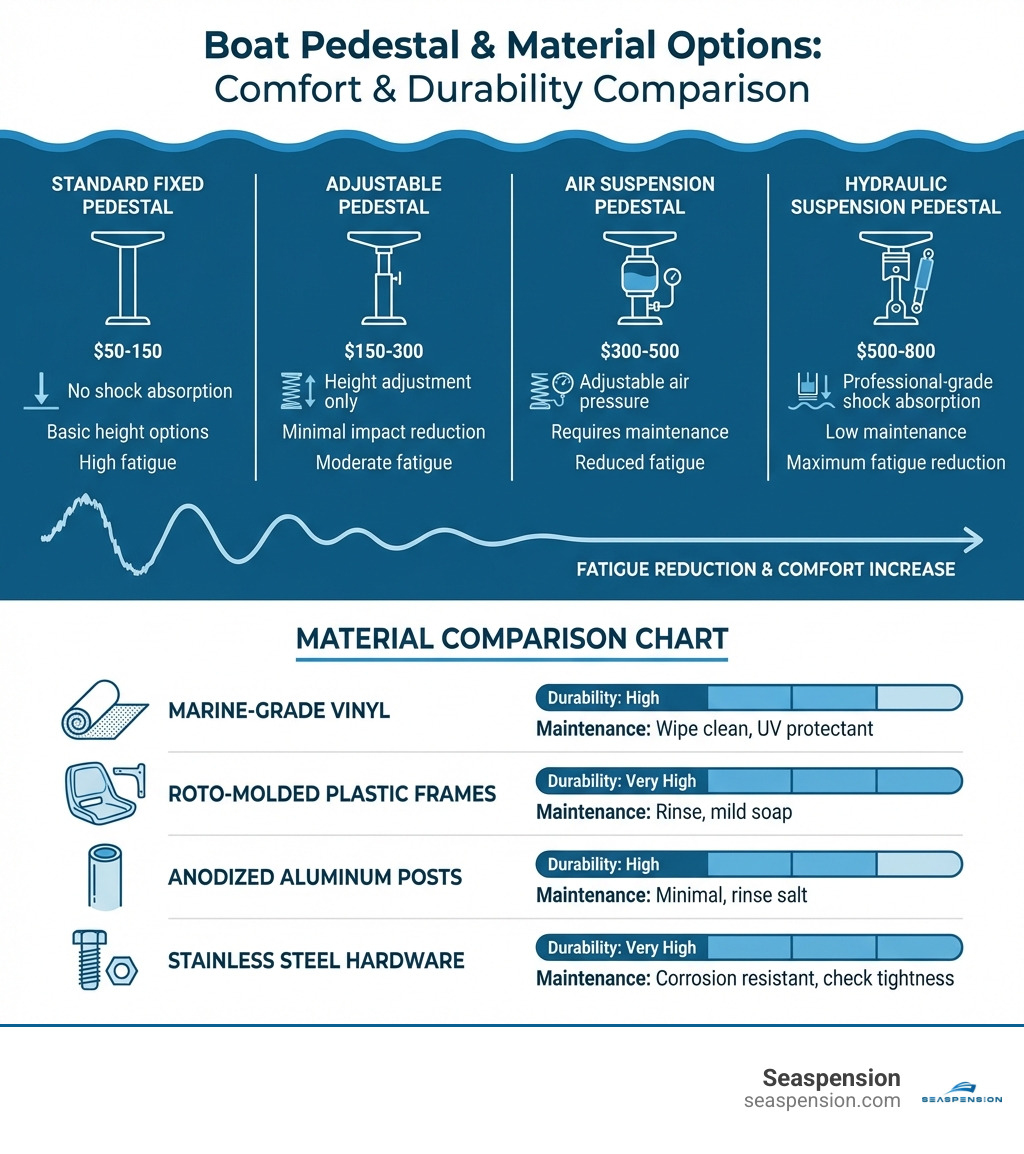
Standard Pedestal Types
When we look at boat seats and pedestals for sale, we typically encounter a few standard types of pedestals:
- Fixed-Height Pedestals: These pedestals offer a single, non-adjustable height. They are simple, sturdy, and generally the most economical option. They are suitable for applications where the seating position does not need to change.
- Adjustable-Height Pedestals: These allow the seat height to be raised or lowered, providing some flexibility for different operators or activities. Adjustment mechanisms can range from manual pins to gas-assisted springs for easier movement.
- Swivel Mechanisms: Most pedestals incorporate a swivel top, allowing the seat to rotate 360 degrees. This is essential for visibility, fishing, and ease of entry and exit. Some pedestals also include seat sliders, which allow the seat to move forward and backward.
- Materials: Standard pedestals are commonly constructed from anodized aluminum or stainless steel. Anodized aluminum offers excellent corrosion resistance and is lightweight, while stainless steel provides superior strength and durability, especially in harsh marine conditions. Our research shows that materials like Almag 35 aluminum are also used for pedestal bases.
While these standard pedestals provide the necessary support and some basic adjustability, they all share a common limitation: they are rigid. This means they transmit virtually all of the boat's motion and impact directly to the occupant.
Why Shock Absorption Matters
The real challenge in boating is not just sitting comfortably, but riding comfortably, especially in rough water. Simple springs and rigid posts, while common, only go so far. They might absorb minor vibrations, but they are largely ineffective against the significant, jarring impacts that occur when hitting waves or wakes. True shock mitigation requires a system specifically designed to absorb and dissipate these major impacts, protecting the occupant from the brunt of the forces.
We understand the science behind how these forces affect the body. When a boat encounters a wave, the impact generates kinetic energy. Without an effective shock-absorbing system, this energy is transferred directly to the boat operator and passengers, leading to spinal compression and overall body fatigue. This is why we focus on true shock absorption. The Science Behind Shock Absorption: Elevating Your Boating Experience with SeaSension digs deeper into this.
When comparing different approaches to shock mitigation, it's important to understand the differences between hydraulic and non-hydraulic systems:
- Hydraulic Dampening Principles: Hydraulic systems work by forcing fluid through an orifice, which creates resistance and dissipates kinetic energy as heat. This provides a controlled, smooth dampening action that effectively absorbs impacts without a "bouncy" or "springy" feel. The system can be tuned to respond differently to varying impact speeds and loads, offering consistent performance. This is critical for absorbing impacts and reducing the effects of traveling on a rough surface.
- How Hydraulic Systems Absorb Impacts: As the seat moves downward from an impact, the hydraulic cylinder compresses, and the fluid resists this compression. This resistance slows the downward motion, absorbing the shock. As the seat returns to its original position, the hydraulic dampening controls the rebound, preventing the occupant from being "thrown" upwards.
- The Limits of Non-Hydraulic Systems: Mechanical or air-based systems can offer some level of cushioning, but they often have limitations. They might not offer the same controlled dampening as hydraulics, potentially leading to a bouncier ride or less effective shock absorption in severe conditions. Spring-only systems, while simple, often lack the ability to control rebound, leading to an uncomfortable "pogo stick" effect. Without proper dampening, they might not effectively dissipate the energy, simply storing and releasing it, which can still be jarring. We've explored this in detail in our article, Hydraulic vs. Air Suspension for Boats: What Most Boaters Don't Know.
For us, the goal is to provide a smooth ride, absorbing the impacts effectively so your body doesn't have to.
How to Choose Quality Boat Seats and Pedestals for Sale
Choosing the right boat seats and pedestals for sale is an investment in your boating experience. It’s not just about initial cost, but about long-term comfort, durability, and safety. Here’s what we consider essential when making a selection.
When we advise boaters on selecting new seating, we emphasize these key factors:
- Build Quality: Inspect the construction. Look for solid, reinforced frames, robust stitching, and quality hardware. A well-built seat will feel substantial and show attention to detail in its finish. This is where durable materials like roto-molded plastic frames, marine-grade vinyl, and stainless steel hardware truly shine.
- Material Specifications: Ensure all materials are marine-grade. This means UV-treated vinyl that won't crack or fade quickly, mildew-resistant foam that won't absorb water and grow mold, and corrosion-resistant metals. Anodized aluminum posts, for example, offer excellent resistance to saltwater environments.
- ABYC Safety Standards: Always check if the seats and pedestals meet ABYC (American Boat and Yacht Council) standards. These standards ensure the products are designed and manufactured to specific safety and performance criteria, which is crucial for marine applications.
- Pedestal Diameter and Compatibility: Standard pedestal diameters are common, such as 2.875 inches, but always verify compatibility with your existing seat mount or the new seat you plan to purchase. Some pedestals also require specific base adapter options depending on the existing deck plate.
- Mounting Bolt Patterns: Many pedestals use an industry-standard six-bolt pattern for installation. Confirm that the new pedestal's bolt pattern matches your boat's existing deck mounting plate or that you're prepared to install a new plate if necessary.
Paying attention to these details ensures you're getting a product that will perform reliably and safely in real-world marine conditions.
Installation Tips for Boat Seats and Pedestals for Sale
Proper installation is just as important as choosing quality components. A poorly installed seat or pedestal can compromise safety and comfort.
- Securing the Base: The pedestal base must be securely fastened to the boat's deck. Use appropriate marine-grade fasteners (stainless steel) that are long enough to penetrate the deck material adequately.
- Importance of Backing Plates: For most installations, especially on fiberglass or thinner decks, a backing plate is crucial. This is a large, flat piece of material (often marine-grade plywood or aluminum) installed underneath the deck to distribute the load from the pedestal's mounting bolts. This prevents the bolts from pulling through the deck under stress, which can happen during rough conditions or heavy use.
- Sealing Hardware: Always use marine-grade sealant around the mounting holes and under the pedestal base to prevent water intrusion into the deck core. Water intrusion can lead to rot, delamination, and structural failure over time.
- Checking Deck Integrity: Before installing, thoroughly inspect the area of the deck where the pedestal will be mounted. Ensure it is solid, dry, and free from any signs of rot or damage. If the deck is compromised, repairs should be made before installation.
For detailed instructions, we offer resources like How to Install a Boat Seat Pedestal and specific guidance for our products, such as How to Install a SeaSension Shock Absorbing Pedestal.
Care, Warranty, and Price
Understanding these aspects helps us evaluate the long-term value of our purchase.
- Typical Price Ranges: The price for boat seats and pedestals for sale can vary significantly. Basic fixed pedestals might start around $50, while adjustable pedestals can range from $150 to $300. High-end, shock-absorbing pedestal systems, which offer superior comfort and protection, typically start from $300 and can exceed $800. Quality boat seats themselves can range from around $56 for simple fishing seats to over $380 for deluxe helm chairs.
- Warranty Coverage: Warranties vary by manufacturer and product type. We've seen warranties ranging from one year for some seat/pedestal packages to three years on pedestals and two years on frames and upholstery for higher-end options. Always check the specific warranty details for your purchase. We also provide a Warranty Registration for our products.
- Cleaning Marine Vinyl: Regular cleaning is essential to extend the life of your marine vinyl seats. Use mild soap and water, and avoid harsh chemicals or abrasive cleaners that can damage the UV coating. For mildew, specialized marine mildew removers are effective.
- Rinsing Hardware with Fresh Water: After each use, especially in saltwater, it's good practice to rinse all metal hardware on your seats and pedestals with fresh water. This helps remove salt residue, which is a primary cause of corrosion, even on stainless steel.
A Practical Solution for All-Day Comfort: Hydraulic Shock-Absorbing Pedestals
For those who regularly steer rough waters, experiencing constant impacts and the resulting fatigue, a standard seat and pedestal simply won't suffice. What's needed is a system designed to actively mitigate these forces. This is where a true hydraulic shock-absorbing pedestal becomes not just a comfort upgrade, but a practical necessity for safety and endurance.
Our Seaspension pedestals are built on a patented hydraulic system designed specifically to reduce impact and protect occupants from jolts. Unlike simple springs or air systems that might offer some cushioning, our hydraulic dampening provides a controlled, consistent absorption of kinetic energy. This means that when your boat hits a wave, the impact is absorbed by the pedestal, not by your body.
This patented hydraulic system offers a distinct advantage:
- Reduced Operator Fatigue: By absorbing the constant pounding, our pedestals significantly reduce the physical strain on your body. This translates directly to less fatigue, allowing you to stay focused and alert for longer periods on the water. This directly impacts safety, as a fatigued operator is a less attentive operator. We dig into this connection in SeaSension and Safety: Elevating Your Boating Experience by Reducing Fatigue and Improving Focus on the Water.
- Durability in Harsh Marine Environments: We design our pedestals with robust, marine-grade materials that can withstand the corrosive effects of saltwater and the constant exposure to sun and weather. This ensures long-term reliability in the demanding conditions found in places like Alaska, Florida, Washington, or anywhere else on the open ocean.
- Low-Maintenance Design: Our hydraulic systems are engineered for reliability and require minimal maintenance. This means less time spent on upkeep and more time enjoying your boat.
- Real-World Testimonials: The effectiveness of our pedestals isn't just theory; it's proven by boaters in real-world conditions. We consistently hear from operators who report a dramatic improvement in comfort, a reduction in back pain, and the ability to enjoy boating again after installing our systems. Many have told us they no longer need chiropractic appointments after installing our pedestals. Whether it's a commercial vessel in Pinellas Park, Florida, or a recreational boat in Homer, Alaska, the feedback is consistent: our pedestals make a noticeable difference. You can read more about these experiences in our Testimonials.
For us, it's about providing a solution that works, reliably and consistently, enabling you to do what you love on the water without the usual physical toll. This is why we believe in the value of our hydraulic shock-absorbing pedestals. You can learn more about our commitment to this by visiting Why Buy.
Conclusion: Invest in Better Days on the Water
When we consider boat seats and pedestals for sale, it's clear that the decision goes beyond simple aesthetics or basic functionality. It's an investment in your safety, comfort, and the longevity of your boating passion. The constant impacts of rough water are a reality of marine life, and ignoring them takes a toll on your body, leading to fatigue and discomfort.
Upgrading your boat’s seating to include a robust shock-absorbing pedestal is not a luxury; it's a practical choice for anyone who spends significant time on the water. By focusing on the shock-absorbing capabilities of the pedestal, you fundamentally improve your ride quality and extend your time on the water, regardless of conditions. This means more enjoyable days, less physical strain, and the ability to stay focused and alert.
For us, the goal is always to provide solutions that make your boating experience better, safer, and more comfortable. Investing in a quality shock-absorbing system is a long-term investment in your well-being and your passion for boating.
We encourage you to explore our range of solutions and see how a properly engineered hydraulic shock-absorbing pedestal can transform your time on the water.
View our range of boat suspension pedestals
Why Most Boat Seats Leave You Sore After a Day on the Water
When searching for boat seats and pedestals for sale, you'll find three main categories to consider:
Quick Shopping Guide:
- Boat Seats - Helm chairs, bucket seats, leaning posts, bench seating, and fold-down fishing seats typically range from $56 to $380+ depending on features and materials
- Standard Pedestals - Fixed-height and adjustable pedestals in aluminum or stainless steel run from $50 to $300
- Shock-Absorbing Pedestals - Suspension systems designed to reduce impact and fatigue, priced from $300 to $800+
Key factors when buying:
- Marine-grade materials (UV-treated vinyl, anodized aluminum, stainless steel)
- Mounting compatibility (standard 6-bolt pattern vs. proprietary)
- Height requirements and adjustability
- Weight capacity and rider comfort
Boating in real-world conditions means constant impacts and vibration. The hull transmits shock through the deck and seat, leading to fatigue in your back and joints. Many boat owners believe thicker cushions or swapping seat styles will solve the problem, but these only address surface comfortnot the root cause. The pedestal beneath your seat is the critical path for shock to reach your body, and most standard pedestals do nothing to absorb those forces.
The marine seating market continues to grow at approximately 4-5% annually, with shock-absorbing pedestals seeing particularly strong demand as boaters prioritize ergonomics and long-term physical comfort. Online sales channels now dominate the market, with replacement seats and upgraded pedestals representing a significant portion of purchases. Whether you're outfitting a fishing boat, pontoon, or commercial vessel, understanding the difference between basic mounting hardware and true shock mitigation technology will determine whether you finish the day energized or exhausted.
I'm Ian Milligan, owner of Seaspension, where we've specialized in hydraulic shock-absorbing boat seat pedestal systems since 2021, serving recreational and commercial operators who face rough water conditions regularly. Throughout my work with boat seats and pedestals for sale, I've seen how the right suspension system fundamentally changes the boating experience for operators dealing with fatigue and physical strain.
Boating is a unique activity where the environment actively works against your comfort and physical well-being. Every wave, every chop, every turn creates forces that travel directly through your boat's structure. These forces, often referred to as G-forces, impact your body.
When your boat hits a wave, the energy of that impact is transferred from the hull, through the deck, and directly up the rigid pedestal into your seat. From there, it's absorbed by your body, particularly your spine, knees, and hips. Over time, these repeated jolts accumulate, leading to muscle fatigue, joint pain, and even more serious issues like back problems. This is especially true for those of us who spend long hours on the water, whether for fishing, cruising, or commercial operations. Our bodies take a constant pounding, often without us realizing the full extent until we're back on shore. This constant impact is the "hidden force" that can turn an enjoyable day into a painful one.
Many boat owners try to solve this discomfort by simply adding thicker cushions or upgrading to a more plush seat. While a comfortable cushion can certainly help with surface pressure and provide some initial relief, it fundamentally misses the point. A thicker cushion might absorb a small amount of vibration, but it does little to mitigate the significant vertical impacts that cause real fatigue and injury. The core problem isn't the seat's padding; it's the rigid connection between the seat and the boat's deck. Until that connection can absorb and dissipate the impact energy, your body will continue to do the job, and you'll continue to feel the effects.
Types of Boat Seats and What Matters for Durability
When we look for boat seats and pedestals for sale, understanding the different types of seats and the materials they're built from is crucial for both comfort and longevity in the harsh marine environment.
Common Boat Seat Styles
The world of boat seats offers a variety of styles, each designed for specific uses and boat types:
- Helm Chairs: These are typically the most robust and comfortable seats on a boat, designed for the captain. They often feature armrests, high backs, and sometimes even reclining capabilities. They are built for long hours at the controls.
- Bucket Seats: Similar to car seats, bucket seats offer good lateral support, making them popular in faster boats or those that experience sharper turns. They often come with a folding bolster to allow standing while still being supported.
- Leaning Posts: Common on center console fishing boats, leaning posts allow the operator to stand or lean against them, offering support during rough conditions while maintaining an liftd view.
- Bench Seating: Found frequently on pontoon boats and in cockpits, bench seats offer seating for multiple passengers. They often incorporate storage underneath.
- Fold-Down Fishing Seats: These are simpler, often compact seats designed for fishing boats. They can be folded down when not in use to maximize deck space, and are typically mounted on a pedestal.
- Jump Seats: Often found in the stern of boats, these are small, often foldable or removable seats designed for occasional use or extra passengers.
For example, we see a wide range of seat types for pontoons, from classic and premium to luxury options. Fishing boats often use high-back folding seats, low-back options, or specialized lean pro seats for casting. Even offshore helm chairs come in standard and deluxe ladder-back versions. The choice depends heavily on the type of boating you do and the level of comfort and support you require.
Materials and Construction
The marine environment is unforgiving, so the materials and construction of your boat seats must be up to the task. When we evaluate boat seats and pedestals for sale, we prioritize durability.
- Marine-Grade Vinyl: This is the industry standard for upholstery due to its resistance to mildew, UV radiation, and general wear and tear. Premium-grade vinyl is essential to prevent cracking, fading, and deterioration from sun and salt exposure.
- UV-Resistant Thread: It's not just the vinyl that needs to withstand the sun; the stitching holding it all together must also be UV-resistant to prevent seams from solveing over time.
- High-Compression Foam: For comfort that lasts, high-compression foam padding is used. This type of foam resists compression and maintains its shape and support for longer, even with heavy use.
- Roto-Molded Plastic Frames: Many quality boat seats use roto-molded, high-impact plastic frames. This construction method creates a strong, one-piece frame that is resistant to rot, corrosion, and structural damage from impacts.
- Corrosion-Resistant Hardware: All fasteners, hinges, and other metal components should be made from stainless steel or anodized aluminum to prevent rust and corrosion, ensuring the seat remains functional and safe in a saltwater environment.
These material choices are not just about aesthetics; they are fundamental to the longevity and performance of your boat seats. Investing in quality materials means your seats will withstand heavy use and exposure to weather conditions for years to come.
The Pedestal: The Critical Link Between Boat and Body
The pedestal is far more than just a support for your seat; it's the primary conduit for forces between your boat's deck and your body. Choosing the right pedestal is as important as selecting a comfortable seat, especially when considering the long-term impact on your comfort and health.
Standard Pedestal Types
When we look at boat seats and pedestals for sale, we typically encounter a few standard types of pedestals:
- Fixed-Height Pedestals: These pedestals offer a single, non-adjustable height. They are simple, sturdy, and generally the most economical option. They are suitable for applications where the seating position does not need to change.
- Adjustable-Height Pedestals: These allow the seat height to be raised or lowered, providing some flexibility for different operators or activities. Adjustment mechanisms can range from manual pins to gas-assisted springs for easier movement.
- Swivel Mechanisms: Most pedestals incorporate a swivel top, allowing the seat to rotate 360 degrees. This is essential for visibility, fishing, and ease of entry and exit. Some pedestals also include seat sliders, which allow the seat to move forward and backward.
- Materials: Standard pedestals are commonly constructed from anodized aluminum or stainless steel. Anodized aluminum offers excellent corrosion resistance and is lightweight, while stainless steel provides superior strength and durability, especially in harsh marine conditions. Our research shows that materials like Almag 35 aluminum are also used for pedestal bases.
While these standard pedestals provide the necessary support and some basic adjustability, they all share a common limitation: they are rigid. This means they transmit virtually all of the boat's motion and impact directly to the occupant.
Why Shock Absorption Matters
The real challenge in boating is not just sitting comfortably, but riding comfortably, especially in rough water. Simple springs and rigid posts, while common, only go so far. They might absorb minor vibrations, but they are largely ineffective against the significant, jarring impacts that occur when hitting waves or wakes. True shock mitigation requires a system specifically designed to absorb and dissipate these major impacts, protecting the occupant from the brunt of the forces.
We understand the science behind how these forces affect the body. When a boat encounters a wave, the impact generates kinetic energy. Without an effective shock-absorbing system, this energy is transferred directly to the boat operator and passengers, leading to spinal compression and overall body fatigue. This is why we focus on true shock absorption. The Science Behind Shock Absorption: Elevating Your Boating Experience with SeaSension digs deeper into this.
When comparing different approaches to shock mitigation, it's important to understand the differences between hydraulic and non-hydraulic systems:
- Hydraulic Dampening Principles: Hydraulic systems work by forcing fluid through an orifice, which creates resistance and dissipates kinetic energy as heat. This provides a controlled, smooth dampening action that effectively absorbs impacts without a "bouncy" or "springy" feel. The system can be tuned to respond differently to varying impact speeds and loads, offering consistent performance. This is critical for absorbing impacts and reducing the effects of traveling on a rough surface.
- How Hydraulic Systems Absorb Impacts: As the seat moves downward from an impact, the hydraulic cylinder compresses, and the fluid resists this compression. This resistance slows the downward motion, absorbing the shock. As the seat returns to its original position, the hydraulic dampening controls the rebound, preventing the occupant from being "thrown" upwards.
- The Limits of Non-Hydraulic Systems: Mechanical or air-based systems can offer some level of cushioning, but they often have limitations. They might not offer the same controlled dampening as hydraulics, potentially leading to a bouncier ride or less effective shock absorption in severe conditions. Spring-only systems, while simple, often lack the ability to control rebound, leading to an uncomfortable "pogo stick" effect. Without proper dampening, they might not effectively dissipate the energy, simply storing and releasing it, which can still be jarring. We've explored this in detail in our article, Hydraulic vs. Air Suspension for Boats: What Most Boaters Don't Know.
For us, the goal is to provide a smooth ride, absorbing the impacts effectively so your body doesn't have to.
How to Choose Quality Boat Seats and Pedestals for Sale
Choosing the right boat seats and pedestals for sale is an investment in your boating experience. It’s not just about initial cost, but about long-term comfort, durability, and safety. Here’s what we consider essential when making a selection.
When we advise boaters on selecting new seating, we emphasize these key factors:
- Build Quality: Inspect the construction. Look for solid, reinforced frames, robust stitching, and quality hardware. A well-built seat will feel substantial and show attention to detail in its finish. This is where durable materials like roto-molded plastic frames, marine-grade vinyl, and stainless steel hardware truly shine.
- Material Specifications: Ensure all materials are marine-grade. This means UV-treated vinyl that won't crack or fade quickly, mildew-resistant foam that won't absorb water and grow mold, and corrosion-resistant metals. Anodized aluminum posts, for example, offer excellent resistance to saltwater environments.
- ABYC Safety Standards: Always check if the seats and pedestals meet ABYC (American Boat and Yacht Council) standards. These standards ensure the products are designed and manufactured to specific safety and performance criteria, which is crucial for marine applications.
- Pedestal Diameter and Compatibility: Standard pedestal diameters are common, such as 2.875 inches, but always verify compatibility with your existing seat mount or the new seat you plan to purchase. Some pedestals also require specific base adapter options depending on the existing deck plate.
- Mounting Bolt Patterns: Many pedestals use an industry-standard six-bolt pattern for installation. Confirm that the new pedestal's bolt pattern matches your boat's existing deck mounting plate or that you're prepared to install a new plate if necessary.
Paying attention to these details ensures you're getting a product that will perform reliably and safely in real-world marine conditions.
Installation Tips for Boat Seats and Pedestals for Sale
Proper installation is just as important as choosing quality components. A poorly installed seat or pedestal can compromise safety and comfort.
- Securing the Base: The pedestal base must be securely fastened to the boat's deck. Use appropriate marine-grade fasteners (stainless steel) that are long enough to penetrate the deck material adequately.
- Importance of Backing Plates: For most installations, especially on fiberglass or thinner decks, a backing plate is crucial. This is a large, flat piece of material (often marine-grade plywood or aluminum) installed underneath the deck to distribute the load from the pedestal's mounting bolts. This prevents the bolts from pulling through the deck under stress, which can happen during rough conditions or heavy use.
- Sealing Hardware: Always use marine-grade sealant around the mounting holes and under the pedestal base to prevent water intrusion into the deck core. Water intrusion can lead to rot, delamination, and structural failure over time.
- Checking Deck Integrity: Before installing, thoroughly inspect the area of the deck where the pedestal will be mounted. Ensure it is solid, dry, and free from any signs of rot or damage. If the deck is compromised, repairs should be made before installation.
For detailed instructions, we offer resources like How to Install a Boat Seat Pedestal and specific guidance for our products, such as How to Install a SeaSension Shock Absorbing Pedestal.
Care, Warranty, and Price
Understanding these aspects helps us evaluate the long-term value of our purchase.
- Typical Price Ranges: The price for boat seats and pedestals for sale can vary significantly. Basic fixed pedestals might start around $50, while adjustable pedestals can range from $150 to $300. High-end, shock-absorbing pedestal systems, which offer superior comfort and protection, typically start from $300 and can exceed $800. Quality boat seats themselves can range from around $56 for simple fishing seats to over $380 for deluxe helm chairs.
- Warranty Coverage: Warranties vary by manufacturer and product type. We've seen warranties ranging from one year for some seat/pedestal packages to three years on pedestals and two years on frames and upholstery for higher-end options. Always check the specific warranty details for your purchase. We also provide a Warranty Registration for our products.
- Cleaning Marine Vinyl: Regular cleaning is essential to extend the life of your marine vinyl seats. Use mild soap and water, and avoid harsh chemicals or abrasive cleaners that can damage the UV coating. For mildew, specialized marine mildew removers are effective.
- Rinsing Hardware with Fresh Water: After each use, especially in saltwater, it's good practice to rinse all metal hardware on your seats and pedestals with fresh water. This helps remove salt residue, which is a primary cause of corrosion, even on stainless steel.
A Practical Solution for All-Day Comfort: Hydraulic Shock-Absorbing Pedestals
For those who regularly steer rough waters, experiencing constant impacts and the resulting fatigue, a standard seat and pedestal simply won't suffice. What's needed is a system designed to actively mitigate these forces. This is where a true hydraulic shock-absorbing pedestal becomes not just a comfort upgrade, but a practical necessity for safety and endurance.
Our Seaspension pedestals are built on a patented hydraulic system designed specifically to reduce impact and protect occupants from jolts. Unlike simple springs or air systems that might offer some cushioning, our hydraulic dampening provides a controlled, consistent absorption of kinetic energy. This means that when your boat hits a wave, the impact is absorbed by the pedestal, not by your body.
This patented hydraulic system offers a distinct advantage:
- Reduced Operator Fatigue: By absorbing the constant pounding, our pedestals significantly reduce the physical strain on your body. This translates directly to less fatigue, allowing you to stay focused and alert for longer periods on the water. This directly impacts safety, as a fatigued operator is a less attentive operator. We dig into this connection in SeaSension and Safety: Elevating Your Boating Experience by Reducing Fatigue and Improving Focus on the Water.
- Durability in Harsh Marine Environments: We design our pedestals with robust, marine-grade materials that can withstand the corrosive effects of saltwater and the constant exposure to sun and weather. This ensures long-term reliability in the demanding conditions found in places like Alaska, Florida, Washington, or anywhere else on the open ocean.
- Low-Maintenance Design: Our hydraulic systems are engineered for reliability and require minimal maintenance. This means less time spent on upkeep and more time enjoying your boat.
- Real-World Testimonials: The effectiveness of our pedestals isn't just theory; it's proven by boaters in real-world conditions. We consistently hear from operators who report a dramatic improvement in comfort, a reduction in back pain, and the ability to enjoy boating again after installing our systems. Many have told us they no longer need chiropractic appointments after installing our pedestals. Whether it's a commercial vessel in Pinellas Park, Florida, or a recreational boat in Homer, Alaska, the feedback is consistent: our pedestals make a noticeable difference. You can read more about these experiences in our Testimonials.
For us, it's about providing a solution that works, reliably and consistently, enabling you to do what you love on the water without the usual physical toll. This is why we believe in the value of our hydraulic shock-absorbing pedestals. You can learn more about our commitment to this by visiting Why Buy.
Conclusion: Invest in Better Days on the Water
When we consider boat seats and pedestals for sale, it's clear that the decision goes beyond simple aesthetics or basic functionality. It's an investment in your safety, comfort, and the longevity of your boating passion. The constant impacts of rough water are a reality of marine life, and ignoring them takes a toll on your body, leading to fatigue and discomfort.
Upgrading your boat’s seating to include a robust shock-absorbing pedestal is not a luxury; it's a practical choice for anyone who spends significant time on the water. By focusing on the shock-absorbing capabilities of the pedestal, you fundamentally improve your ride quality and extend your time on the water, regardless of conditions. This means more enjoyable days, less physical strain, and the ability to stay focused and alert.
For us, the goal is always to provide solutions that make your boating experience better, safer, and more comfortable. Investing in a quality shock-absorbing system is a long-term investment in your well-being and your passion for boating.
We encourage you to explore our range of solutions and see how a properly engineered hydraulic shock-absorbing pedestal can transform your time on the water.
View our range of boat suspension pedestals


