A folding footrest for boat installations solves a simple but serious problem: leg fatigue from hours at the helm. Here's what to look for when choosing one:
Key specs: Most extend 6–8.5 inches when deployed, with widths from 15–36 inches depending on application.
Standing or sitting at the helm without foot support leads to real problems. Your legs dangle. Blood pools. Your lower back compensates. After a few hours in rough water, you're exhausted—not from the conditions, but from fighting your own posture.
The issue gets worse when wave impacts and vibration add up over time. Without a stable place to brace your feet, every shock travels straight through your legs and spine. This isn't about comfort. It's about fatigue that affects your reaction time, decision-making, and safety.
Many boaters try foam cushions, portable steps, or makeshift platforms. These solutions slide, corrode, or take up space when you don't need them. A properly installed folding footrest addresses the root cause: it gives you stable support when you need it and disappears when you don't.
I'm Ian Milligan, owner of SeaSpension, where we specialize in shock-absorbing pedestal systems and marine ergonomics. Over the years, I've seen how proper foot support—especially when paired with suspension technology—reduces fatigue and keeps operators safer in rough conditions, which is why understanding the folding footrest for boat market matters for anyone serious about long-term comfort on the water.
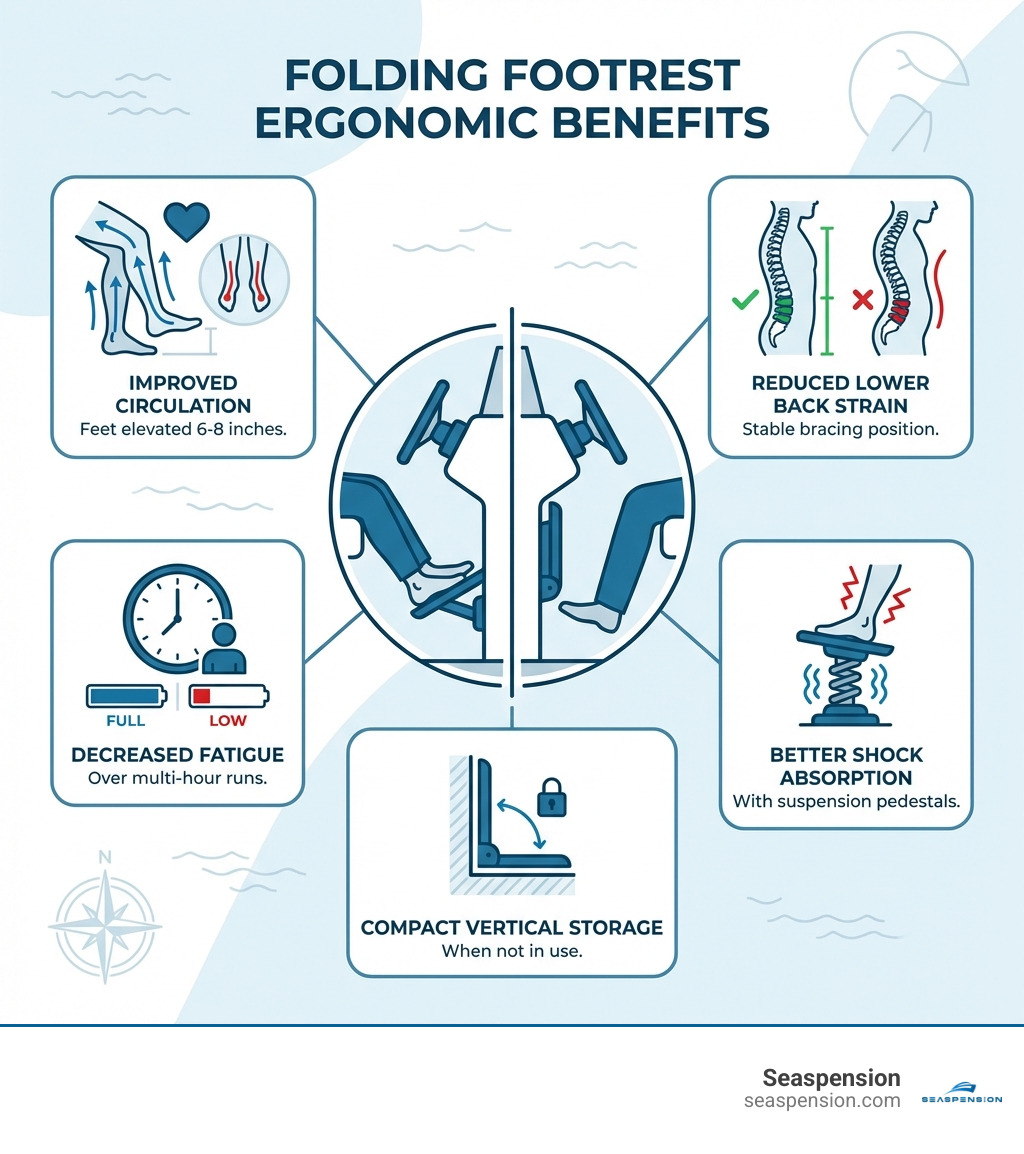
When you are operating a boat, your body is constantly fighting to maintain equilibrium. Unlike sitting in a chair at home, a boat is a moving platform influenced by wind, current, and wave chop.

If you are seated in a high helm chair or leaning against a bolster without a footrest, your legs often dangle or rest at an awkward angle. This creates a "heavy leg" sensation caused by restricted blood circulation. Gravity pulls blood toward your feet, and without the muscular "pump" action that comes from having your feet firmly planted, you experience swelling and discomfort.
In a standing position, the lack of a dedicated footrest forces you to lock your knees to brace against the boat's movement. This transfers every vibration and wave impact directly into your joints and lower back. Over a long run—say, a two-hour trek to the fishing grounds—this constant micro-adjustment leads to significant physical exhaustion. By the time you reach your destination, your legs feel like lead, and your back is tight.
We often see boaters try to solve this problem with "good enough" fixes. A common one is using a cooler or a tackle box as a makeshift step. While this provides a temporary place to put your feet, it is inherently dangerous. These items aren't secured; in a sudden swell or a sharp turn, the "footrest" slides away, potentially causing the operator to lose balance at a critical moment.
Another misconception is that thick seat cushions can replace proper ergonomics. While a soft seat feels good for the first ten minutes, it doesn't fix the skeletal alignment issues caused by dangling legs.
Some owners simply ignore the need for a footrest, thinking it’s a luxury. However, in professional environments—like the US Coast Guard, which has nearly 2000 units with integrated folding footrests in active service—proper foot support is recognized as a safety requirement. It keeps the operator locked into the seat, providing the stability needed to maintain control of the vessel in high-seas.
When selecting a folding footrest for boat use, the primary goal is a balance between stability and space efficiency. On most center consoles or walk-arounds, deck space is at a premium. You need a solution that is there when you’re driving but gone when you’re fishing or moving around the cockpit.
Key features to prioritize include:
One size rarely fits all in the marine world. Whether you are mounting to a flat bulkhead or a leaning post frame, precision is required.
For custom aluminum footrests, length is typically measured "center-to-center." This refers to the distance between the centers of the two vertical pipes or mounting points. If you are ordering a Custom Folding Footrest, you must also know the outer diameter (OD) of your piping.
In the marine industry, "nominal" pipe sizes are different from actual measurements. For example, a standard 1-1/4" aluminum pipe actually has a 1.66" outer diameter. Getting this measurement wrong means your clamp-on couplers won't fit, leading to a frustrating installation process.
The salt air is a brutal environment for hardware. Your material choice dictates how much time you'll spend cleaning versus boating.
How you mount your footrest is just as important as the footrest itself. A footrest that pulls out of the fiberglass under load is a safety hazard.
Surface Mount vs. Through-Bolting If you are mounting to a thin fiberglass console, simple screws won't hold. We always recommend through-bolting with a washer and locknut. This distributes the load across a larger surface area. For heavy-duty applications, using a backing plate—a secondary piece of metal or Starboard on the inside of the console—is the best way to ensure the fiberglass doesn't flex or crack.
Clamp-On vs. Weld-On For boaters with an existing leaning post, a Marine Folding Foot Rest Pipe Mount is a great choice. These use split couplers that clamp around your existing pipework. It requires no drilling into the boat and can be adjusted for height easily. Weld-on versions are more permanent and usually seen on new custom builds.
Fastener Selection Always use 316 stainless steel fasteners. Using zinc-plated or lower-grade steel will result in rust streaks down your gelcoat within weeks. Most marine footrests require 1/4" or 5/16" fasteners depending on the size of the unit.
A footrest is a piece of safety equipment. When the boat hits a wave, your feet apply significant downward force to that platform.
Anti-Slip Surfaces The marine environment is wet and often slippery. A smooth metal bar is a recipe for a slipped foot and a twisted ankle. Look for footrests with integrated anti-skid surfaces, such as traction-grooved treads or Self Stowing Folding Footrests made with King Starboard. These provide grip even when your boots are covered in fish slime or salt spray.
Load-Bearing Hinges The hinge is the weakest point of any folding hardware. High-quality marine footrests use heavy-duty aluminum extrusions or cast stainless steel hinges designed to support the full weight of an adult bracing against a wave. Avoid "light duty" hardware that isn't specifically rated for marine seating applications.
This is where ergonomics meets engineering. At Seaspension, we focus on shock mitigation. While our pedestals absorb the vertical energy of a wave, a footrest provides the necessary bracing to keep your body in the "neutral" position where the suspension can do its job best.
When you use a Springfield Boat Seat Footrest in conjunction with a shock-absorbing pedestal, you are creating a complete "suspension envelope." Your feet move with the seat, rather than being jarred by the floor while your body stays still. This synchronization is what professional operators—like those in the military and Coast Guard—rely on to stay effective during 10-hour shifts in heavy seas.
By elevating your feet, you also allow the pedestal footrest to help distribute your weight more evenly across the seat base, further reducing pressure points on your legs and lower back.
To get the right fit, measure the overall width of the area where you want to mount it. If you're mounting to pipes, measure "center-to-center" (from the middle of one pipe to the middle of the other). For a Custom Folding Footrest, also specify the extension—usually 8.5 inches—to ensure you have enough room for your feet without blocking the deck.
316 stainless steel is the most resistant to "tea staining" and corrosion. However, anodized aluminum is a very close second and is often preferred for larger footrests because it is lighter. For the step surface, UV-stabilized polymers like King Starboard are ideal because they require zero maintenance and provide excellent grip.
Yes. You can use clamp-on pipe couplers that match the diameter of your leaning post (common sizes are 1.32", 1.66", or 1.90" OD). Alternatively, if you have a flat vertical surface on your console, a surface-mount folding footrest can be bolted on directly.
Investing in a folding footrest for boat use is one of the most cost-effective ways to improve your experience on the water. It’s a small addition that pays huge dividends in reduced fatigue, better circulation, and increased safety. Whether you choose a Stainless Steel Folding Footrest for its classic look or a custom-fabricated aluminum model for its perfect fit, the goal remains the same: stability and comfort.
At Seaspension, we understand that every component of your helm station contributes to your physical well-being. Our shock-absorbing pedestals work in harmony with high-quality footrests to protect you from the physical toll of wave impacts.
If you're ready to stop "fighting the boat" and start enjoying the ride, we invite you to explore our Product Category Pedestal Footrest options.
Learn how Seaspension footrests and mounting plates for boat seats can transform your time on the water into a more comfortable, safer experience. For more technical insights on boat ergonomics, check out our guide on anchoring your comfort with pedestals and bases.
A folding footrest for boat installations solves a simple but serious problem: leg fatigue from hours at the helm. Here's what to look for when choosing one:
Key specs: Most extend 6–8.5 inches when deployed, with widths from 15–36 inches depending on application.
Standing or sitting at the helm without foot support leads to real problems. Your legs dangle. Blood pools. Your lower back compensates. After a few hours in rough water, you're exhausted—not from the conditions, but from fighting your own posture.
The issue gets worse when wave impacts and vibration add up over time. Without a stable place to brace your feet, every shock travels straight through your legs and spine. This isn't about comfort. It's about fatigue that affects your reaction time, decision-making, and safety.
Many boaters try foam cushions, portable steps, or makeshift platforms. These solutions slide, corrode, or take up space when you don't need them. A properly installed folding footrest addresses the root cause: it gives you stable support when you need it and disappears when you don't.
I'm Ian Milligan, owner of SeaSpension, where we specialize in shock-absorbing pedestal systems and marine ergonomics. Over the years, I've seen how proper foot support—especially when paired with suspension technology—reduces fatigue and keeps operators safer in rough conditions, which is why understanding the folding footrest for boat market matters for anyone serious about long-term comfort on the water.
When you are operating a boat, your body is constantly fighting to maintain equilibrium. Unlike sitting in a chair at home, a boat is a moving platform influenced by wind, current, and wave chop.
If you are seated in a high helm chair or leaning against a bolster without a footrest, your legs often dangle or rest at an awkward angle. This creates a "heavy leg" sensation caused by restricted blood circulation. Gravity pulls blood toward your feet, and without the muscular "pump" action that comes from having your feet firmly planted, you experience swelling and discomfort.
In a standing position, the lack of a dedicated footrest forces you to lock your knees to brace against the boat's movement. This transfers every vibration and wave impact directly into your joints and lower back. Over a long run—say, a two-hour trek to the fishing grounds—this constant micro-adjustment leads to significant physical exhaustion. By the time you reach your destination, your legs feel like lead, and your back is tight.
We often see boaters try to solve this problem with "good enough" fixes. A common one is using a cooler or a tackle box as a makeshift step. While this provides a temporary place to put your feet, it is inherently dangerous. These items aren't secured; in a sudden swell or a sharp turn, the "footrest" slides away, potentially causing the operator to lose balance at a critical moment.
Another misconception is that thick seat cushions can replace proper ergonomics. While a soft seat feels good for the first ten minutes, it doesn't fix the skeletal alignment issues caused by dangling legs.
Some owners simply ignore the need for a footrest, thinking it’s a luxury. However, in professional environments—like the US Coast Guard, which has nearly 2000 units with integrated folding footrests in active service—proper foot support is recognized as a safety requirement. It keeps the operator locked into the seat, providing the stability needed to maintain control of the vessel in high-seas.
When selecting a folding footrest for boat use, the primary goal is a balance between stability and space efficiency. On most center consoles or walk-arounds, deck space is at a premium. You need a solution that is there when you’re driving but gone when you’re fishing or moving around the cockpit.
Key features to prioritize include:
One size rarely fits all in the marine world. Whether you are mounting to a flat bulkhead or a leaning post frame, precision is required.
For custom aluminum footrests, length is typically measured "center-to-center." This refers to the distance between the centers of the two vertical pipes or mounting points. If you are ordering a Custom Folding Footrest, you must also know the outer diameter (OD) of your piping.
In the marine industry, "nominal" pipe sizes are different from actual measurements. For example, a standard 1-1/4" aluminum pipe actually has a 1.66" outer diameter. Getting this measurement wrong means your clamp-on couplers won't fit, leading to a frustrating installation process.
The salt air is a brutal environment for hardware. Your material choice dictates how much time you'll spend cleaning versus boating.
How you mount your footrest is just as important as the footrest itself. A footrest that pulls out of the fiberglass under load is a safety hazard.
Surface Mount vs. Through-Bolting If you are mounting to a thin fiberglass console, simple screws won't hold. We always recommend through-bolting with a washer and locknut. This distributes the load across a larger surface area. For heavy-duty applications, using a backing plate—a secondary piece of metal or Starboard on the inside of the console—is the best way to ensure the fiberglass doesn't flex or crack.
Clamp-On vs. Weld-On For boaters with an existing leaning post, a Marine Folding Foot Rest Pipe Mount is a great choice. These use split couplers that clamp around your existing pipework. It requires no drilling into the boat and can be adjusted for height easily. Weld-on versions are more permanent and usually seen on new custom builds.
Fastener Selection Always use 316 stainless steel fasteners. Using zinc-plated or lower-grade steel will result in rust streaks down your gelcoat within weeks. Most marine footrests require 1/4" or 5/16" fasteners depending on the size of the unit.
A footrest is a piece of safety equipment. When the boat hits a wave, your feet apply significant downward force to that platform.
Anti-Slip Surfaces The marine environment is wet and often slippery. A smooth metal bar is a recipe for a slipped foot and a twisted ankle. Look for footrests with integrated anti-skid surfaces, such as traction-grooved treads or Self Stowing Folding Footrests made with King Starboard. These provide grip even when your boots are covered in fish slime or salt spray.
Load-Bearing Hinges The hinge is the weakest point of any folding hardware. High-quality marine footrests use heavy-duty aluminum extrusions or cast stainless steel hinges designed to support the full weight of an adult bracing against a wave. Avoid "light duty" hardware that isn't specifically rated for marine seating applications.
This is where ergonomics meets engineering. At Seaspension, we focus on shock mitigation. While our pedestals absorb the vertical energy of a wave, a footrest provides the necessary bracing to keep your body in the "neutral" position where the suspension can do its job best.
When you use a Springfield Boat Seat Footrest in conjunction with a shock-absorbing pedestal, you are creating a complete "suspension envelope." Your feet move with the seat, rather than being jarred by the floor while your body stays still. This synchronization is what professional operators—like those in the military and Coast Guard—rely on to stay effective during 10-hour shifts in heavy seas.
By elevating your feet, you also allow the pedestal footrest to help distribute your weight more evenly across the seat base, further reducing pressure points on your legs and lower back.
To get the right fit, measure the overall width of the area where you want to mount it. If you're mounting to pipes, measure "center-to-center" (from the middle of one pipe to the middle of the other). For a Custom Folding Footrest, also specify the extension—usually 8.5 inches—to ensure you have enough room for your feet without blocking the deck.
316 stainless steel is the most resistant to "tea staining" and corrosion. However, anodized aluminum is a very close second and is often preferred for larger footrests because it is lighter. For the step surface, UV-stabilized polymers like King Starboard are ideal because they require zero maintenance and provide excellent grip.
Yes. You can use clamp-on pipe couplers that match the diameter of your leaning post (common sizes are 1.32", 1.66", or 1.90" OD). Alternatively, if you have a flat vertical surface on your console, a surface-mount folding footrest can be bolted on directly.
Investing in a folding footrest for boat use is one of the most cost-effective ways to improve your experience on the water. It’s a small addition that pays huge dividends in reduced fatigue, better circulation, and increased safety. Whether you choose a Stainless Steel Folding Footrest for its classic look or a custom-fabricated aluminum model for its perfect fit, the goal remains the same: stability and comfort.
At Seaspension, we understand that every component of your helm station contributes to your physical well-being. Our shock-absorbing pedestals work in harmony with high-quality footrests to protect you from the physical toll of wave impacts.
If you're ready to stop "fighting the boat" and start enjoying the ride, we invite you to explore our Product Category Pedestal Footrest options.
Learn how Seaspension footrests and mounting plates for boat seats can transform your time on the water into a more comfortable, safer experience. For more technical insights on boat ergonomics, check out our guide on anchoring your comfort with pedestals and bases.


