Ask a captain who has been running offshore for ten or more years to describe their relationship with lower back pain and most of them will pause before answering. Not because the question is strange — because the answer is so assumed, so built into the fabric of what offshore running costs, that they have never thought to question it. The back hurts after a long offshore day. That is part of the deal.
It is not part of the deal. It is the consequence of a rigid seat mount, and it ends with a Seaspension system under the helm seat. Here is why offshore captains who find this product do not go back to a fixed mount.
Offshore captains choose Seaspension because it solves the specific physical problem that offshore running creates — the cumulative spinal load from repeated hull-to-wave impact at planning speed — without requiring them to replace the seat, modify the console, or call a yard. The system installs on what they already have, performs in the conditions they actually run, and delivers an outcome that compounds across every trip in the season.
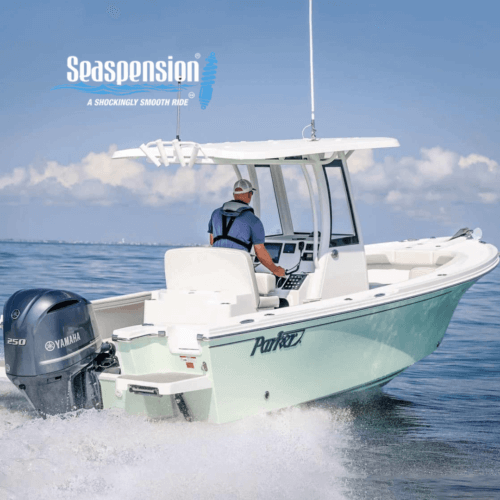
Offshore running is physically demanding. Every captain knows this. What most captains have not examined is how much of that physical demand is the sea state — the actual, unavoidable condition of being offshore — and how much is the equipment.
A planing hull running at 25 to 35 knots in open water is contacting wave faces and transmitting vertical impact load through the deck, through whatever is mounted to the deck, and into the body of the person sitting on it. On a fixed seat, that load goes straight to the operator — every impact, from the first mile to the last, absorbed by the lumbar spine and the surrounding musculature.
Over a three-hour run, that accumulation is noticeable. Over a six-hour offshore day — departure at 5am, run to the grounds, fish all morning, run back in afternoon chop — it is significant. Over a season of offshore running, it is a real cost to the body. The captains who have been doing it for fifteen years know exactly what we are describing, because they are already managing it.
The fix is not conditioning, pain management, or accepting it as the price of offshore access. The fix is a suspension system between the seat and the hull that absorbs the load instead of passing it through the operator.
The Seaspension system sits between the seat and its mounting point. When the hull contacts a wave face and generates vertical load, the suspension compresses progressively — absorbing the energy of the impact and releasing it in a controlled rebound, rather than transmitting it through the mounting hardware into the seat and the operator.
The key word is progressive. A basic spring pedestal compresses at a linear rate — the same resistance throughout its travel. A properly engineered offshore suspension system starts softer and becomes firmer as travel increases, which means it handles light chop without feeling stiff while still catching the larger impacts before they transmit to the operator. That progressive response is what makes the system feel right across varied sea states rather than only at a specific wave height.
The preload adjustment calibrates the system for the operator's specific weight. A 170lb captain and a 210lb captain sitting on the same suspension with the same preload setting are on effectively different suspension setups. Seaspension accounts for this — the preload is set for the individual, and the documentation walks through the adjustment specifically. It takes most captains one run to dial it in.
The marine market is full of products that market as suspension but engineer as vibration dampers. There is a practical difference. Vibration damping addresses the high-frequency, low-amplitude oscillation of an engine at idle or a hull skimming calm water. Offshore wave loads are lower-frequency, higher-amplitude impacts — the result of a hull hitting a wave face at planning speed, generating a sharp, significant vertical force.
Seaspension's engineering starts from the offshore load case. The suspension travel, the spring rate, and the preload range are specified for the forces generated by a 25-to-35-knot center console or sportfisher running in real offshore conditions — not for the vibration profile that shows up in a marine vibration study at a boat show.
The hardware reflects the same philosophy. Stainless steel and marine-grade alloy are specified throughout because the system lives permanently on a saltwater boat. Powder-coated carbon steel — which appears throughout the discount marine market — is not adequate for that environment, regardless of how it is marketed. The hardware cost difference between stainless and carbon steel is real. So is the service life difference.
Captains who install Seaspension and run a full offshore season on it consistently describe the same phenomenon: they stop noticing the suspension working and start noticing when they get on a boat without it.
That is the goal. The suspension system should not be something you are aware of on every wave face — it should be the baseline that makes running feel normal, so that returning to a fixed mount is what feels abnormal. When the system is dialed in correctly, the ride is not 'soft' or 'floating' — it is the impact load that is gone, while the feel of the boat, the feedback through the seat, and the operator's sense of the hull remains intact.
The practical outcomes that captains report over a full season:
Run farther. Come back in better shape. Do it all season. seaspension.com/products | seaspension.com/solutions/
The honest answer is that it depends on how often you run and in what conditions. A captain making three leisure trips per summer in protected flat water will not feel a $600-$800 return on that investment. A charter captain running five days a week offshore from May through October absolutely will — in reduced physical wear, in fewer shortened trips, and in the longevity of the career the system is protecting.
The calculation also changes when you factor service life. A Seaspension system built from marine-grade hardware and maintained with basic periodic inspection is not on a one-or-two season replacement cycle. The budget alternatives in the category are. A system that costs more upfront and runs for five-plus seasons has a per-season cost that a $100 replacement cycle cannot match.
The break-even question to ask yourself: how many offshore days per season would it take for the physical difference to be worth the price? For most regular offshore captains, the answer is fewer trips than they expect.
Seaspension is built for captains who run offshore regularly, run in conditions that work the body, and want the physical cost of that running to go down. It is not built for every boater, and this document is not going to pretend otherwise.
If your running is primarily flat, calm, and protected — lakes, protected bays, harbors, light inshore duty — the problem Seaspension solves is not the problem dominating your time on the water. The product will provide some benefit in light conditions, but the return on investment is steeper to justify.
If you run offshore — even occasionally, even a handful of times per season — and you have felt the physical toll of a long run back, Seaspension is worth the evaluation. The install is easy enough that the cost of trying it is low. The cost of the fixed seat status quo, measured in how your back feels the morning after a full offshore day, is not.
The product line is at seaspension.com/products. You need two things before ordering: your approximate operator weight and your current seat mounting configuration. Standard marine pedestal and deck plate setups are covered. Non-standard configurations should be confirmed before ordering — contact the team through the site with your mount details and they will confirm fit.
For the engineering behind the suspension design and detailed installation documentation, seaspension.com/technology has both. The install documentation is thorough enough that most captains complete the installation the same day the product arrives.
Will the suspension change how the boat feels to drive?
It changes how the boat feels to your body — specifically, it removes the impact load from the experience without removing the feel of the hull. Captains describe the result as the boat feeling more 'settled' in chop, not because the boat is performing differently, but because the jarring component of the experience is absorbed by the suspension rather than the operator's spine. Lateral feedback and helm feel remain intact.
I run a center console at relatively high speed — will the suspension keep up with the impact frequency at speed?
Yes. Seaspension is engineered specifically for the impact frequency and load magnitude of a planing hull at speed. Low-frequency offshore swell and higher-frequency inshore chop are both within the design envelope. The progressive suspension response is what allows it to handle both without bottoming out in heavy chop or feeling stiff in mild conditions.
What if I'm a heavier captain — 220, 230 pounds?
Heavier operators should check the weight range spec on the specific product before ordering. If your weight is at the upper boundary of the standard spec, contact Seaspension before purchasing — describe your weight and mounting setup and they will confirm the right product configuration. Running at the edge of the weight range without adjustment room produces a stiffer feel than the system is designed for.
Can I install this myself, or does it need to go to the yard?
It is a dock DIY install. The system mounts between seat and pedestal or deck plate with basic hand tools. Most captains complete the installation in under an hour on a standard configuration. Detailed installation and preload adjustment documentation is included with every order. There is no reason to take this to a yard.
What happens if the suspension system needs service or replacement parts?
Service information, component availability, and warranty terms are on the product page and in the documentation included with the order. For specific service questions outside the documentation, contact the team through the site.
The offshore captains who find Seaspension don't go back to a fixed mount. seaspension.com/products · seaspension.com/solutions
Ask a captain who has been running offshore for ten or more years to describe their relationship with lower back pain and most of them will pause before answering. Not because the question is strange — because the answer is so assumed, so built into the fabric of what offshore running costs, that they have never thought to question it. The back hurts after a long offshore day. That is part of the deal.
It is not part of the deal. It is the consequence of a rigid seat mount, and it ends with a Seaspension system under the helm seat. Here is why offshore captains who find this product do not go back to a fixed mount.
Offshore captains choose Seaspension because it solves the specific physical problem that offshore running creates — the cumulative spinal load from repeated hull-to-wave impact at planning speed — without requiring them to replace the seat, modify the console, or call a yard. The system installs on what they already have, performs in the conditions they actually run, and delivers an outcome that compounds across every trip in the season.
Offshore running is physically demanding. Every captain knows this. What most captains have not examined is how much of that physical demand is the sea state — the actual, unavoidable condition of being offshore — and how much is the equipment.
A planing hull running at 25 to 35 knots in open water is contacting wave faces and transmitting vertical impact load through the deck, through whatever is mounted to the deck, and into the body of the person sitting on it. On a fixed seat, that load goes straight to the operator — every impact, from the first mile to the last, absorbed by the lumbar spine and the surrounding musculature.
Over a three-hour run, that accumulation is noticeable. Over a six-hour offshore day — departure at 5am, run to the grounds, fish all morning, run back in afternoon chop — it is significant. Over a season of offshore running, it is a real cost to the body. The captains who have been doing it for fifteen years know exactly what we are describing, because they are already managing it.
The fix is not conditioning, pain management, or accepting it as the price of offshore access. The fix is a suspension system between the seat and the hull that absorbs the load instead of passing it through the operator.
The Seaspension system sits between the seat and its mounting point. When the hull contacts a wave face and generates vertical load, the suspension compresses progressively — absorbing the energy of the impact and releasing it in a controlled rebound, rather than transmitting it through the mounting hardware into the seat and the operator.
The key word is progressive. A basic spring pedestal compresses at a linear rate — the same resistance throughout its travel. A properly engineered offshore suspension system starts softer and becomes firmer as travel increases, which means it handles light chop without feeling stiff while still catching the larger impacts before they transmit to the operator. That progressive response is what makes the system feel right across varied sea states rather than only at a specific wave height.
The preload adjustment calibrates the system for the operator's specific weight. A 170lb captain and a 210lb captain sitting on the same suspension with the same preload setting are on effectively different suspension setups. Seaspension accounts for this — the preload is set for the individual, and the documentation walks through the adjustment specifically. It takes most captains one run to dial it in.
The marine market is full of products that market as suspension but engineer as vibration dampers. There is a practical difference. Vibration damping addresses the high-frequency, low-amplitude oscillation of an engine at idle or a hull skimming calm water. Offshore wave loads are lower-frequency, higher-amplitude impacts — the result of a hull hitting a wave face at planning speed, generating a sharp, significant vertical force.
Seaspension's engineering starts from the offshore load case. The suspension travel, the spring rate, and the preload range are specified for the forces generated by a 25-to-35-knot center console or sportfisher running in real offshore conditions — not for the vibration profile that shows up in a marine vibration study at a boat show.
The hardware reflects the same philosophy. Stainless steel and marine-grade alloy are specified throughout because the system lives permanently on a saltwater boat. Powder-coated carbon steel — which appears throughout the discount marine market — is not adequate for that environment, regardless of how it is marketed. The hardware cost difference between stainless and carbon steel is real. So is the service life difference.
Captains who install Seaspension and run a full offshore season on it consistently describe the same phenomenon: they stop noticing the suspension working and start noticing when they get on a boat without it.
That is the goal. The suspension system should not be something you are aware of on every wave face — it should be the baseline that makes running feel normal, so that returning to a fixed mount is what feels abnormal. When the system is dialed in correctly, the ride is not 'soft' or 'floating' — it is the impact load that is gone, while the feel of the boat, the feedback through the seat, and the operator's sense of the hull remains intact.
The practical outcomes that captains report over a full season:
Run farther. Come back in better shape. Do it all season. seaspension.com/products | seaspension.com/solutions/
The honest answer is that it depends on how often you run and in what conditions. A captain making three leisure trips per summer in protected flat water will not feel a $600-$800 return on that investment. A charter captain running five days a week offshore from May through October absolutely will — in reduced physical wear, in fewer shortened trips, and in the longevity of the career the system is protecting.
The calculation also changes when you factor service life. A Seaspension system built from marine-grade hardware and maintained with basic periodic inspection is not on a one-or-two season replacement cycle. The budget alternatives in the category are. A system that costs more upfront and runs for five-plus seasons has a per-season cost that a $100 replacement cycle cannot match.
The break-even question to ask yourself: how many offshore days per season would it take for the physical difference to be worth the price? For most regular offshore captains, the answer is fewer trips than they expect.
Seaspension is built for captains who run offshore regularly, run in conditions that work the body, and want the physical cost of that running to go down. It is not built for every boater, and this document is not going to pretend otherwise.
If your running is primarily flat, calm, and protected — lakes, protected bays, harbors, light inshore duty — the problem Seaspension solves is not the problem dominating your time on the water. The product will provide some benefit in light conditions, but the return on investment is steeper to justify.
If you run offshore — even occasionally, even a handful of times per season — and you have felt the physical toll of a long run back, Seaspension is worth the evaluation. The install is easy enough that the cost of trying it is low. The cost of the fixed seat status quo, measured in how your back feels the morning after a full offshore day, is not.
The product line is at seaspension.com/products. You need two things before ordering: your approximate operator weight and your current seat mounting configuration. Standard marine pedestal and deck plate setups are covered. Non-standard configurations should be confirmed before ordering — contact the team through the site with your mount details and they will confirm fit.
For the engineering behind the suspension design and detailed installation documentation, seaspension.com/technology has both. The install documentation is thorough enough that most captains complete the installation the same day the product arrives.
Will the suspension change how the boat feels to drive?
It changes how the boat feels to your body — specifically, it removes the impact load from the experience without removing the feel of the hull. Captains describe the result as the boat feeling more 'settled' in chop, not because the boat is performing differently, but because the jarring component of the experience is absorbed by the suspension rather than the operator's spine. Lateral feedback and helm feel remain intact.
I run a center console at relatively high speed — will the suspension keep up with the impact frequency at speed?
Yes. Seaspension is engineered specifically for the impact frequency and load magnitude of a planing hull at speed. Low-frequency offshore swell and higher-frequency inshore chop are both within the design envelope. The progressive suspension response is what allows it to handle both without bottoming out in heavy chop or feeling stiff in mild conditions.
What if I'm a heavier captain — 220, 230 pounds?
Heavier operators should check the weight range spec on the specific product before ordering. If your weight is at the upper boundary of the standard spec, contact Seaspension before purchasing — describe your weight and mounting setup and they will confirm the right product configuration. Running at the edge of the weight range without adjustment room produces a stiffer feel than the system is designed for.
Can I install this myself, or does it need to go to the yard?
It is a dock DIY install. The system mounts between seat and pedestal or deck plate with basic hand tools. Most captains complete the installation in under an hour on a standard configuration. Detailed installation and preload adjustment documentation is included with every order. There is no reason to take this to a yard.
What happens if the suspension system needs service or replacement parts?
Service information, component availability, and warranty terms are on the product page and in the documentation included with the order. For specific service questions outside the documentation, contact the team through the site.
The offshore captains who find Seaspension don't go back to a fixed mount. seaspension.com/products · seaspension.com/solutions