Air suspension boat seats are designed to absorb shock and vibration from waves, reducing physical strain on boaters. They work by using either an air spring system (with adjustable pressure) or a hydraulic shock absorber to cushion impacts, protecting your back, neck, and spine during rough water conditions.
Key Options for Shock-Absorbing Boat Seats:
| System Type | How It Works | Best For |
|---|---|---|
| Air Suspension | Airbag compresses under impact; adjustable via hand pump or compressor | Lighter loads, adjustable comfort preferences |
| Hydraulic Suspension | Coil spring over hydraulic damper; velocity-sensitive shock absorption | Consistent performance, low maintenance, controlled rebound |
| Mechanical Spring | Basic spring compression (older technology) | Budget-conscious buyers; limited shock control |
Every boater who spends time in rough water knows the feeling: you're tired, your lower back aches, and your neck feels stiff hours after you've left the dock. One angler who had undergone three spinal surgeries noted that a hydraulic boat seat allowed him to "compete after three spinal surgeries" and "fish in large waves with absolutely no discomfort."
That discomfort isn't just about a long day. It's about repeated impact. When your boat slams through chop, the force travels through the hull, into your seat, and directly into your body. Over time, this constant jarring wears you down—and it can lead to real, lasting pain.
Standard boat seats don't solve this problem. A thick cushion might feel comfortable at the dock, but it does almost nothing when you hit a wave at speed. The foam compresses, then rebounds—often making the impact worse. Without true shock absorption, you're absorbing every hit with your spine.
As Ian Milligan, owner of Seaspension, I've spent years working with boaters who need reliable, low-maintenance solutions for rough water conditions. Our hydraulic suspension pedestals are built to manage impact and rebound in real-world marine environments, helping operators stay comfortable and in control.
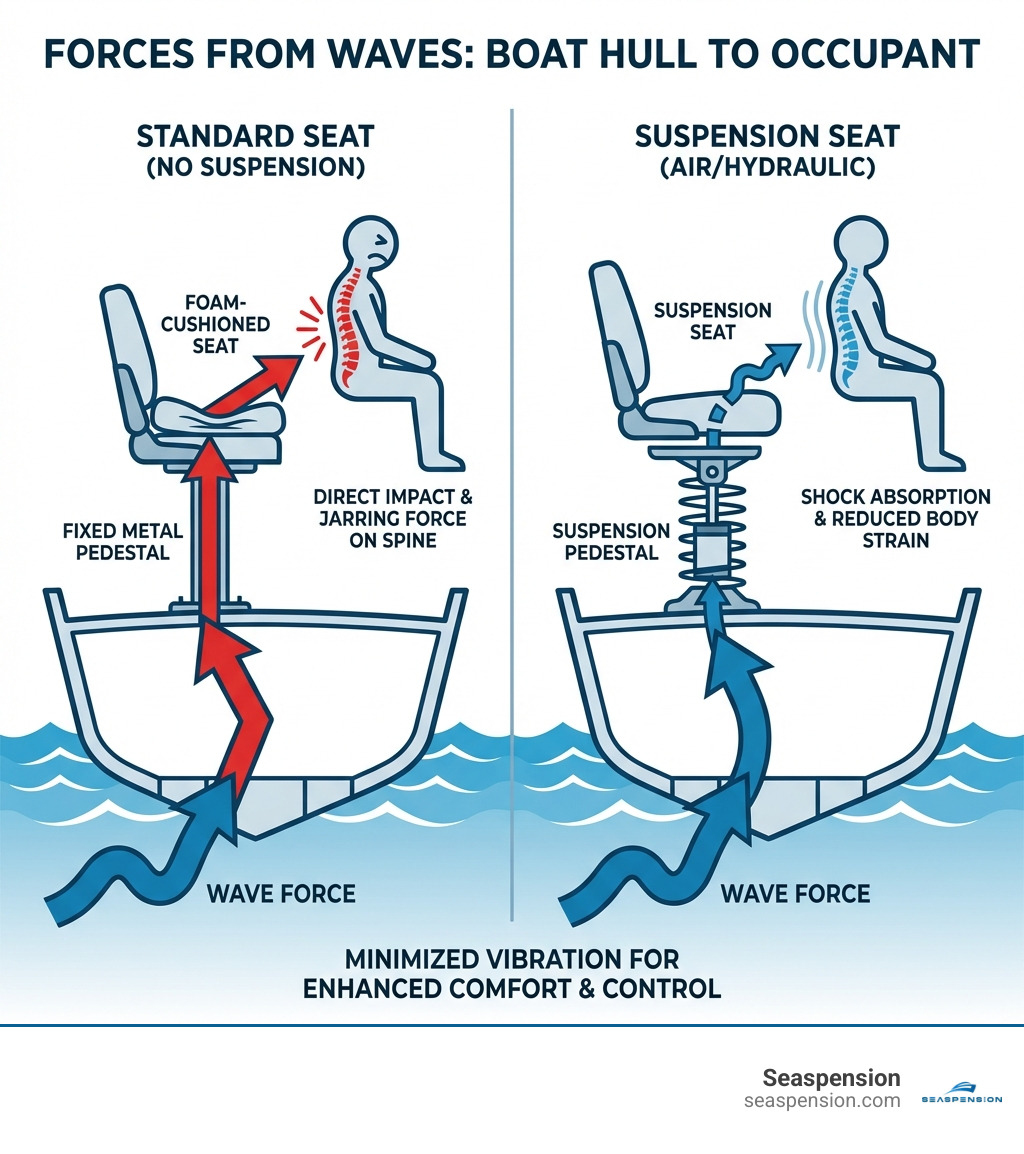
When you're out on the water, especially in choppy conditions, your boat isn't just gliding; it's constantly moving, pitching, and slamming into waves. A standard boat seat, typically mounted on a fixed pedestal with a basic foam cushion, acts like a direct conduit for all these forces. There's no buffer, no mechanism to dissipate the energy.
These seats offer minimal protection. While a thick foam cushion might initially feel soft, it quickly compresses under impact. This isn't true shock absorption; it's merely a temporary deformation. Once compressed, the foam often rebounds quickly, contributing to a harsh "bottoming out" sensation that can be as jarring as the initial impact. This lack of controlled damping means that every jolt and bump from the water is transmitted directly to your body, leading to constant jarring of the spine.
We've heard accounts of boaters experiencing severe discomfort, even to the point of injury, from prolonged exposure to these impacts. The consistent pounding can lead to physical fatigue, back pain, neck strain, and even more serious issues over time. A standard seat simply cannot provide the necessary isolation from the boat's movement to prevent these problems.

To truly mitigate the impact of rough water, we need to separate the seat from the boat's direct motion. This is where suspension pedestals come into play. The core principle behind effective shock mitigation is a combination of a spring and a damper. The spring absorbs the initial energy of an impact (compression), while the damper controls the release of that energy, preventing a harsh rebound.
This controlled movement is crucial. Without proper damping, a spring alone would simply bounce you up and down, potentially leading to a "catapult" or "eject" feeling. Effective suspension systems manage both the upward and downward forces, providing a smooth, controlled ride even in challenging conditions.
For example, a device used in a vehicle to reduce the effects of traveling on a rough surface is a shock absorber, and the same principle applies to marine suspension. These specialized systems are purpose-built for medium-duty usage in the marine environment, constructed with premium materials. They are designed to manage the constant pounding from hitting waves, which can take its toll on boaters.
Air suspension boat seats use a compressible air chamber, often an airbag, as their primary spring mechanism. When the boat hits a wave, the air in the chamber compresses, absorbing the impact. This mechanism is designed to take the hit for you.
A key benefit of air suspension is its adjustability. The air pressure within the chamber can be fine-tuned to accommodate different occupant weights and preferences. This adjustment can be made with a simple hand pump for basic systems, allowing you to personalize your comfort setting. More advanced air suspension boat seats may feature integrated compressors that can be activated with the touch of a button, eliminating the need for a manual pump. These compressors often require a 12V power source, either plugged into an outlet or hardwired into the boat's electrical system.
The way air absorbs and releases energy is unique. Some systems, for instance, use a black airbag that pushes air into a manifold and then into an accumulator tube. This design aims for a controlled up and down motion, preventing an "eject or catapult feeling" and delivering a smooth ride. An easily adjustable air chamber can provide a "bottomless feel" and accommodate a wide range of rider weights, with some systems allowing for 0-200psi of air spring preload to handle occupants up to 400 lbs or more. This type of system is built for comfort and designed to last, reducing constant jarring of the spine.
Another highly effective method for marine shock mitigation involves hydraulic shock absorption systems. These systems typically pair a robust coil spring with a hydraulic damper. The coil spring absorbs the initial impact, similar to an air spring, but the hydraulic damper is where the precision comes in.
A hydraulic damper uses fluid resistance to control the rate at which the suspension compresses and extends. This is known as velocity-sensitive damping: the faster the impact (e.g., hitting a large wave), the more resistance the damper provides. This progressive resistance ensures that the energy from the impact is smoothly dissipated, preventing both harsh bottoming out and uncontrolled rebound.
The result is a highly controlled ride, more akin to the suspension found on a dirt bike. The hydraulic system actively slows the rate of rise and fall, smoothing out the jolts without the "catapult" effect that can occur with less sophisticated suspension. Hydraulic systems are often praised for their mechanical simplicity and robust nature, making them a reliable choice for the demanding marine environment. We've seen hydraulic seats enable individuals to continue fishing in large waves with absolutely no discomfort, even after multiple spinal surgeries. They are often considered simpler, lighter, and more compact than some air ride systems, offering a superior ride for many boaters.
When considering suspension for your boat, understanding the distinctions between air and hydraulic systems is crucial. Both aim to reduce impact, but they achieve it through different mechanisms, leading to varying performance characteristics in the harsh marine environment.
Here's a comparison to help illustrate the differences:
| Feature | Air Suspension | Hydraulic Suspension |
|---|---|---|
| Rebound Control | Can be smooth, but simpler systems may lack precise, progressive damping. Some advanced designs use accumulators for better control. | Offers precise, velocity-sensitive damping, actively slowing both compression and rebound for a highly controlled motion. |
| Maintenance Needs | May involve checking air pressure, potential for leaks in air bladders or lines. Systems with compressors have electrical components. | Generally low maintenance due to sealed, self-contained hydraulic dampers. Focus is on mechanical integrity. |
| System Complexity | Ranges from simple airbag with hand pump to more complex systems with manifolds, accumulators, and integrated compressors. | Mechanically simpler, relying on the sophisticated design of the hydraulic damper to manage forces. Fewer electrical components. |
| Performance in Choppy Water | Excellent for cushioning impacts and providing a "soft" ride. Can be tuned for various weights. May be overwhelmed by rapid, successive large impacts if not optimally designed. | Excels in consistently controlling fast, repeated impacts due to progressive damping. Provides a stable platform by actively managing boat motion. |
| Long-Term Durability | Relies on the integrity of air bladders, seals, and O-rings. Electrical components (compressors) can be points of failure. | Highly durable in marine environments, often constructed with robust materials. Fewer moving electrical parts reduce potential failure points. |
For those seeking more in-depth information, we have a comprehensive article dedicated to exploring the nuances of Hydraulic vs. Air Suspension for Boats: What Most Boaters Don't Know.
Choosing the right suspension pedestal for your boat involves more than just picking the first option you see. It requires careful consideration of your specific boating habits, the conditions you typically encounter, and the needs of those on board.
First, think about your boat type and size. A small skiff used in calm bays will have different requirements than an offshore fishing vessel tackling large swells off the coast of Alaska or California. The typical water conditions you face—whether it's mild chop, significant waves, or sustained rough seas—will heavily influence the type and robustness of the suspension you need.
The operator's weight range is also critical. A good suspension system should be adjustable to accommodate different occupants, ensuring everyone gets the benefit of the shock absorption. For example, some systems can adjust for weights up to 350 lbs, while others can handle 400 lbs or more.
Finally, consider the balance between budget and long-term value. While initial cost is always a factor, investing in a durable, effective suspension system can save you money (and pain) in the long run by extending your time on the water and protecting your body.
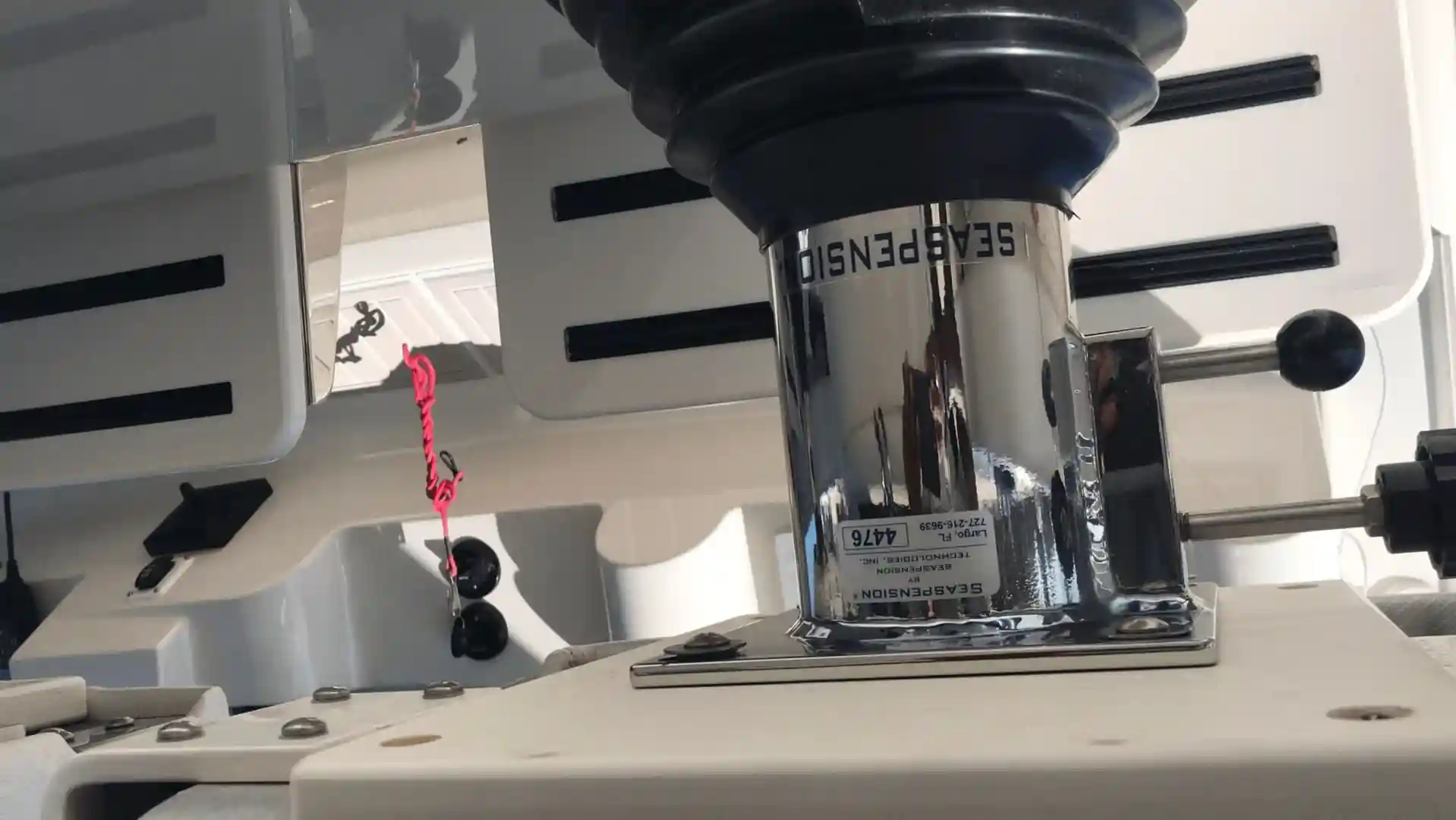
Suspension travel refers to how much the seat can move up and down to absorb an impact. Generally, more travel, typically ranging from 4 to 8 inches, means the system can absorb larger and more severe impacts effectively. This is vital for reducing the harshness of hitting big waves.
Adjustability is another key feature. Whether it's through air pressure settings (0-200psi for some systems) or mechanical adjustments, the ability to fine-tune the suspension to the occupant's weight is paramount. This ensures that a 120lb passenger and a 270lb passenger both experience the intended smooth ride. Many systems are designed to accommodate a wide range of rider weights, often up to 350 lbs or even 400 lbs or more.
Beyond shock absorption, comfort features like 360-degree swivel and fore/aft slide functions allow for optimal positioning, sightlines, and ease of movement at the helm. Finally, proper sizing for the correct seat height is essential for ergonomics and safety. Pedestals come in various heights (e.g., 10, 12, 14, 16 inches) to ensure your seat is at the right level once the suspension is installed. You'll need to measure from the bottom of your seat cushion to the boat floor to determine the appropriate pedestal size.
The marine environment is notoriously harsh, with constant exposure to saltwater, UV rays, and vibrations. Therefore, the materials and construction of your suspension pedestal are paramount for long-term durability and performance.
Look for marine-grade materials such as aircraft-grade aluminum, stainless steel, and powder-coated steel. These materials offer high strength, lightweight properties, and excellent corrosion resistance. For instance, some pedestals use aircraft-grade aluminum with a hard-anodized finish to reduce friction and improve durability. Others feature salt water-resistant powder-coated steel and a protective rubber boot to shield internal components.
Critical moving parts, like the main shaft, might have a super hard chrome finish to further reduce friction, while seals and O-rings are specifically designed for friction reduction and extended lifespan. These details contribute to a system that is built to last and withstand the rigors of boating in areas like Florida, Washington, or the open waters off Alaska.
Regular maintenance is key to extending the lifespan of any marine equipment. While hydraulic systems are often praised for being low maintenance due to their sealed nature, all suspension components benefit from periodic inspection and care. For a deeper dive into maintaining your system and answering common questions, explore Everything You Need to Know About SeaSension: FAQs for a Smoother Ride.
Installing a new suspension pedestal can seem daunting, but many systems are designed for straightforward integration. Most modern suspension pedestals use industry-standard six-bolt patterns, which allows for easy installation and retrofitting to existing boat seats.
For those comfortable with basic tools, a DIY installation is often feasible. The process typically involves unbolting your current seat and pedestal, then bolting the new suspension pedestal into the existing mounting pattern. Some manufacturers provide detailed installation videos and guides to walk you through each step. For example, you can watch How To Install a Pedestal for a visual guide. We also offer specific instructions on How to Install a SeaSension Shock Absorbing Pedestal.
However, if you're unsure, lack the necessary tools, or prefer to ensure a perfect fit, professional installation by a marine technician is always a wise choice. This is especially true for more complex systems or if your boat requires custom modifications.
The investment in quality marine suspension seating translates directly into tangible benefits for every boater, especially those who frequent the waters off Pinellas Park, Florida, or Homer, Alaska.
The most immediate benefit is significantly reduced fatigue. When your body isn't constantly bracing for impact, you expend less energy, allowing for longer, more comfortable trips. This means you can get offshore faster, farther, and more comfortably, extending your time on the water without feeling completely worn out at the end of the day.
For individuals with pre-existing back or neck issues, suspension seats are a game-changer. They provide a crucial layer of protection, absorbing waves so your back doesn't have to. We've heard countless stories of boaters, even those who have undergone spinal surgeries, finding immense relief and the ability to continue their passion without discomfort. As one boater aptly put it, preventing back and neck pain is easier than treating it.
Beyond personal comfort, suspension seats can improve overall vessel control. By keeping the operator stable and comfortable, they can maintain better focus and control of the boat, enhancing safety in rough seas. This is particularly important for commercial operators and recreational boaters who prioritize safety for themselves and their passengers.
We've explored the differences between air suspension boat seats and hydraulic systems. While air systems offer adjustability and cushioning, hydraulic systems often provide a more consistent and precisely controlled damping experience, particularly in rapid, successive impacts. For serious boaters, commercial operators, or anyone who regularly faces challenging marine conditions, controlled damping and robust durability are paramount.
At Seaspension, we focus on providing a simple, robust, and highly effective solution. Our independently operating hydraulic shock-absorbing system is engineered to deliver reliable performance and safety for demanding boaters. We understand that in the real world, you need equipment that works, day in and day out, with minimal fuss. Our pedestals are built to manage both impact and rebound effectively, offering optimal comfort and safety for boaters, even with varying occupant weights.
If you're ready to experience a smoother, more comfortable, and safer ride on the water, we invite you to explore our range of solutions. Learn more about how our technology can transform your boating experience by visiting Discover SeaSension's Shock-Absorbing Boat Seats.
Air suspension boat seats are designed to absorb shock and vibration from waves, reducing physical strain on boaters. They work by using either an air spring system (with adjustable pressure) or a hydraulic shock absorber to cushion impacts, protecting your back, neck, and spine during rough water conditions.
Key Options for Shock-Absorbing Boat Seats:
| System Type | How It Works | Best For |
|---|---|---|
| Air Suspension | Airbag compresses under impact; adjustable via hand pump or compressor | Lighter loads, adjustable comfort preferences |
| Hydraulic Suspension | Coil spring over hydraulic damper; velocity-sensitive shock absorption | Consistent performance, low maintenance, controlled rebound |
| Mechanical Spring | Basic spring compression (older technology) | Budget-conscious buyers; limited shock control |
Every boater who spends time in rough water knows the feeling: you're tired, your lower back aches, and your neck feels stiff hours after you've left the dock. One angler who had undergone three spinal surgeries noted that a hydraulic boat seat allowed him to "compete after three spinal surgeries" and "fish in large waves with absolutely no discomfort."
That discomfort isn't just about a long day. It's about repeated impact. When your boat slams through chop, the force travels through the hull, into your seat, and directly into your body. Over time, this constant jarring wears you down—and it can lead to real, lasting pain.
Standard boat seats don't solve this problem. A thick cushion might feel comfortable at the dock, but it does almost nothing when you hit a wave at speed. The foam compresses, then rebounds—often making the impact worse. Without true shock absorption, you're absorbing every hit with your spine.
As Ian Milligan, owner of Seaspension, I've spent years working with boaters who need reliable, low-maintenance solutions for rough water conditions. Our hydraulic suspension pedestals are built to manage impact and rebound in real-world marine environments, helping operators stay comfortable and in control.
When you're out on the water, especially in choppy conditions, your boat isn't just gliding; it's constantly moving, pitching, and slamming into waves. A standard boat seat, typically mounted on a fixed pedestal with a basic foam cushion, acts like a direct conduit for all these forces. There's no buffer, no mechanism to dissipate the energy.
These seats offer minimal protection. While a thick foam cushion might initially feel soft, it quickly compresses under impact. This isn't true shock absorption; it's merely a temporary deformation. Once compressed, the foam often rebounds quickly, contributing to a harsh "bottoming out" sensation that can be as jarring as the initial impact. This lack of controlled damping means that every jolt and bump from the water is transmitted directly to your body, leading to constant jarring of the spine.
We've heard accounts of boaters experiencing severe discomfort, even to the point of injury, from prolonged exposure to these impacts. The consistent pounding can lead to physical fatigue, back pain, neck strain, and even more serious issues over time. A standard seat simply cannot provide the necessary isolation from the boat's movement to prevent these problems.
To truly mitigate the impact of rough water, we need to separate the seat from the boat's direct motion. This is where suspension pedestals come into play. The core principle behind effective shock mitigation is a combination of a spring and a damper. The spring absorbs the initial energy of an impact (compression), while the damper controls the release of that energy, preventing a harsh rebound.
This controlled movement is crucial. Without proper damping, a spring alone would simply bounce you up and down, potentially leading to a "catapult" or "eject" feeling. Effective suspension systems manage both the upward and downward forces, providing a smooth, controlled ride even in challenging conditions.
For example, a device used in a vehicle to reduce the effects of traveling on a rough surface is a shock absorber, and the same principle applies to marine suspension. These specialized systems are purpose-built for medium-duty usage in the marine environment, constructed with premium materials. They are designed to manage the constant pounding from hitting waves, which can take its toll on boaters.
Air suspension boat seats use a compressible air chamber, often an airbag, as their primary spring mechanism. When the boat hits a wave, the air in the chamber compresses, absorbing the impact. This mechanism is designed to take the hit for you.
A key benefit of air suspension is its adjustability. The air pressure within the chamber can be fine-tuned to accommodate different occupant weights and preferences. This adjustment can be made with a simple hand pump for basic systems, allowing you to personalize your comfort setting. More advanced air suspension boat seats may feature integrated compressors that can be activated with the touch of a button, eliminating the need for a manual pump. These compressors often require a 12V power source, either plugged into an outlet or hardwired into the boat's electrical system.
The way air absorbs and releases energy is unique. Some systems, for instance, use a black airbag that pushes air into a manifold and then into an accumulator tube. This design aims for a controlled up and down motion, preventing an "eject or catapult feeling" and delivering a smooth ride. An easily adjustable air chamber can provide a "bottomless feel" and accommodate a wide range of rider weights, with some systems allowing for 0-200psi of air spring preload to handle occupants up to 400 lbs or more. This type of system is built for comfort and designed to last, reducing constant jarring of the spine.
Another highly effective method for marine shock mitigation involves hydraulic shock absorption systems. These systems typically pair a robust coil spring with a hydraulic damper. The coil spring absorbs the initial impact, similar to an air spring, but the hydraulic damper is where the precision comes in.
A hydraulic damper uses fluid resistance to control the rate at which the suspension compresses and extends. This is known as velocity-sensitive damping: the faster the impact (e.g., hitting a large wave), the more resistance the damper provides. This progressive resistance ensures that the energy from the impact is smoothly dissipated, preventing both harsh bottoming out and uncontrolled rebound.
The result is a highly controlled ride, more akin to the suspension found on a dirt bike. The hydraulic system actively slows the rate of rise and fall, smoothing out the jolts without the "catapult" effect that can occur with less sophisticated suspension. Hydraulic systems are often praised for their mechanical simplicity and robust nature, making them a reliable choice for the demanding marine environment. We've seen hydraulic seats enable individuals to continue fishing in large waves with absolutely no discomfort, even after multiple spinal surgeries. They are often considered simpler, lighter, and more compact than some air ride systems, offering a superior ride for many boaters.
When considering suspension for your boat, understanding the distinctions between air and hydraulic systems is crucial. Both aim to reduce impact, but they achieve it through different mechanisms, leading to varying performance characteristics in the harsh marine environment.
Here's a comparison to help illustrate the differences:
| Feature | Air Suspension | Hydraulic Suspension |
|---|---|---|
| Rebound Control | Can be smooth, but simpler systems may lack precise, progressive damping. Some advanced designs use accumulators for better control. | Offers precise, velocity-sensitive damping, actively slowing both compression and rebound for a highly controlled motion. |
| Maintenance Needs | May involve checking air pressure, potential for leaks in air bladders or lines. Systems with compressors have electrical components. | Generally low maintenance due to sealed, self-contained hydraulic dampers. Focus is on mechanical integrity. |
| System Complexity | Ranges from simple airbag with hand pump to more complex systems with manifolds, accumulators, and integrated compressors. | Mechanically simpler, relying on the sophisticated design of the hydraulic damper to manage forces. Fewer electrical components. |
| Performance in Choppy Water | Excellent for cushioning impacts and providing a "soft" ride. Can be tuned for various weights. May be overwhelmed by rapid, successive large impacts if not optimally designed. | Excels in consistently controlling fast, repeated impacts due to progressive damping. Provides a stable platform by actively managing boat motion. |
| Long-Term Durability | Relies on the integrity of air bladders, seals, and O-rings. Electrical components (compressors) can be points of failure. | Highly durable in marine environments, often constructed with robust materials. Fewer moving electrical parts reduce potential failure points. |
For those seeking more in-depth information, we have a comprehensive article dedicated to exploring the nuances of Hydraulic vs. Air Suspension for Boats: What Most Boaters Don't Know.
Choosing the right suspension pedestal for your boat involves more than just picking the first option you see. It requires careful consideration of your specific boating habits, the conditions you typically encounter, and the needs of those on board.
First, think about your boat type and size. A small skiff used in calm bays will have different requirements than an offshore fishing vessel tackling large swells off the coast of Alaska or California. The typical water conditions you face—whether it's mild chop, significant waves, or sustained rough seas—will heavily influence the type and robustness of the suspension you need.
The operator's weight range is also critical. A good suspension system should be adjustable to accommodate different occupants, ensuring everyone gets the benefit of the shock absorption. For example, some systems can adjust for weights up to 350 lbs, while others can handle 400 lbs or more.
Finally, consider the balance between budget and long-term value. While initial cost is always a factor, investing in a durable, effective suspension system can save you money (and pain) in the long run by extending your time on the water and protecting your body.
Suspension travel refers to how much the seat can move up and down to absorb an impact. Generally, more travel, typically ranging from 4 to 8 inches, means the system can absorb larger and more severe impacts effectively. This is vital for reducing the harshness of hitting big waves.
Adjustability is another key feature. Whether it's through air pressure settings (0-200psi for some systems) or mechanical adjustments, the ability to fine-tune the suspension to the occupant's weight is paramount. This ensures that a 120lb passenger and a 270lb passenger both experience the intended smooth ride. Many systems are designed to accommodate a wide range of rider weights, often up to 350 lbs or even 400 lbs or more.
Beyond shock absorption, comfort features like 360-degree swivel and fore/aft slide functions allow for optimal positioning, sightlines, and ease of movement at the helm. Finally, proper sizing for the correct seat height is essential for ergonomics and safety. Pedestals come in various heights (e.g., 10, 12, 14, 16 inches) to ensure your seat is at the right level once the suspension is installed. You'll need to measure from the bottom of your seat cushion to the boat floor to determine the appropriate pedestal size.
The marine environment is notoriously harsh, with constant exposure to saltwater, UV rays, and vibrations. Therefore, the materials and construction of your suspension pedestal are paramount for long-term durability and performance.
Look for marine-grade materials such as aircraft-grade aluminum, stainless steel, and powder-coated steel. These materials offer high strength, lightweight properties, and excellent corrosion resistance. For instance, some pedestals use aircraft-grade aluminum with a hard-anodized finish to reduce friction and improve durability. Others feature salt water-resistant powder-coated steel and a protective rubber boot to shield internal components.
Critical moving parts, like the main shaft, might have a super hard chrome finish to further reduce friction, while seals and O-rings are specifically designed for friction reduction and extended lifespan. These details contribute to a system that is built to last and withstand the rigors of boating in areas like Florida, Washington, or the open waters off Alaska.
Regular maintenance is key to extending the lifespan of any marine equipment. While hydraulic systems are often praised for being low maintenance due to their sealed nature, all suspension components benefit from periodic inspection and care. For a deeper dive into maintaining your system and answering common questions, explore Everything You Need to Know About SeaSension: FAQs for a Smoother Ride.
Installing a new suspension pedestal can seem daunting, but many systems are designed for straightforward integration. Most modern suspension pedestals use industry-standard six-bolt patterns, which allows for easy installation and retrofitting to existing boat seats.
For those comfortable with basic tools, a DIY installation is often feasible. The process typically involves unbolting your current seat and pedestal, then bolting the new suspension pedestal into the existing mounting pattern. Some manufacturers provide detailed installation videos and guides to walk you through each step. For example, you can watch How To Install a Pedestal for a visual guide. We also offer specific instructions on How to Install a SeaSension Shock Absorbing Pedestal.
However, if you're unsure, lack the necessary tools, or prefer to ensure a perfect fit, professional installation by a marine technician is always a wise choice. This is especially true for more complex systems or if your boat requires custom modifications.
The investment in quality marine suspension seating translates directly into tangible benefits for every boater, especially those who frequent the waters off Pinellas Park, Florida, or Homer, Alaska.
The most immediate benefit is significantly reduced fatigue. When your body isn't constantly bracing for impact, you expend less energy, allowing for longer, more comfortable trips. This means you can get offshore faster, farther, and more comfortably, extending your time on the water without feeling completely worn out at the end of the day.
For individuals with pre-existing back or neck issues, suspension seats are a game-changer. They provide a crucial layer of protection, absorbing waves so your back doesn't have to. We've heard countless stories of boaters, even those who have undergone spinal surgeries, finding immense relief and the ability to continue their passion without discomfort. As one boater aptly put it, preventing back and neck pain is easier than treating it.
Beyond personal comfort, suspension seats can improve overall vessel control. By keeping the operator stable and comfortable, they can maintain better focus and control of the boat, enhancing safety in rough seas. This is particularly important for commercial operators and recreational boaters who prioritize safety for themselves and their passengers.
We've explored the differences between air suspension boat seats and hydraulic systems. While air systems offer adjustability and cushioning, hydraulic systems often provide a more consistent and precisely controlled damping experience, particularly in rapid, successive impacts. For serious boaters, commercial operators, or anyone who regularly faces challenging marine conditions, controlled damping and robust durability are paramount.
At Seaspension, we focus on providing a simple, robust, and highly effective solution. Our independently operating hydraulic shock-absorbing system is engineered to deliver reliable performance and safety for demanding boaters. We understand that in the real world, you need equipment that works, day in and day out, with minimal fuss. Our pedestals are built to manage both impact and rebound effectively, offering optimal comfort and safety for boaters, even with varying occupant weights.
If you're ready to experience a smoother, more comfortable, and safer ride on the water, we invite you to explore our range of solutions. Learn more about how our technology can transform your boating experience by visiting Discover SeaSension's Shock-Absorbing Boat Seats.


