Why Boat Seat Pedestal Accessories Matter More Than You Think
Boat seat pedestal accessories are the components that connect, adjust, and secure your boat seat to its pedestal—including swivel tops, seat slides, locking mechanisms, mounting bases, and hardware. These accessories determine how your seat moves, locks, and adapts to different conditions on the water.
Core Boat Seat Pedestal Accessories:
- Swivel Tops - Enable 360-degree rotation for fishing, docking, and visibility
- Seat Slides - Allow fore-and-aft positioning for ergonomic adjustment
- Locking Mechanisms - Secure the seat in place when underway (required for helm seats)
- Mounting Bases - Attach the pedestal to the deck (fixed or socket-style)
- Swivel Plates & Hardware - Connect the seat to the pedestal top
If you've spent a day on choppy water, you know the feeling. Every wave sends a jolt through the deck, up through your seat, and straight into your spine. You brace. You shift. You stand up to stretch your lower back. By the time you're back at the dock, you're exhausted—not from the activity, but from the impact.
Most boaters focus on the seat itself—the cushion, the upholstery, the backrest. But the real problem isn't comfort. It's shock transfer. And that starts with what's between your seat and the deck: the pedestal and its accessories.
The pedestal is the structural link between your boat and your body. A basic pedestal just holds the seat in place. But the right pedestal system—with the right accessories—can swivel, slide, lock, and in some cases, absorb the forces that cause fatigue and injury. The difference between a long, painful day and a productive one often comes down to what's bolted to your deck.
I'm Ian Milligan, owner of Seaspension, a Florida-based company that specializes in shock-absorbing pedestal systems for recreational and commercial boaters. Since 2021, I've worked with operators across the country to reduce impact fatigue through engineered suspension solutions, and I've seen how the right boat seat pedestal accessories can transform time on the water.
Understanding the Foundation: Types of Boat Seat Pedestals
When we talk about boat seat pedestal accessories, it's important to first understand the foundation: the pedestals themselves. Pedestals come in various forms, each designed to serve different purposes and offer distinct advantages. The choice often depends on your boating activity, the type of boat you have, and your personal comfort needs.
We see a global marine seating market valued at over a billion dollars, projected to grow significantly. This growth reflects increasing boat ownership and recreational activities, driving demand for better seating solutions, including advanced pedestals.
Fixed Height Pedestals
Fixed-height pedestals are the simplest and most cost-effective option. They provide a static elevation for your boat seat, maintaining a consistent height above the deck. These are commonly found on smaller boats or in positions where height adjustment isn't critical. Their main benefits are their straightforward design, durability, and minimal maintenance. While they lack adjustability, their solid construction ensures stability.
Adjustable Height Pedestals
For those who need more flexibility, adjustable height pedestals are a popular choice. These pedestals allow you to change the seat's height, accommodating different users or adapting to varying conditions on the water.
The primary difference between a fixed and adjustable boat seat pedestal lies in this ability to change height. Adjustable pedestals typically come in two main types:
- Gas-powered (Gas Spring) Pedestals: These use a gas-filled cylinder to assist with height adjustments, making it easier to raise or lower the seat with a lever. They often provide a smoother feel during adjustment.
- Manual Adjustment Pedestals: These require a manual locking mechanism, like a pin or clamp, to set the desired height. While less effortless than gas-powered models, they are robust and reliable.
Adjustable pedestals offer a range of height options, with common ranges including 13-19 inches and 18-25 inches, catering to diverse user needs and boat configurations. This versatility is invaluable for ensuring comfort and clear sightlines for different operators or passengers.
Shock Absorbing Boat Seat Pedestals
This is where we focus our expertise. Traditional pedestals, whether fixed or adjustable, transmit the full force of wave impacts directly to the occupant. Our shock-absorbing pedestals are engineered to mitigate these forces. They incorporate advanced suspension systems, often hydraulic, that absorb vertical impacts, cushioning the ride significantly. This is particularly beneficial in rough water conditions, reducing fatigue and protecting occupants from the physical toll of constant jarring. We'll dig deeper into the mechanics of shock absorption later, but for now, understand that these pedestals are designed for superior comfort and safety. You can learn more about our shock-absorbing pedestals here.
Removable Pedestals
Removable pedestals use a socket base installed flush with the deck. The pedestal post can be inserted or removed as needed, offering flexible deck space. This is ideal for boats where the seating arrangement needs to change, or where you want to clear the deck for fishing or other activities. When removed, the deck remains clear, reducing tripping hazards and making cleaning easier.
Key Features and Essential Boat Seat Pedestal Accessories
Beyond the pedestal itself, the right boat seat pedestal accessories are crucial for optimizing your seating experience. These components improve functionality, comfort, and safety.

To better understand how these parts work together, it can help to look at how a typical swivel seat mount functions in other applications. The same basic principles apply on the water, but with far higher loads and harsher environmental conditions, which is why marine-grade construction and proper standards matter.
Essential boat seat pedestal accessories: Swivels, Slides, and Locks
What features should you look for in a boat seat pedestal system? It often comes down to how you use your boat.
- Swivel Tops: A swivel top is one of the most popular and beneficial boat seat pedestal accessories. It allows your boat seat to rotate 360 degrees. This is incredibly useful for fishing, as it lets you track action around the boat without straining. For docking or conversing with others, it offers easy rotation. Many swivel tops, like those made from marine-grade nylon, offer corrosion resistance and sometimes feature adjustable swivel tension via a thumb screw for customizable rotation ease. This flexibility improves comfort and versatility on the water.
- Seat Slides: Seat slides provide fore-and-aft adjustment, similar to car seats. This allows you to fine-tune your seating position for optimal ergonomics, reach to the helm, or simply to find a more comfortable spot. This is particularly valuable for different operators or when transitioning between cruising and fishing.
- Locking Mechanisms: The advantages of a pedestal with a locking mechanism are primarily safety and stability. For helm seats, ABYC H-31 regulations often mandate that the seat must be locked forward when the vessel is in motion. Locking mechanisms prevent unintended rotation or sliding, ensuring the occupant remains securely positioned, especially in rough seas. This includes both rotational locks for swivels and slide locks for fore-and-aft movement. Many quality systems are designed to meet these ABYC H-31 regulations for driver's seat applications.
Choosing the right materials for boat seat pedestal accessories
The marine environment is harsh, with constant exposure to saltwater, UV rays, and vibrations. Therefore, the materials used for boat seat pedestal accessories are critical for longevity and performance. Many boat seat pedestals are constructed from marine-grade nylon or aluminum alloy, materials chosen for their corrosion resistance and durability.
- Marine-grade aluminum: Lightweight yet incredibly strong, aluminum alloys are a top choice. They resist corrosion exceptionally well, making them suitable for both freshwater and saltwater use. Often, they receive an anodized finish for added protection and a sleek look.
- Powder-coated steel: While heavier than aluminum, powder-coated steel offers excellent durability and strength. The powder coating provides a protective layer against rust and corrosion, making it a robust option for various applications.
- Stainless steel hardware: Throughout any pedestal system, you'll find fasteners, nuts, and washers. These should always be marine-grade stainless steel to prevent rust and maintain structural integrity. Using anything less can lead to premature failure and safety hazards. We dive deeper into material specifications and their importance on our specs page.
Choosing and Installing Your Pedestal System
Selecting and properly installing your boat seat pedestal and its accessories is fundamental to a safe and comfortable boating experience.
How to Choose the Right Pedestal Height
Choosing the right height for your boat seat pedestal is more than just comfort; it's about safety and control.
- Ergonomics: Ideally, when seated, your knees should be at a 90-degree angle, with your feet flat on the deck or a footrest. This ergonomic position reduces strain on your back and legs during long hours on the water.
- Clear Sightlines: The pedestal height must allow for clear sightlines over the bow of your boat, especially when operating from the helm. You need an unobstructed view of the water ahead, navigation markers, and any potential hazards.
- Measuring from deck to cushion: To determine the correct height, measure from the deck to the top of your seat cushion while seated in a comfortable, upright posture. Remember to factor in the thickness of your specific seat, as this will add to the overall seated height.
- Common height ranges: As noted, adjustable pedestals typically offer ranges like 13-19 inches or 18-25 inches. Fixed pedestals come in specific heights. The best sitting height, including the seat, is often cited around 15-1/2 inches (39cm) above the deck for general applications.
We've compiled an extensive FAQ to help you steer these choices and more, ensuring you get the most out of your setup. Find answers to common questions about height selection and other topics in Everything You Need to Know About SeaSpenSion: FAQs for a Smoother Ride.
A Practical Guide to Pedestal Installation
Installing a boat seat pedestal correctly is critical for safety and performance. Here's a general overview of the process:
- Tools needed: You'll typically need a drill, appropriate drill bits, marine-grade sealant (like 3M 5200 or 4200), a wrench set, and stainless steel fasteners.
- Deck reinforcement: Before mounting, ensure your deck can support the stresses of a seat and occupant, especially in rough water. We always recommend using a backing plate—either aluminum or stainless steel—underneath the deck for added strength and load distribution. This is a best practice often aligned with ABYC standards for mounting substrates.
- Mounting the base: Position the pedestal base according to your desired layout. Use the base as a template to mark and drill pilot holes. It's crucial to drill through the deck and any backing plate. Apply marine sealant to all drilled holes before inserting fasteners to prevent water intrusion into the deck core. Thru-bolt the base using appropriate stainless steel machine screws, washers, and nuts. Avoid copper or copper-plated fasteners, as they can cause galvanic corrosion in a marine environment.
- Attaching the seat: Most seat mounts or slider platforms attach to the underside of your boat seat using a standard bolt pattern. Insert stainless steel machine screws through washers and into the T-nuts provided in the seat, or thru-bolt if T-nuts are not present. Ensure sufficient thread length for a secure connection.
For a detailed, step-by-step guide, we've outlined the process for our systems. You can find comprehensive instructions on How to Install a Boat Seat Pedestal to Your Recreational Boat. Always remember to abide by all ABYC and U.S. Coast Guard regulations for marine installations.
Pedestal Maintenance for Longevity and Safety
Proper maintenance of your boat seat pedestal and its accessories is key to ensuring their longevity, reliable operation, and continued safety on the water.
- Regular cleaning: The marine environment is tough on equipment. Regularly clean your pedestal and accessories with mild soap and fresh water. This is especially important after use in saltwater to rinse away corrosive salt deposits. Avoid abrasive cleansers or polishing agents that could damage finishes.
- Inspection: Periodically, conduct a thorough visual inspection. Check all fasteners for proper tightness. Vibrations from boating can loosen bolts over time, leading to wobbles or, worse, structural failure. Examine the pedestal and its components for any signs of corrosion, cracks, or excessive wear. Pay close attention to welding points, pivot points, and locking mechanisms.
- Lubrication: For moving parts such as swivel mechanisms, slide tracks, and adjustable components, marine-grade grease or silicone spray can prevent seizing and ensure smooth operation. Apply sparingly to avoid attracting dirt, and reapply as needed, especially if you notice stiffness or squeaking.
- Addressing issues promptly: If you notice any issues during inspection—a loose bolt, a stiff swivel, or a corroded spot—address it immediately. Small problems can quickly escalate into larger, more expensive repairs or safety hazards if ignored.
Taking these simple steps will significantly extend the life of your boat seat pedestal accessories and keep your seating system performing optimally. We believe in providing solutions that last, and proper care is a big part of that. Learn more about the long-term ownership benefits of quality marine accessories on our Why Buy page.
The Critical Difference: Why True Shock Mitigation Matters
We've discussed various pedestals and accessories, but it's crucial to address the fundamental problem that drives many boaters to seek upgrades: the relentless impact of waves.
The problem with basic solutions
Many boat owners try to solve discomfort with simple fixes:
- Cushions: While a thicker cushion might feel softer initially, it does little to absorb the significant vertical forces of a wave impact. The energy still transfers through, simply delayed by a fraction of a second.
- "Springy" pedestals: Some pedestals incorporate basic spring mechanisms. While these might offer a small amount of travel, they often lack true dampening. This can lead to a "springy" or "bouncy" sensation, where the seat bottoms out hard or rebounds violently, sometimes referred to as "pogo-sticking." This can be just as jarring as a fixed pedestal, if not more so.
- Bottoming out: When a suspension system lacks proper dampening, it can hit its mechanical limits with a hard jolt—what we call "bottoming out." This sends a sharp impact through the body, contributing to fatigue and potential injury.
The science of impact
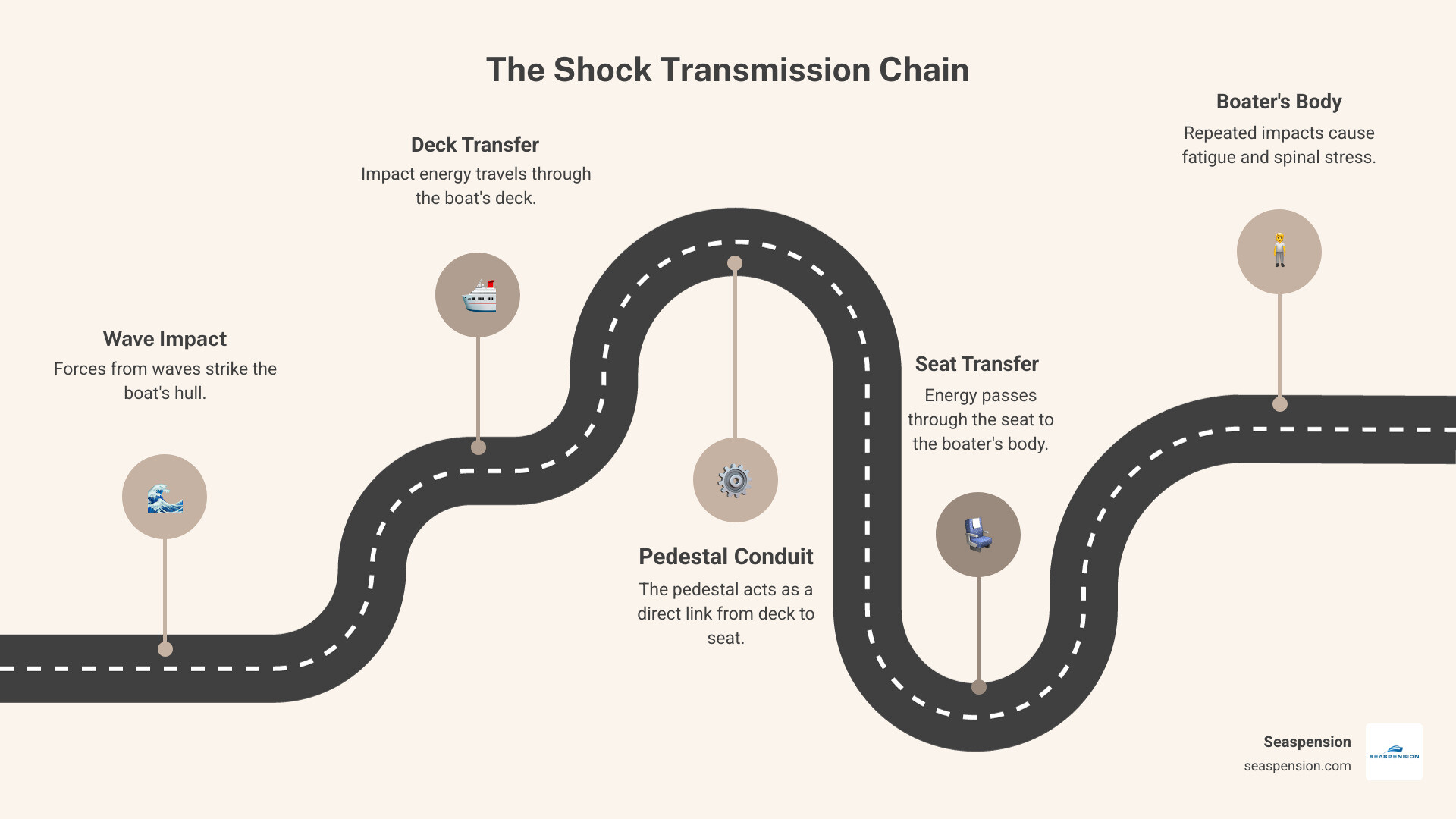
The human body is not designed to absorb repetitive, high-force impacts. When your boat hits a wave, the force travels from the hull, through the deck, up the pedestal, and into your body. This causes:
- Whole-body vibration (WBV): Constant vibration and jarring impacts lead to muscle fatigue, back pain, and even long-term spinal issues. This is a common complaint among boaters, especially those who spend extended periods in rough water.
- Cumulative fatigue: The constant bracing and impact absorption takes a toll, leading to operator fatigue, reduced focus, and decreased reaction times. This isn't just uncomfortable; it's a safety concern.
We dig into the mechanics of this impact and its effect on your body in The Hidden Force of Boating: Why Your Body Feels the Impact and How SeaSpenSion Softens the Blow.
How effective suspension works
True shock mitigation goes beyond a simple spring. It's about a controlled absorption of energy. Our pedestals use an independently operating, high-performance hydraulic shock-absorbing system.
- Hydraulic dampening: Unlike basic springs, hydraulic systems use fluid resistance to control both the compression (when the seat moves down) and rebound (when it moves back up) phases of impact. This "dampens" the energy, converting it into heat rather than transmitting it to your body.
- Controlled compression and rebound: This precise control means the seat travels smoothly through its range of motion, absorbing the impact without bottoming out or bouncing erratically.
- Isolating the boater from impact: The goal is to create a buffer between the boat's motion and the occupant. This significantly reduces the forces experienced, leading to a smoother, more comfortable, and safer ride. This allows boaters in places like Florida, Alaska, California, and Washington to enjoy their time on the water even in challenging conditions, reducing the strain on their bodies.
This technology isn't just about comfort; it's about extending your time on the water, enhancing your safety, and protecting your long-term health.
Conclusion: An Investment in Your Time on the Water
As we've explored, boat seat pedestal accessories is far more than just nuts and bolts. It's a critical aspect of your overall boating experience, directly impacting your comfort, safety, and endurance on the water.
The pedestal, often an overlooked component, is the vital link between you and your vessel. Choosing the right type—whether fixed, adjustable, or especially, a shock-absorbing system—along with essential accessories like swivels, slides, and locking mechanisms, transforms your ride. It's an investment in minimizing the physical toll of boating, allowing you to enjoy more time doing what you love.
For those who regularly steer rough waters, the benefits of advanced, high-performance systems like ours are undeniable. By actively mitigating the jarring impacts and whole-body vibrations, we help reduce fatigue, prevent discomfort, and improve focus, making every outing more enjoyable and safer.
We invite you to explore our range of advanced boat suspension pedestals and find how a truly effective shock-absorbing system can make a profound difference in your boating life. It’s not just an upgrade; it’s an investment in your well-being on the water. Explore our advanced boat suspension pedestals here.
Why Boat Seat Pedestal Accessories Matter More Than You Think
Boat seat pedestal accessories are the components that connect, adjust, and secure your boat seat to its pedestal—including swivel tops, seat slides, locking mechanisms, mounting bases, and hardware. These accessories determine how your seat moves, locks, and adapts to different conditions on the water.
Core Boat Seat Pedestal Accessories:
- Swivel Tops - Enable 360-degree rotation for fishing, docking, and visibility
- Seat Slides - Allow fore-and-aft positioning for ergonomic adjustment
- Locking Mechanisms - Secure the seat in place when underway (required for helm seats)
- Mounting Bases - Attach the pedestal to the deck (fixed or socket-style)
- Swivel Plates & Hardware - Connect the seat to the pedestal top
If you've spent a day on choppy water, you know the feeling. Every wave sends a jolt through the deck, up through your seat, and straight into your spine. You brace. You shift. You stand up to stretch your lower back. By the time you're back at the dock, you're exhausted—not from the activity, but from the impact.
Most boaters focus on the seat itself—the cushion, the upholstery, the backrest. But the real problem isn't comfort. It's shock transfer. And that starts with what's between your seat and the deck: the pedestal and its accessories.
The pedestal is the structural link between your boat and your body. A basic pedestal just holds the seat in place. But the right pedestal system—with the right accessories—can swivel, slide, lock, and in some cases, absorb the forces that cause fatigue and injury. The difference between a long, painful day and a productive one often comes down to what's bolted to your deck.
I'm Ian Milligan, owner of Seaspension, a Florida-based company that specializes in shock-absorbing pedestal systems for recreational and commercial boaters. Since 2021, I've worked with operators across the country to reduce impact fatigue through engineered suspension solutions, and I've seen how the right boat seat pedestal accessories can transform time on the water.
Understanding the Foundation: Types of Boat Seat Pedestals
When we talk about boat seat pedestal accessories, it's important to first understand the foundation: the pedestals themselves. Pedestals come in various forms, each designed to serve different purposes and offer distinct advantages. The choice often depends on your boating activity, the type of boat you have, and your personal comfort needs.
We see a global marine seating market valued at over a billion dollars, projected to grow significantly. This growth reflects increasing boat ownership and recreational activities, driving demand for better seating solutions, including advanced pedestals.
Fixed Height Pedestals
Fixed-height pedestals are the simplest and most cost-effective option. They provide a static elevation for your boat seat, maintaining a consistent height above the deck. These are commonly found on smaller boats or in positions where height adjustment isn't critical. Their main benefits are their straightforward design, durability, and minimal maintenance. While they lack adjustability, their solid construction ensures stability.
Adjustable Height Pedestals
For those who need more flexibility, adjustable height pedestals are a popular choice. These pedestals allow you to change the seat's height, accommodating different users or adapting to varying conditions on the water.
The primary difference between a fixed and adjustable boat seat pedestal lies in this ability to change height. Adjustable pedestals typically come in two main types:
- Gas-powered (Gas Spring) Pedestals: These use a gas-filled cylinder to assist with height adjustments, making it easier to raise or lower the seat with a lever. They often provide a smoother feel during adjustment.
- Manual Adjustment Pedestals: These require a manual locking mechanism, like a pin or clamp, to set the desired height. While less effortless than gas-powered models, they are robust and reliable.
Adjustable pedestals offer a range of height options, with common ranges including 13-19 inches and 18-25 inches, catering to diverse user needs and boat configurations. This versatility is invaluable for ensuring comfort and clear sightlines for different operators or passengers.
Shock Absorbing Boat Seat Pedestals
This is where we focus our expertise. Traditional pedestals, whether fixed or adjustable, transmit the full force of wave impacts directly to the occupant. Our shock-absorbing pedestals are engineered to mitigate these forces. They incorporate advanced suspension systems, often hydraulic, that absorb vertical impacts, cushioning the ride significantly. This is particularly beneficial in rough water conditions, reducing fatigue and protecting occupants from the physical toll of constant jarring. We'll dig deeper into the mechanics of shock absorption later, but for now, understand that these pedestals are designed for superior comfort and safety. You can learn more about our shock-absorbing pedestals here.
Removable Pedestals
Removable pedestals use a socket base installed flush with the deck. The pedestal post can be inserted or removed as needed, offering flexible deck space. This is ideal for boats where the seating arrangement needs to change, or where you want to clear the deck for fishing or other activities. When removed, the deck remains clear, reducing tripping hazards and making cleaning easier.
Key Features and Essential Boat Seat Pedestal Accessories
Beyond the pedestal itself, the right boat seat pedestal accessories are crucial for optimizing your seating experience. These components improve functionality, comfort, and safety.
To better understand how these parts work together, it can help to look at how a typical swivel seat mount functions in other applications. The same basic principles apply on the water, but with far higher loads and harsher environmental conditions, which is why marine-grade construction and proper standards matter.
Essential boat seat pedestal accessories: Swivels, Slides, and Locks
What features should you look for in a boat seat pedestal system? It often comes down to how you use your boat.
- Swivel Tops: A swivel top is one of the most popular and beneficial boat seat pedestal accessories. It allows your boat seat to rotate 360 degrees. This is incredibly useful for fishing, as it lets you track action around the boat without straining. For docking or conversing with others, it offers easy rotation. Many swivel tops, like those made from marine-grade nylon, offer corrosion resistance and sometimes feature adjustable swivel tension via a thumb screw for customizable rotation ease. This flexibility improves comfort and versatility on the water.
- Seat Slides: Seat slides provide fore-and-aft adjustment, similar to car seats. This allows you to fine-tune your seating position for optimal ergonomics, reach to the helm, or simply to find a more comfortable spot. This is particularly valuable for different operators or when transitioning between cruising and fishing.
- Locking Mechanisms: The advantages of a pedestal with a locking mechanism are primarily safety and stability. For helm seats, ABYC H-31 regulations often mandate that the seat must be locked forward when the vessel is in motion. Locking mechanisms prevent unintended rotation or sliding, ensuring the occupant remains securely positioned, especially in rough seas. This includes both rotational locks for swivels and slide locks for fore-and-aft movement. Many quality systems are designed to meet these ABYC H-31 regulations for driver's seat applications.
Choosing the right materials for boat seat pedestal accessories
The marine environment is harsh, with constant exposure to saltwater, UV rays, and vibrations. Therefore, the materials used for boat seat pedestal accessories are critical for longevity and performance. Many boat seat pedestals are constructed from marine-grade nylon or aluminum alloy, materials chosen for their corrosion resistance and durability.
- Marine-grade aluminum: Lightweight yet incredibly strong, aluminum alloys are a top choice. They resist corrosion exceptionally well, making them suitable for both freshwater and saltwater use. Often, they receive an anodized finish for added protection and a sleek look.
- Powder-coated steel: While heavier than aluminum, powder-coated steel offers excellent durability and strength. The powder coating provides a protective layer against rust and corrosion, making it a robust option for various applications.
- Stainless steel hardware: Throughout any pedestal system, you'll find fasteners, nuts, and washers. These should always be marine-grade stainless steel to prevent rust and maintain structural integrity. Using anything less can lead to premature failure and safety hazards. We dive deeper into material specifications and their importance on our specs page.
Choosing and Installing Your Pedestal System
Selecting and properly installing your boat seat pedestal and its accessories is fundamental to a safe and comfortable boating experience.
How to Choose the Right Pedestal Height
Choosing the right height for your boat seat pedestal is more than just comfort; it's about safety and control.
- Ergonomics: Ideally, when seated, your knees should be at a 90-degree angle, with your feet flat on the deck or a footrest. This ergonomic position reduces strain on your back and legs during long hours on the water.
- Clear Sightlines: The pedestal height must allow for clear sightlines over the bow of your boat, especially when operating from the helm. You need an unobstructed view of the water ahead, navigation markers, and any potential hazards.
- Measuring from deck to cushion: To determine the correct height, measure from the deck to the top of your seat cushion while seated in a comfortable, upright posture. Remember to factor in the thickness of your specific seat, as this will add to the overall seated height.
- Common height ranges: As noted, adjustable pedestals typically offer ranges like 13-19 inches or 18-25 inches. Fixed pedestals come in specific heights. The best sitting height, including the seat, is often cited around 15-1/2 inches (39cm) above the deck for general applications.
We've compiled an extensive FAQ to help you steer these choices and more, ensuring you get the most out of your setup. Find answers to common questions about height selection and other topics in Everything You Need to Know About SeaSpenSion: FAQs for a Smoother Ride.
A Practical Guide to Pedestal Installation
Installing a boat seat pedestal correctly is critical for safety and performance. Here's a general overview of the process:
- Tools needed: You'll typically need a drill, appropriate drill bits, marine-grade sealant (like 3M 5200 or 4200), a wrench set, and stainless steel fasteners.
- Deck reinforcement: Before mounting, ensure your deck can support the stresses of a seat and occupant, especially in rough water. We always recommend using a backing plate—either aluminum or stainless steel—underneath the deck for added strength and load distribution. This is a best practice often aligned with ABYC standards for mounting substrates.
- Mounting the base: Position the pedestal base according to your desired layout. Use the base as a template to mark and drill pilot holes. It's crucial to drill through the deck and any backing plate. Apply marine sealant to all drilled holes before inserting fasteners to prevent water intrusion into the deck core. Thru-bolt the base using appropriate stainless steel machine screws, washers, and nuts. Avoid copper or copper-plated fasteners, as they can cause galvanic corrosion in a marine environment.
- Attaching the seat: Most seat mounts or slider platforms attach to the underside of your boat seat using a standard bolt pattern. Insert stainless steel machine screws through washers and into the T-nuts provided in the seat, or thru-bolt if T-nuts are not present. Ensure sufficient thread length for a secure connection.
For a detailed, step-by-step guide, we've outlined the process for our systems. You can find comprehensive instructions on How to Install a Boat Seat Pedestal to Your Recreational Boat. Always remember to abide by all ABYC and U.S. Coast Guard regulations for marine installations.
Pedestal Maintenance for Longevity and Safety
Proper maintenance of your boat seat pedestal and its accessories is key to ensuring their longevity, reliable operation, and continued safety on the water.
- Regular cleaning: The marine environment is tough on equipment. Regularly clean your pedestal and accessories with mild soap and fresh water. This is especially important after use in saltwater to rinse away corrosive salt deposits. Avoid abrasive cleansers or polishing agents that could damage finishes.
- Inspection: Periodically, conduct a thorough visual inspection. Check all fasteners for proper tightness. Vibrations from boating can loosen bolts over time, leading to wobbles or, worse, structural failure. Examine the pedestal and its components for any signs of corrosion, cracks, or excessive wear. Pay close attention to welding points, pivot points, and locking mechanisms.
- Lubrication: For moving parts such as swivel mechanisms, slide tracks, and adjustable components, marine-grade grease or silicone spray can prevent seizing and ensure smooth operation. Apply sparingly to avoid attracting dirt, and reapply as needed, especially if you notice stiffness or squeaking.
- Addressing issues promptly: If you notice any issues during inspection—a loose bolt, a stiff swivel, or a corroded spot—address it immediately. Small problems can quickly escalate into larger, more expensive repairs or safety hazards if ignored.
Taking these simple steps will significantly extend the life of your boat seat pedestal accessories and keep your seating system performing optimally. We believe in providing solutions that last, and proper care is a big part of that. Learn more about the long-term ownership benefits of quality marine accessories on our Why Buy page.
The Critical Difference: Why True Shock Mitigation Matters
We've discussed various pedestals and accessories, but it's crucial to address the fundamental problem that drives many boaters to seek upgrades: the relentless impact of waves.
The problem with basic solutions
Many boat owners try to solve discomfort with simple fixes:
- Cushions: While a thicker cushion might feel softer initially, it does little to absorb the significant vertical forces of a wave impact. The energy still transfers through, simply delayed by a fraction of a second.
- "Springy" pedestals: Some pedestals incorporate basic spring mechanisms. While these might offer a small amount of travel, they often lack true dampening. This can lead to a "springy" or "bouncy" sensation, where the seat bottoms out hard or rebounds violently, sometimes referred to as "pogo-sticking." This can be just as jarring as a fixed pedestal, if not more so.
- Bottoming out: When a suspension system lacks proper dampening, it can hit its mechanical limits with a hard jolt—what we call "bottoming out." This sends a sharp impact through the body, contributing to fatigue and potential injury.
The science of impact
The human body is not designed to absorb repetitive, high-force impacts. When your boat hits a wave, the force travels from the hull, through the deck, up the pedestal, and into your body. This causes:
- Whole-body vibration (WBV): Constant vibration and jarring impacts lead to muscle fatigue, back pain, and even long-term spinal issues. This is a common complaint among boaters, especially those who spend extended periods in rough water.
- Cumulative fatigue: The constant bracing and impact absorption takes a toll, leading to operator fatigue, reduced focus, and decreased reaction times. This isn't just uncomfortable; it's a safety concern.
We dig into the mechanics of this impact and its effect on your body in The Hidden Force of Boating: Why Your Body Feels the Impact and How SeaSpenSion Softens the Blow.
How effective suspension works
True shock mitigation goes beyond a simple spring. It's about a controlled absorption of energy. Our pedestals use an independently operating, high-performance hydraulic shock-absorbing system.
- Hydraulic dampening: Unlike basic springs, hydraulic systems use fluid resistance to control both the compression (when the seat moves down) and rebound (when it moves back up) phases of impact. This "dampens" the energy, converting it into heat rather than transmitting it to your body.
- Controlled compression and rebound: This precise control means the seat travels smoothly through its range of motion, absorbing the impact without bottoming out or bouncing erratically.
- Isolating the boater from impact: The goal is to create a buffer between the boat's motion and the occupant. This significantly reduces the forces experienced, leading to a smoother, more comfortable, and safer ride. This allows boaters in places like Florida, Alaska, California, and Washington to enjoy their time on the water even in challenging conditions, reducing the strain on their bodies.
This technology isn't just about comfort; it's about extending your time on the water, enhancing your safety, and protecting your long-term health.
Conclusion: An Investment in Your Time on the Water
As we've explored, boat seat pedestal accessories is far more than just nuts and bolts. It's a critical aspect of your overall boating experience, directly impacting your comfort, safety, and endurance on the water.
The pedestal, often an overlooked component, is the vital link between you and your vessel. Choosing the right type—whether fixed, adjustable, or especially, a shock-absorbing system—along with essential accessories like swivels, slides, and locking mechanisms, transforms your ride. It's an investment in minimizing the physical toll of boating, allowing you to enjoy more time doing what you love.
For those who regularly steer rough waters, the benefits of advanced, high-performance systems like ours are undeniable. By actively mitigating the jarring impacts and whole-body vibrations, we help reduce fatigue, prevent discomfort, and improve focus, making every outing more enjoyable and safer.
We invite you to explore our range of advanced boat suspension pedestals and find how a truly effective shock-absorbing system can make a profound difference in your boating life. It’s not just an upgrade; it’s an investment in your well-being on the water. Explore our advanced boat suspension pedestals here.


