Boat seat comfort isn't just about cushions and upholstery — it's about protecting your body from the repetitive impacts that occur every time your hull meets a wave. Poor seating can lead to long-term back pain, pinched nerves, compressed spines, and chronic fatigue. The industry is full of boaters who walk with a lurch, sport scars from back surgery, or cut their time on the water short because their body can't handle it anymore.
Quick Answer: How to Maximize Boat Seat Comfort
Key factors that contribute to real boat seat comfort:
| Factor | Why It Matters |
|---|---|
| Shock absorption | Reduces G-forces from wave impacts that cause spinal compression |
| Controlled motion | Prevents ejection or catapult feeling when bottoming out |
| Durability | Marine environments demand corrosion-resistant materials and sealed systems |
| Adjustability | Allows customization for different operator weights and sea conditions |
| Installation quality | Poor mounting leads to flex, noise, and premature failure |
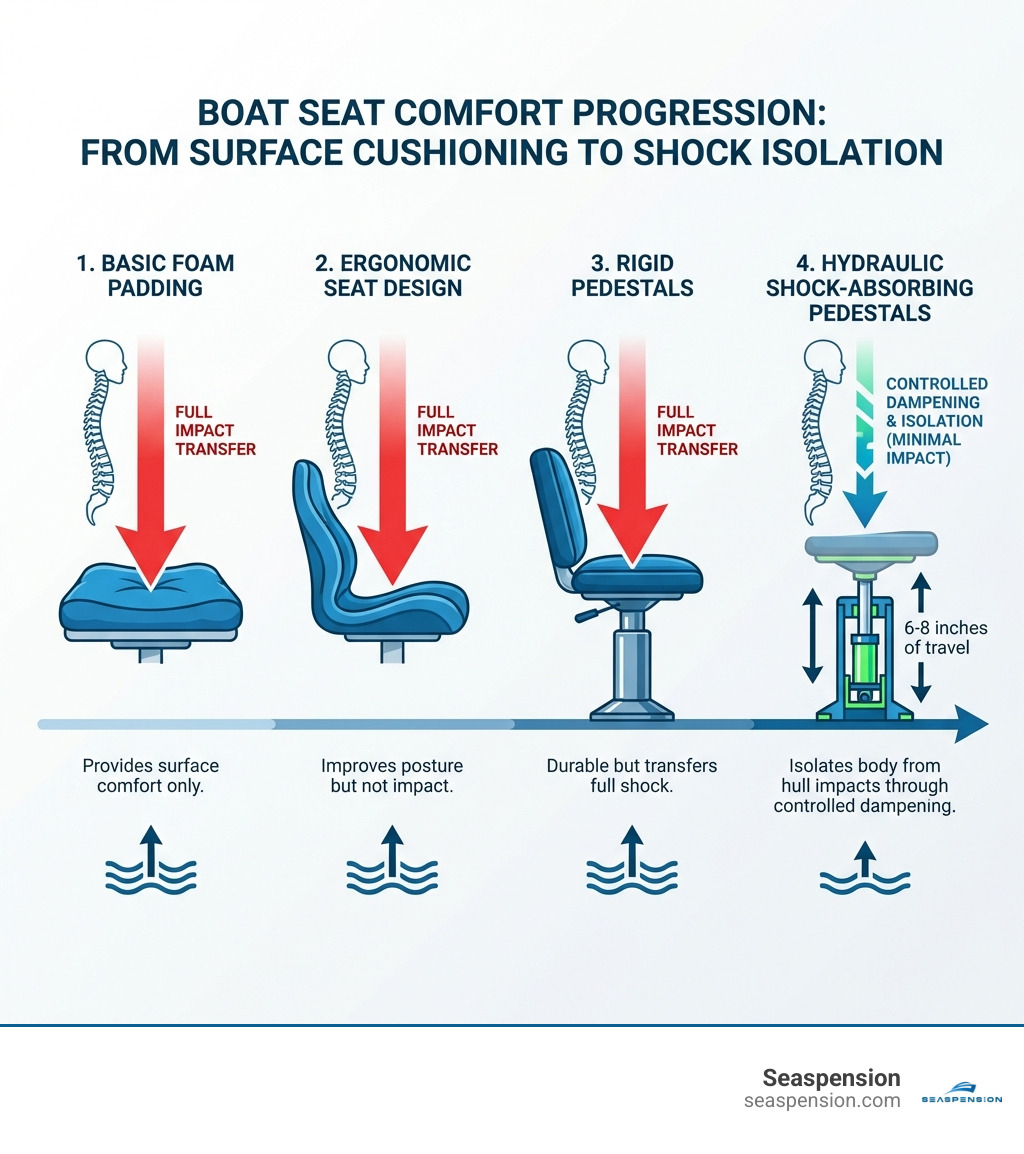
Most boaters focus on the wrong things when trying to improve comfort. They upgrade to premium helm chairs with better cushioning, add lumbar support, or invest in high-end materials — but still experience back pain and fatigue after a day on rough water. The reason is simple: cushions and upholstery address surface comfort, not impact forces. A plush seat on a rigid pedestal still transfers every wave strike directly into your body.
The solution isn't more padding. It's isolating your body from the hull through proper shock mitigation. This means understanding how suspension systems work, what types of dampening are most effective, and how to match a shock-absorbing pedestal to your specific boating conditions.
I'm Ian Milligan, owner of Seaspension, a marine technology company specializing in hydraulic shock-absorbing boat seat pedestals for recreational and commercial vessels. Over the past several years, I've worked with boaters dealing with fatigue and injury from inadequate boat seat comfort solutions, and I've seen what works in real-world marine conditions.
Boating is a passion for many of us, but it often comes with an unspoken cost: the physical toll it takes on our bodies. Every time our boat encounters a wave, the impact force travels directly through the hull, up through the seat, and into our spine. This constant jarring, known as whole-body vibration, can accumulate over hours, days, and decades on the water.
We've all seen or experienced it: the boater who steps off their vessel with an aching back, or the seasoned marine professional whose gait tells a story of years spent enduring rough conditions. The statistics bear this out: boaters can experience long-term back pain, pinched nerves, and compressed spines due to decades of riding in boats with poor seating. The marine industry is unfortunately full of individuals who walk with a lurch, have hunchbacks, and sport ugly scars from back surgery, often due to this chronic exposure. This is the hidden force of boating, and it's why addressing boat seat comfort goes far beyond superficial padding. It's about protecting your long-term health and enhancing your safety. You can learn more about this impact on your body and how it can be softened by reading our article, The Hidden Force of Boating: Why Your Body Feels the Impact and How Seaspension Softens the Blow.
The consequences of this repetitive impact are severe and extend beyond mere discomfort. We're talking about pinched nerves, compressed spinal discs, and chronic back pain that can lead to significant medical interventions, including surgery. Many boaters, after years of enduring rough rides, find themselves facing these very real and debilitating issues. The scars from back surgery are a stark reminder of the physical toll that neglecting proper shock mitigation can exact.
Beyond the pain, there's another critical factor: reduced focus. When your body is constantly bracing for impact, or when you're distracted by discomfort, your ability to concentrate on navigation, watch for hazards, or react quickly diminishes. This isn't just about personal comfort; it's a significant safety concern. Elevating your boating experience by reducing fatigue and improving focus on the water is essential, and you can find more insights in our guide, Seaspension and Safety: Elevating Your Boating Experience by Reducing Fatigue and Improving Focus on the Water.
Fatigue on the water is more insidious than simply feeling tired at the end of the day. It directly impacts your cognitive and physical performance. We've seen how prolonged exposure to whole-body vibration and the constant physical strain of a rough ride can lead to reduced reaction time, poor decision-making, and an increased risk of accidents. When your body is exhausted from absorbing impacts, your mind isn't as sharp, and your reflexes are dulled.
This isn't just about end-of-day soreness; it's about the safety implications for everyone on board. A fatigued captain is a less safe captain. For those who have already experienced back injuries or even undergone surgery, returning to boating can be a challenge. Investing in solutions that mitigate these impacts allows us to enjoy longer, safer, and more comfortable days on the water. Learn how we can help you get back on the water after an injury in Boating After Back Surgery: How Seaspension Can Help You Get Back on the Water.

It's easy to fall into the trap of thinking that a plush, well-upholstered seat automatically means superior boat seat comfort. We see many boaters invest heavily in what appear to be high-end helm seats, complete with luxurious materials and ergonomic designs, only to find themselves still experiencing discomfort after a long day. This is a common misconception, as these "surface-level solutions" often fail to address the root cause of impact and vibration.
The problem isn't the seat itself, but the rigid connection it has to the boat's hull. Conventional seating, no matter how well-padded, transmits virtually every jarring impact directly to the occupant. The limitations of this traditional approach become painfully clear the moment you hit a chop. It's why we advocate for a fundamental shift in how boaters approach seating comfort, moving beyond mere aesthetics to true impact mitigation. We've explored this in detail in Seaspension vs Conventional Boat Seating: Why Make the Switch?.
When we talk about upholstery and padding, we're typically discussing materials like marine-grade vinyl and closed-cell foam. These materials are indeed crucial for surface comfort and durability in the harsh marine environment. Marine-grade vinyl is robust, water-resistant, easy to clean, and designed to endure harsh weather and UV rays, preventing fading and resisting mildew. Closed-cell foam is chosen because it doesn't absorb water, which helps prevent mildew and keeps the seat dry. Features like UV resistance and antimicrobial properties are vital for the longevity and cleanliness of your boat seats.
However, these materials, while excellent for their intended purpose, do very little to absorb the significant impact forces generated by waves. A thick cushion might momentarily soften the initial blow, but it quickly "bottoms out," transferring the remaining force directly to your body. Worse, some foams can have a "rebound effect," pushing you back up after impact, which can be just as jarring. This is why, even with the best marine-grade vinyl and foam, if the seat is rigidly mounted, you're still going to feel every bump. Different types of boat seats offer varying levels of comfort; you can explore them further in 7 Types of Boat Seats and How to Select Your Seating.
Many boaters confuse ergonomic design with shock absorption. Helm chairs, leaning posts, flip-up bolsters, and armrests are all excellent features that contribute to improved posture, support, and convenience. For example, flip-up bolsters allow a captain to easily switch between sitting and standing, which is great for visibility and comfort during long runs. Adjustable bases that move fore/aft and up/down, along with features like flip-down toe rests, allow for personalized positioning and reduce strain. We've seen how important these features are, particularly for center console helm seats, as highlighted in What to Look For In Center-Console Helm Seats | Boating Mag.
However, while these ergonomic considerations significantly improve overall comfort and reduce fatigue from poor posture, they do not, by themselves, mitigate the shock from wave impacts. An ergonomically perfect seat on a rigid pedestal will still transmit damaging forces to your spine. True boat seat comfort in rough conditions requires isolating the occupant from these impacts, a function that traditional seat designs simply aren't built to provide.

The real solution to maximizing boat seat comfort and protecting your body lies in shock mitigation through suspension systems. Instead of simply cushioning the impact, these systems actively absorb and dissipate the energy from wave strikes, preventing it from reaching your body. The core principle is to isolate the seat, and therefore the occupant, from the hull's motion.
By effectively reducing G-forces—the measure of acceleration force—that your body experiences, shock-absorbing pedestals dramatically lessen the impact on your spine and joints. This isn't about making the ride feel "softer" in the traditional sense; it's about making it safer and more sustainable for your body. The science behind this shock absorption is critical to elevating your boating experience, as we detail in The Science Behind Shock Absorption: Elevating Your Boating Experience with Seaspension.
At the heart of effective shock mitigation for boat seats is the hydraulic shock-absorbing pedestal. Unlike simpler designs that might rely on basic springs or air bladders, a well-engineered hydraulic system provides controlled motion. When a wave impact occurs, the hydraulic dampening system compresses smoothly, absorbing the energy. This controlled compression prevents the jarring "bottoming out" feeling that rigid seats or inadequate suspension systems can cause.
Crucially, hydraulic systems also manage the rebound. Instead of "ejecting" or "catapulting" the occupant upwards after an impact, the hydraulic dampening controls the return motion, ensuring a smooth and gentle recovery. This controlled movement, combined with ample shock travel (typically 6-8 inches in high-performance systems), means your body remains relatively stable even when the boat is moving violently beneath you. This precise engineering is why you don't get jiggled with the best boat seat suspension systems, a topic we cover in Don't Get Jiggled: Choosing the Best Boat Seat Suspension System.
While every boater can appreciate improved comfort, certain individuals and applications benefit most profoundly from a suspension upgrade. We've seen the transformative effect our pedestals have on:
Anyone who spends significant time on the water, especially in rough conditions, will find a hydraulic shock-absorbing pedestal to be one of the most impactful upgrades for their boat seat comfort. Our systems are designed to benefit a wide array of boating activities, from fishing to cruising and more, as detailed in How Seaspension Benefits Different Boating Activities: Fishing, Cruising, and More.
Deciding to upgrade your boat's seating system with shock-absorbing pedestals is a significant step towards maximizing your boat seat comfort and extending your time on the water. However, it's not simply a matter of swapping out one pedestal for another. Proper installation, careful measurement, and a focus on long-term durability and maintenance are all crucial to realizing the full benefits.
This upgrade isn't just about adding a new piece of equipment; it's about enhancing your entire boating experience, making your vessel feel new again. We believe that the best upgrades are those that allow you to keep doing what you love, comfortably and safely. Find out more about how to revitalize your boat in How to Make Your Old Boat Feel New Again: Best 2025 Upgrades That Help You Keep Doing What You Love.
When selecting and installing a shock-absorbing pedestal, precision is key. We always advise careful measurement to ensure a perfect fit for your boat and your existing seat.
While many boaters are comfortable with DIY projects, we offer detailed installation guides and support to ensure correct setup. When in doubt, a professional marine installer can ensure optimal performance and safety. For a step-by-step guide, refer to How to Install a Seaspension Shock-Absorbing Boat Seat Pedestal.
The difference between basic boat seats and premium options, particularly those with integrated suspension, goes far beyond price. It's rooted in construction quality, materials, and rigorous testing.
Basic seats might offer minimal padding and a rigid frame, providing little to no impact absorption. Premium options, on the other hand, incorporate advanced engineering. When evaluating true boat seat comfort, we look at:
Maximizing your boat seat comfort is about more than just a softer ride; it's about enhancing your safety, extending your time on the water, and protecting your body from the cumulative effects of wave impacts. We've seen how ignoring these forces can lead to long-term physical ailments and reduce the enjoyment of boating.
By understanding the limitations of conventional seating and embracing the proven benefits of hydraulic shock-absorbing pedestals, you can mitigate impact, reduce fatigue, and significantly improve your boating experience. Our hydraulic solutions are engineered for real-world durability and controlled motion, ensuring that you can steer rough waters with greater confidence and comfort.
Don't let discomfort cut your boating adventures short. Invest in a solution that truly protects your body and allows you to fully accept the open water. We encourage you to Explore our full range of shock-absorbing boat seats and pedestals to find the perfect upgrade for your vessel.
Boat seat comfort isn't just about cushions and upholstery — it's about protecting your body from the repetitive impacts that occur every time your hull meets a wave. Poor seating can lead to long-term back pain, pinched nerves, compressed spines, and chronic fatigue. The industry is full of boaters who walk with a lurch, sport scars from back surgery, or cut their time on the water short because their body can't handle it anymore.
Quick Answer: How to Maximize Boat Seat Comfort
Key factors that contribute to real boat seat comfort:
| Factor | Why It Matters |
|---|---|
| Shock absorption | Reduces G-forces from wave impacts that cause spinal compression |
| Controlled motion | Prevents ejection or catapult feeling when bottoming out |
| Durability | Marine environments demand corrosion-resistant materials and sealed systems |
| Adjustability | Allows customization for different operator weights and sea conditions |
| Installation quality | Poor mounting leads to flex, noise, and premature failure |
Most boaters focus on the wrong things when trying to improve comfort. They upgrade to premium helm chairs with better cushioning, add lumbar support, or invest in high-end materials — but still experience back pain and fatigue after a day on rough water. The reason is simple: cushions and upholstery address surface comfort, not impact forces. A plush seat on a rigid pedestal still transfers every wave strike directly into your body.
The solution isn't more padding. It's isolating your body from the hull through proper shock mitigation. This means understanding how suspension systems work, what types of dampening are most effective, and how to match a shock-absorbing pedestal to your specific boating conditions.
I'm Ian Milligan, owner of Seaspension, a marine technology company specializing in hydraulic shock-absorbing boat seat pedestals for recreational and commercial vessels. Over the past several years, I've worked with boaters dealing with fatigue and injury from inadequate boat seat comfort solutions, and I've seen what works in real-world marine conditions.
Boating is a passion for many of us, but it often comes with an unspoken cost: the physical toll it takes on our bodies. Every time our boat encounters a wave, the impact force travels directly through the hull, up through the seat, and into our spine. This constant jarring, known as whole-body vibration, can accumulate over hours, days, and decades on the water.
We've all seen or experienced it: the boater who steps off their vessel with an aching back, or the seasoned marine professional whose gait tells a story of years spent enduring rough conditions. The statistics bear this out: boaters can experience long-term back pain, pinched nerves, and compressed spines due to decades of riding in boats with poor seating. The marine industry is unfortunately full of individuals who walk with a lurch, have hunchbacks, and sport ugly scars from back surgery, often due to this chronic exposure. This is the hidden force of boating, and it's why addressing boat seat comfort goes far beyond superficial padding. It's about protecting your long-term health and enhancing your safety. You can learn more about this impact on your body and how it can be softened by reading our article, The Hidden Force of Boating: Why Your Body Feels the Impact and How Seaspension Softens the Blow.
The consequences of this repetitive impact are severe and extend beyond mere discomfort. We're talking about pinched nerves, compressed spinal discs, and chronic back pain that can lead to significant medical interventions, including surgery. Many boaters, after years of enduring rough rides, find themselves facing these very real and debilitating issues. The scars from back surgery are a stark reminder of the physical toll that neglecting proper shock mitigation can exact.
Beyond the pain, there's another critical factor: reduced focus. When your body is constantly bracing for impact, or when you're distracted by discomfort, your ability to concentrate on navigation, watch for hazards, or react quickly diminishes. This isn't just about personal comfort; it's a significant safety concern. Elevating your boating experience by reducing fatigue and improving focus on the water is essential, and you can find more insights in our guide, Seaspension and Safety: Elevating Your Boating Experience by Reducing Fatigue and Improving Focus on the Water.
Fatigue on the water is more insidious than simply feeling tired at the end of the day. It directly impacts your cognitive and physical performance. We've seen how prolonged exposure to whole-body vibration and the constant physical strain of a rough ride can lead to reduced reaction time, poor decision-making, and an increased risk of accidents. When your body is exhausted from absorbing impacts, your mind isn't as sharp, and your reflexes are dulled.
This isn't just about end-of-day soreness; it's about the safety implications for everyone on board. A fatigued captain is a less safe captain. For those who have already experienced back injuries or even undergone surgery, returning to boating can be a challenge. Investing in solutions that mitigate these impacts allows us to enjoy longer, safer, and more comfortable days on the water. Learn how we can help you get back on the water after an injury in Boating After Back Surgery: How Seaspension Can Help You Get Back on the Water.
It's easy to fall into the trap of thinking that a plush, well-upholstered seat automatically means superior boat seat comfort. We see many boaters invest heavily in what appear to be high-end helm seats, complete with luxurious materials and ergonomic designs, only to find themselves still experiencing discomfort after a long day. This is a common misconception, as these "surface-level solutions" often fail to address the root cause of impact and vibration.
The problem isn't the seat itself, but the rigid connection it has to the boat's hull. Conventional seating, no matter how well-padded, transmits virtually every jarring impact directly to the occupant. The limitations of this traditional approach become painfully clear the moment you hit a chop. It's why we advocate for a fundamental shift in how boaters approach seating comfort, moving beyond mere aesthetics to true impact mitigation. We've explored this in detail in Seaspension vs Conventional Boat Seating: Why Make the Switch?.
When we talk about upholstery and padding, we're typically discussing materials like marine-grade vinyl and closed-cell foam. These materials are indeed crucial for surface comfort and durability in the harsh marine environment. Marine-grade vinyl is robust, water-resistant, easy to clean, and designed to endure harsh weather and UV rays, preventing fading and resisting mildew. Closed-cell foam is chosen because it doesn't absorb water, which helps prevent mildew and keeps the seat dry. Features like UV resistance and antimicrobial properties are vital for the longevity and cleanliness of your boat seats.
However, these materials, while excellent for their intended purpose, do very little to absorb the significant impact forces generated by waves. A thick cushion might momentarily soften the initial blow, but it quickly "bottoms out," transferring the remaining force directly to your body. Worse, some foams can have a "rebound effect," pushing you back up after impact, which can be just as jarring. This is why, even with the best marine-grade vinyl and foam, if the seat is rigidly mounted, you're still going to feel every bump. Different types of boat seats offer varying levels of comfort; you can explore them further in 7 Types of Boat Seats and How to Select Your Seating.
Many boaters confuse ergonomic design with shock absorption. Helm chairs, leaning posts, flip-up bolsters, and armrests are all excellent features that contribute to improved posture, support, and convenience. For example, flip-up bolsters allow a captain to easily switch between sitting and standing, which is great for visibility and comfort during long runs. Adjustable bases that move fore/aft and up/down, along with features like flip-down toe rests, allow for personalized positioning and reduce strain. We've seen how important these features are, particularly for center console helm seats, as highlighted in What to Look For In Center-Console Helm Seats | Boating Mag.
However, while these ergonomic considerations significantly improve overall comfort and reduce fatigue from poor posture, they do not, by themselves, mitigate the shock from wave impacts. An ergonomically perfect seat on a rigid pedestal will still transmit damaging forces to your spine. True boat seat comfort in rough conditions requires isolating the occupant from these impacts, a function that traditional seat designs simply aren't built to provide.
The real solution to maximizing boat seat comfort and protecting your body lies in shock mitigation through suspension systems. Instead of simply cushioning the impact, these systems actively absorb and dissipate the energy from wave strikes, preventing it from reaching your body. The core principle is to isolate the seat, and therefore the occupant, from the hull's motion.
By effectively reducing G-forces—the measure of acceleration force—that your body experiences, shock-absorbing pedestals dramatically lessen the impact on your spine and joints. This isn't about making the ride feel "softer" in the traditional sense; it's about making it safer and more sustainable for your body. The science behind this shock absorption is critical to elevating your boating experience, as we detail in The Science Behind Shock Absorption: Elevating Your Boating Experience with Seaspension.
At the heart of effective shock mitigation for boat seats is the hydraulic shock-absorbing pedestal. Unlike simpler designs that might rely on basic springs or air bladders, a well-engineered hydraulic system provides controlled motion. When a wave impact occurs, the hydraulic dampening system compresses smoothly, absorbing the energy. This controlled compression prevents the jarring "bottoming out" feeling that rigid seats or inadequate suspension systems can cause.
Crucially, hydraulic systems also manage the rebound. Instead of "ejecting" or "catapulting" the occupant upwards after an impact, the hydraulic dampening controls the return motion, ensuring a smooth and gentle recovery. This controlled movement, combined with ample shock travel (typically 6-8 inches in high-performance systems), means your body remains relatively stable even when the boat is moving violently beneath you. This precise engineering is why you don't get jiggled with the best boat seat suspension systems, a topic we cover in Don't Get Jiggled: Choosing the Best Boat Seat Suspension System.
While every boater can appreciate improved comfort, certain individuals and applications benefit most profoundly from a suspension upgrade. We've seen the transformative effect our pedestals have on:
Anyone who spends significant time on the water, especially in rough conditions, will find a hydraulic shock-absorbing pedestal to be one of the most impactful upgrades for their boat seat comfort. Our systems are designed to benefit a wide array of boating activities, from fishing to cruising and more, as detailed in How Seaspension Benefits Different Boating Activities: Fishing, Cruising, and More.
Deciding to upgrade your boat's seating system with shock-absorbing pedestals is a significant step towards maximizing your boat seat comfort and extending your time on the water. However, it's not simply a matter of swapping out one pedestal for another. Proper installation, careful measurement, and a focus on long-term durability and maintenance are all crucial to realizing the full benefits.
This upgrade isn't just about adding a new piece of equipment; it's about enhancing your entire boating experience, making your vessel feel new again. We believe that the best upgrades are those that allow you to keep doing what you love, comfortably and safely. Find out more about how to revitalize your boat in How to Make Your Old Boat Feel New Again: Best 2025 Upgrades That Help You Keep Doing What You Love.
When selecting and installing a shock-absorbing pedestal, precision is key. We always advise careful measurement to ensure a perfect fit for your boat and your existing seat.
While many boaters are comfortable with DIY projects, we offer detailed installation guides and support to ensure correct setup. When in doubt, a professional marine installer can ensure optimal performance and safety. For a step-by-step guide, refer to How to Install a Seaspension Shock-Absorbing Boat Seat Pedestal.
The difference between basic boat seats and premium options, particularly those with integrated suspension, goes far beyond price. It's rooted in construction quality, materials, and rigorous testing.
Basic seats might offer minimal padding and a rigid frame, providing little to no impact absorption. Premium options, on the other hand, incorporate advanced engineering. When evaluating true boat seat comfort, we look at:
Maximizing your boat seat comfort is about more than just a softer ride; it's about enhancing your safety, extending your time on the water, and protecting your body from the cumulative effects of wave impacts. We've seen how ignoring these forces can lead to long-term physical ailments and reduce the enjoyment of boating.
By understanding the limitations of conventional seating and embracing the proven benefits of hydraulic shock-absorbing pedestals, you can mitigate impact, reduce fatigue, and significantly improve your boating experience. Our hydraulic solutions are engineered for real-world durability and controlled motion, ensuring that you can steer rough waters with greater confidence and comfort.
Don't let discomfort cut your boating adventures short. Invest in a solution that truly protects your body and allows you to fully accept the open water. We encourage you to Explore our full range of shock-absorbing boat seats and pedestals to find the perfect upgrade for your vessel.


