Smooth ride boat seats are shock-absorbing pedestal systems that use springs and hydraulic dampers to reduce wave impact by up to 75%, protecting your body from jolts and vibrations during rough water conditions.
Key Features to Look For:
If you've ever spent a full day on the water and felt it in your back for days afterward, you're not alone. One forum user described their friend who "has had multiple back surgeries and struggles with rough water" — a problem that keeps many boaters off the water entirely. Another boater reported that after three spinal surgeries, a hydraulic suspension seat allowed them to "compete and fish in large waves with absolutely no discomfort."
The difference between a standard boat seat and a true shock-absorbing pedestal isn't just comfort. It's about reducing the repeated compression forces that travel through your spine with every wave impact. Standard cushioned seats absorb almost nothing — they simply spread the impact across a wider area. A proper suspension system actively absorbs energy before it reaches your body.
What causes the problem: When your boat hits a wave, the impact generates forces that travel straight up through the hull, deck, seat pedestal, and into your spine. Without proper suspension, your body acts as the shock absorber. Over time, this causes fatigue, reduces your ability to focus, and can lead to chronic pain or injury.
I'm Ian Milligan, owner of Seaspension, where we've helped thousands of boaters reduce impact fatigue through purpose-built marine suspension systems. Since taking over the company in 2021, I've seen how the right smooth ride boat seats transform not just comfort, but safety and time on the water.
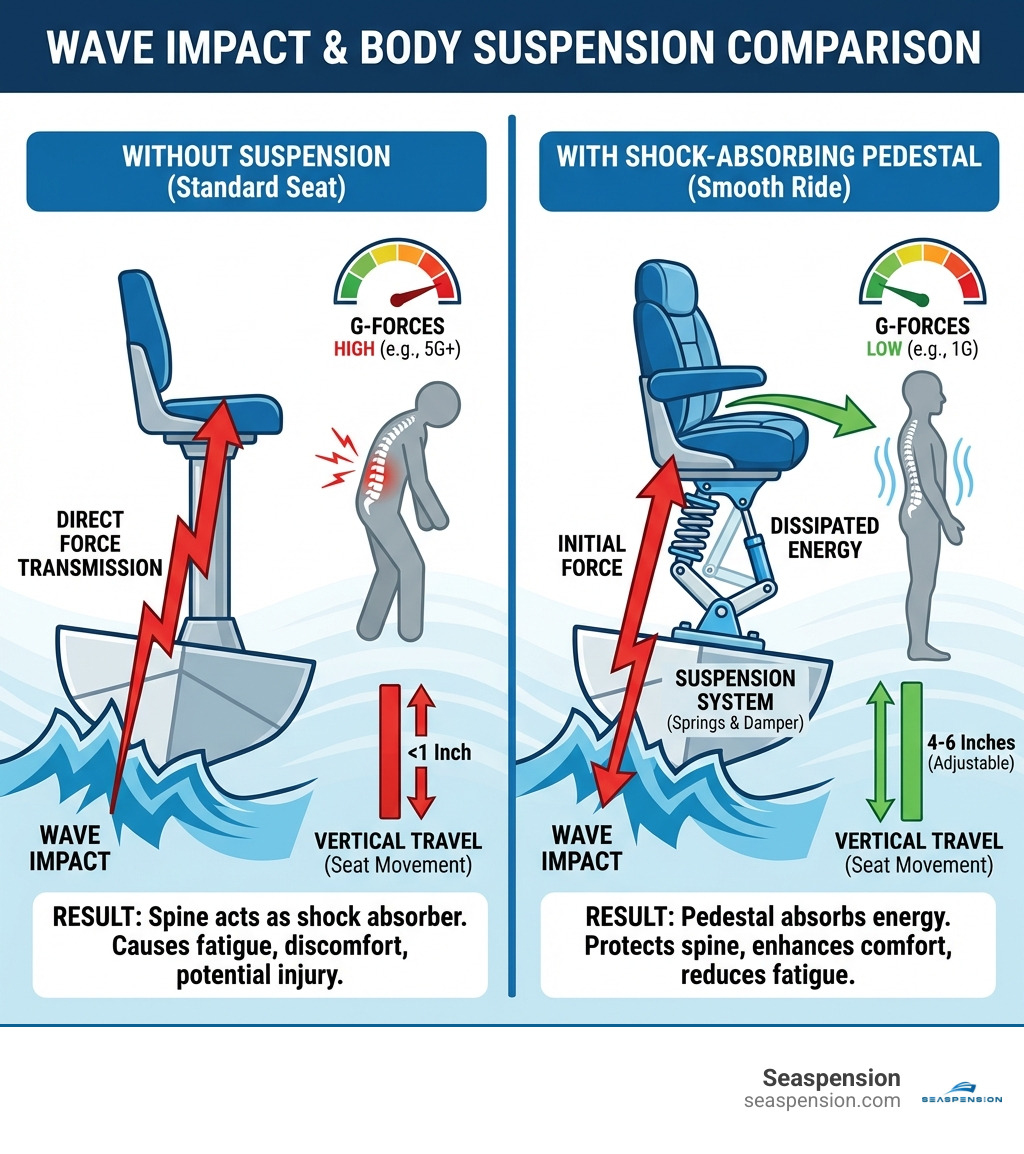
Boating is inherently an activity that exposes us to dynamic forces. Every wave, every chop, every sudden change in speed translates into an impact that travels through our bodies. This phenomenon, known as whole-body vibration, is more than just an uncomfortable nuisance; it poses significant risks to our health and overall boating experience.

When we spend hours on the water, especially in rough conditions, our bodies are constantly absorbing these shocks. This leads to operator fatigue, which can impair judgment and reaction times. The repeated jolts contribute to back and joint pain, a common complaint among avid boaters. This can reduce our control over the vessel, diminishing both performance and safety. We understand the hidden forces at play and how they impact your time on the water. To dig deeper into this, we invite you to explore The Hidden Force of Boating: Why Your Body Feels the Impact and How Seaspension Softens the Blow.
The human body is not designed to withstand constant impact. Each time your boat slams into a wave, a shockwave travels through your skeletal system. This can result in reduced focus, as your body tenses to brace for the next impact, diverting attention from navigation or fishing. Over time, these cumulative forces can lead to long-term joint wear, particularly in the knees, hips, and spine. Neck and back strain are almost inevitable for those who frequently boat in choppy waters without adequate shock mitigation. This isn't just about comfort; it's a critical safety concern. Improving your boating experience means understanding these impacts. Learn more about how we prioritize your well-being in Seaspension and Safety: Elevating Your Boating Experience by Reducing Fatigue and Improving Focus on the Water.
While anyone can benefit from a smoother ride, certain groups feel the effects of rough water most acutely. Offshore anglers, who often venture far from shore in pursuit of big game, frequently encounter challenging conditions that demand peak physical endurance. Commercial operators, including charter captains and professional guides, spend countless hours on the water, making them highly susceptible to cumulative trauma. Law enforcement and military personnel operating patrol boats rely on sustained focus and physical resilience, which can be severely compromised by constant impacts.
Perhaps most critically, boaters with prior injuries, especially those related to the back or neck, find rough water unbearable. As one boater shared, "a hydraulic suspension seat has allowed me to compete after three spinal surgeries. I fish in large waves with absolutely no discomfort to me or my passenger." This underscores the profound impact these systems can have. Even families with children benefit, as a smoother ride makes boating more enjoyable and safer for younger, more delicate bodies. For those considering getting back on the water after an injury, we have resources like Boating After Back Surgery: How Seaspension Can Help You Get Back on the Water. Our solutions are designed for everyone, from the recreational enthusiast to the commercial professional, as detailed in Commercial vs. Recreational Marine Seating: Why Seaspension Works for Every Kind of Boater.
Many boaters believe that a heavily padded seat or a thicker cushion will solve the problem of rough water. This is a common misconception. While a plush seat might feel comfortable at the dock, it offers little to no real shock absorption when you hit a two-foot chop. Standard boat seats, even those with some built-in springs, are primarily designed for static comfort, not dynamic impact mitigation.

Think of it this way: a pillow might be soft, but it won't absorb the impact of jumping from a height. Similarly, cushioned seats merely spread the impact across a wider area of your body; they don't dissipate the energy that causes jolts. We've seen boaters attempt makeshift solutions, like piling up life jackets or extra cushions, but these often create instability and offer minimal, if any, effective shock absorption. The limitations of basic spring posts are also quickly apparent in rough conditions, often leading to a "springy action" that can feel like it's throwing you out of your seat rather than cushioning the blow. For a detailed look at why conventional seating falls short, check out Seaspension vs. Conventional Boat Seating: Why Make the Switch?.
The solution to truly achieving a smooth ride lies in purpose-built shock-absorbing pedestals. These systems don't just add padding; they actively manage and dissipate the energy from impacts before it reaches your body. The core principle is to isolate the seat from the boat's hull movement, allowing the seat to remain relatively stable while the boat moves beneath it.
This is achieved through a combination of a spring and a damper system. The spring absorbs the initial impact, compressing to take the brunt of the force. The damper, or shock absorber, then controls the rate at which the spring compresses and, crucially, rebounds. This controlled vertical travel prevents the jarring "bottoming out" sensation and the uncomfortable "ejection" feeling that can occur with lesser systems. The science behind this is fascinating and effective. You can learn more about it in The Science Behind Shock Absorption: Elevating Your Boating Experience with Seaspension.
At the heart of every effective shock-absorbing pedestal are its two main components: the spring and the shock absorber. The spring, typically a heavy-duty coil spring, is responsible for bearing the load and absorbing the initial impact energy. It compresses under force, storing that energy.
The shock absorber, often hydraulic, plays a critical role in controlling this stored energy. It works by converting the kinetic energy of the impact into heat, which is then dissipated. This process, known as hydraulic damping, prevents the spring from bouncing uncontrollably, ensuring a smooth, controlled compression and rebound. Without proper damping, a spring alone would create a bouncy, unstable ride. Together, they create a system that absorbs energy, cushions the ride, and controls movement. Explore the specifics of these systems in Shock Absorbing Boat Seat Pedestal.
When it comes to smooth ride boat seats, the technology used for shock absorption is critical. Hydraulic suspension systems, which are at the core of Seaspension pedestals, are highly effective. They use fluid dynamics to provide a controlled and consistent ride, absorbing impacts without the "springy" or "bouncy" feeling that lesser systems can produce. This method ensures a smooth compression and rebound, effectively eliminating harsh jolts. Our independently operating shock-absorbing system is designed for optimal comfort and safety, automatically adjusting to varying occupant weights.
While other suspension technologies exist, understanding the specific benefits of a hydraulic system is key to making an informed decision. Hydraulic damping provides superior performance in a wide range of conditions and prevents the system from bottoming out on heavy impacts. For boaters seeking a truly smooth and controlled experience, the fluid dynamics of a hydraulic pedestal offer a distinct advantage. For a more detailed comparison of different suspension types, you can read Hydraulic vs. Air Suspension for Boats: What Most Boaters Don't Know.
Selecting the ideal shock-absorbing pedestal for your boat involves more than just picking a product off the shelf. It requires careful consideration of several factors to ensure optimal performance, comfort, and longevity. We want you to make the right decision for your boating needs. To help you avoid common pitfalls, we've put together a guide: Don't Get Jiggled: Choosing the Best Boat Seat Suspension System.
When evaluating smooth ride boat seats, keep the following in mind:
For additional insights into marine seating options, you may find this resource helpful: Further reading on marine seating options.
The difference between a generic suspension seat and a purpose-built marine shock pedestal is stark. While some generic solutions might offer a degree of cushioning, they often lack the durability, stability, and specific engineering required for the relentless demands of the marine environment. Marine-grade pedestals are constructed from robust, corrosion-resistant materials designed to withstand saltwater, UV exposure, and constant vibration.
Their stability is paramount; an unstable suspension system can be more dangerous than no suspension at all, particularly in rough seas. True marine shock pedestals offer real-world performance, engineered to absorb the unique forces encountered on the water, not just on land. They provide controlled rebound, preventing you from being "catapulted" out of your seat. This combination of durability, stability, and precise engineering ensures that your investment provides genuine comfort and safety for years to come. For a deeper understanding of this distinction, consider Seaspension vs. Conventional Boat Seating: Why Make the Switch?.
Integrating smooth ride boat seats into your vessel is a straightforward process for most boaters, but understanding the steps and requirements is key. Whether you opt for a DIY approach or professional installation, having a clear picture of what's involved will ensure a successful upgrade.
Many high-quality pedestals are designed with an industry-standard six-bolt pattern, which simplifies the process significantly as they often align with existing mounting holes. We believe in empowering boaters with the knowledge to upgrade their experience. For a comprehensive walkthrough, refer to How to Install a Seaspension Shock-Absorbing Pedestal.
The installation process for a shock-absorbing boat seat pedestal typically involves a few key steps:
While many installations can be a rewarding DIY project, always refer to the specific instructions provided with your pedestal. If you're unsure, consulting a marine professional is always a wise choice. For more detailed guidance, our resource on The Ultimate Guide to Boat Seat Installation can be highly beneficial.
Proper care and maintenance are crucial for extending the lifespan and ensuring the continued performance of your shock-absorbing boat seat pedestal. Marine environments are harsh, and even the most robust materials require attention.
By dedicating a small amount of time to these simple maintenance tasks, you can ensure your smooth ride boat seats continue to provide optimal comfort and protection for many seasons to come. If you have any questions about specific care requirements, our FAQ section is a great place to start.
The most profound benefits of installing smooth ride boat seats are experienced on the water. These aren't just theoretical advantages; they translate directly into a better, safer, and more enjoyable boating experience. The relief felt after installation is often immediate and significant.
For those who spend countless hours pursuing their passion or profession on the water, shock-absorbing pedestals are not a luxury but a necessity. The reduced fatigue on long runs means maintaining focus and stamina throughout the day, which can be the difference between a successful tournament and a missed opportunity. One boater noted that after installing a high-performance pedestal, they found "no springy action that throws you out of your seat, just a pure comfortable ride." This allows for faster travel in rough seas, as the body is protected from the constant pounding, enabling the captain to push the boat more efficiently. Perhaps most importantly, it means less wear and tear on the body, preserving physical health for years of continued boating. As one professional angler, who had previously suffered from back pain, shared, they had "not had a single chiropractic appointment" since installing such a system. We understand the demands of serious angling, which is why we’ve focused on creating solutions that help you Fish Like a Pro, Relax Like a King with Seaspension.
The benefits extend far beyond the competitive circuit. For recreational boaters and families, smooth ride boat seats transform the entire experience. Making boating more enjoyable for everyone means that even in choppy conditions, passengers remain comfortable and happy, preventing complaints and cutting trips short. An 89-year-old passenger on Lake Erie, for example, experienced "no jarring" and raved about the difference a suspension seat made. This also improves safety for passengers, as they are less likely to be thrown around the boat during unexpected impacts. It means extending the boating season, allowing you to enjoy your vessel in a wider range of conditions without discomfort. Creating a comfortable experience for everyone on board is a priority for us. Learn how we improve comfort for all passengers in Enhancing Comfort for Every Passenger: Seaspension for First Mates and Guests. The relief you feel after installing a quality system can truly transform your time on the water, as highlighted in The Relief You Feel After Installing Seaspension on Your Boat.
Investing in smooth ride boat seats is an investment in your comfort, safety, and overall enjoyment of boating. We've explored how these advanced shock-absorbing pedestals actively mitigate the damaging effects of rough water, reducing fatigue, preventing pain, and enhancing control. Unlike standard seats or makeshift solutions, a purpose-built marine suspension system offers genuine shock absorption and controlled movement, changing even challenging conditions into a far more pleasant experience.
The long-term value of such an upgrade cannot be overstated. It protects your body from cumulative trauma, extends your time on the water, and makes boating accessible and enjoyable for everyone on board, from seasoned anglers to families with young children. When choosing a solution, prioritize durability, adjustability, and a design specifically engineered for the unique demands of the marine environment.
We are dedicated to providing superior shock mitigation solutions. If you're ready to experience the difference a truly smooth ride can make, we invite you to explore our range of shock-absorbing pedestals and find the perfect fit for your vessel.
Smooth ride boat seats are shock-absorbing pedestal systems that use springs and hydraulic dampers to reduce wave impact by up to 75%, protecting your body from jolts and vibrations during rough water conditions.
Key Features to Look For:
If you've ever spent a full day on the water and felt it in your back for days afterward, you're not alone. One forum user described their friend who "has had multiple back surgeries and struggles with rough water" — a problem that keeps many boaters off the water entirely. Another boater reported that after three spinal surgeries, a hydraulic suspension seat allowed them to "compete and fish in large waves with absolutely no discomfort."
The difference between a standard boat seat and a true shock-absorbing pedestal isn't just comfort. It's about reducing the repeated compression forces that travel through your spine with every wave impact. Standard cushioned seats absorb almost nothing — they simply spread the impact across a wider area. A proper suspension system actively absorbs energy before it reaches your body.
What causes the problem: When your boat hits a wave, the impact generates forces that travel straight up through the hull, deck, seat pedestal, and into your spine. Without proper suspension, your body acts as the shock absorber. Over time, this causes fatigue, reduces your ability to focus, and can lead to chronic pain or injury.
I'm Ian Milligan, owner of Seaspension, where we've helped thousands of boaters reduce impact fatigue through purpose-built marine suspension systems. Since taking over the company in 2021, I've seen how the right smooth ride boat seats transform not just comfort, but safety and time on the water.
Boating is inherently an activity that exposes us to dynamic forces. Every wave, every chop, every sudden change in speed translates into an impact that travels through our bodies. This phenomenon, known as whole-body vibration, is more than just an uncomfortable nuisance; it poses significant risks to our health and overall boating experience.
When we spend hours on the water, especially in rough conditions, our bodies are constantly absorbing these shocks. This leads to operator fatigue, which can impair judgment and reaction times. The repeated jolts contribute to back and joint pain, a common complaint among avid boaters. This can reduce our control over the vessel, diminishing both performance and safety. We understand the hidden forces at play and how they impact your time on the water. To dig deeper into this, we invite you to explore The Hidden Force of Boating: Why Your Body Feels the Impact and How Seaspension Softens the Blow.
The human body is not designed to withstand constant impact. Each time your boat slams into a wave, a shockwave travels through your skeletal system. This can result in reduced focus, as your body tenses to brace for the next impact, diverting attention from navigation or fishing. Over time, these cumulative forces can lead to long-term joint wear, particularly in the knees, hips, and spine. Neck and back strain are almost inevitable for those who frequently boat in choppy waters without adequate shock mitigation. This isn't just about comfort; it's a critical safety concern. Improving your boating experience means understanding these impacts. Learn more about how we prioritize your well-being in Seaspension and Safety: Elevating Your Boating Experience by Reducing Fatigue and Improving Focus on the Water.
While anyone can benefit from a smoother ride, certain groups feel the effects of rough water most acutely. Offshore anglers, who often venture far from shore in pursuit of big game, frequently encounter challenging conditions that demand peak physical endurance. Commercial operators, including charter captains and professional guides, spend countless hours on the water, making them highly susceptible to cumulative trauma. Law enforcement and military personnel operating patrol boats rely on sustained focus and physical resilience, which can be severely compromised by constant impacts.
Perhaps most critically, boaters with prior injuries, especially those related to the back or neck, find rough water unbearable. As one boater shared, "a hydraulic suspension seat has allowed me to compete after three spinal surgeries. I fish in large waves with absolutely no discomfort to me or my passenger." This underscores the profound impact these systems can have. Even families with children benefit, as a smoother ride makes boating more enjoyable and safer for younger, more delicate bodies. For those considering getting back on the water after an injury, we have resources like Boating After Back Surgery: How Seaspension Can Help You Get Back on the Water. Our solutions are designed for everyone, from the recreational enthusiast to the commercial professional, as detailed in Commercial vs. Recreational Marine Seating: Why Seaspension Works for Every Kind of Boater.
Many boaters believe that a heavily padded seat or a thicker cushion will solve the problem of rough water. This is a common misconception. While a plush seat might feel comfortable at the dock, it offers little to no real shock absorption when you hit a two-foot chop. Standard boat seats, even those with some built-in springs, are primarily designed for static comfort, not dynamic impact mitigation.
Think of it this way: a pillow might be soft, but it won't absorb the impact of jumping from a height. Similarly, cushioned seats merely spread the impact across a wider area of your body; they don't dissipate the energy that causes jolts. We've seen boaters attempt makeshift solutions, like piling up life jackets or extra cushions, but these often create instability and offer minimal, if any, effective shock absorption. The limitations of basic spring posts are also quickly apparent in rough conditions, often leading to a "springy action" that can feel like it's throwing you out of your seat rather than cushioning the blow. For a detailed look at why conventional seating falls short, check out Seaspension vs. Conventional Boat Seating: Why Make the Switch?.
The solution to truly achieving a smooth ride lies in purpose-built shock-absorbing pedestals. These systems don't just add padding; they actively manage and dissipate the energy from impacts before it reaches your body. The core principle is to isolate the seat from the boat's hull movement, allowing the seat to remain relatively stable while the boat moves beneath it.
This is achieved through a combination of a spring and a damper system. The spring absorbs the initial impact, compressing to take the brunt of the force. The damper, or shock absorber, then controls the rate at which the spring compresses and, crucially, rebounds. This controlled vertical travel prevents the jarring "bottoming out" sensation and the uncomfortable "ejection" feeling that can occur with lesser systems. The science behind this is fascinating and effective. You can learn more about it in The Science Behind Shock Absorption: Elevating Your Boating Experience with Seaspension.
At the heart of every effective shock-absorbing pedestal are its two main components: the spring and the shock absorber. The spring, typically a heavy-duty coil spring, is responsible for bearing the load and absorbing the initial impact energy. It compresses under force, storing that energy.
The shock absorber, often hydraulic, plays a critical role in controlling this stored energy. It works by converting the kinetic energy of the impact into heat, which is then dissipated. This process, known as hydraulic damping, prevents the spring from bouncing uncontrollably, ensuring a smooth, controlled compression and rebound. Without proper damping, a spring alone would create a bouncy, unstable ride. Together, they create a system that absorbs energy, cushions the ride, and controls movement. Explore the specifics of these systems in Shock Absorbing Boat Seat Pedestal.
When it comes to smooth ride boat seats, the technology used for shock absorption is critical. Hydraulic suspension systems, which are at the core of Seaspension pedestals, are highly effective. They use fluid dynamics to provide a controlled and consistent ride, absorbing impacts without the "springy" or "bouncy" feeling that lesser systems can produce. This method ensures a smooth compression and rebound, effectively eliminating harsh jolts. Our independently operating shock-absorbing system is designed for optimal comfort and safety, automatically adjusting to varying occupant weights.
While other suspension technologies exist, understanding the specific benefits of a hydraulic system is key to making an informed decision. Hydraulic damping provides superior performance in a wide range of conditions and prevents the system from bottoming out on heavy impacts. For boaters seeking a truly smooth and controlled experience, the fluid dynamics of a hydraulic pedestal offer a distinct advantage. For a more detailed comparison of different suspension types, you can read Hydraulic vs. Air Suspension for Boats: What Most Boaters Don't Know.
Selecting the ideal shock-absorbing pedestal for your boat involves more than just picking a product off the shelf. It requires careful consideration of several factors to ensure optimal performance, comfort, and longevity. We want you to make the right decision for your boating needs. To help you avoid common pitfalls, we've put together a guide: Don't Get Jiggled: Choosing the Best Boat Seat Suspension System.
When evaluating smooth ride boat seats, keep the following in mind:
For additional insights into marine seating options, you may find this resource helpful: Further reading on marine seating options.
The difference between a generic suspension seat and a purpose-built marine shock pedestal is stark. While some generic solutions might offer a degree of cushioning, they often lack the durability, stability, and specific engineering required for the relentless demands of the marine environment. Marine-grade pedestals are constructed from robust, corrosion-resistant materials designed to withstand saltwater, UV exposure, and constant vibration.
Their stability is paramount; an unstable suspension system can be more dangerous than no suspension at all, particularly in rough seas. True marine shock pedestals offer real-world performance, engineered to absorb the unique forces encountered on the water, not just on land. They provide controlled rebound, preventing you from being "catapulted" out of your seat. This combination of durability, stability, and precise engineering ensures that your investment provides genuine comfort and safety for years to come. For a deeper understanding of this distinction, consider Seaspension vs. Conventional Boat Seating: Why Make the Switch?.
Integrating smooth ride boat seats into your vessel is a straightforward process for most boaters, but understanding the steps and requirements is key. Whether you opt for a DIY approach or professional installation, having a clear picture of what's involved will ensure a successful upgrade.
Many high-quality pedestals are designed with an industry-standard six-bolt pattern, which simplifies the process significantly as they often align with existing mounting holes. We believe in empowering boaters with the knowledge to upgrade their experience. For a comprehensive walkthrough, refer to How to Install a Seaspension Shock-Absorbing Pedestal.
The installation process for a shock-absorbing boat seat pedestal typically involves a few key steps:
While many installations can be a rewarding DIY project, always refer to the specific instructions provided with your pedestal. If you're unsure, consulting a marine professional is always a wise choice. For more detailed guidance, our resource on The Ultimate Guide to Boat Seat Installation can be highly beneficial.
Proper care and maintenance are crucial for extending the lifespan and ensuring the continued performance of your shock-absorbing boat seat pedestal. Marine environments are harsh, and even the most robust materials require attention.
By dedicating a small amount of time to these simple maintenance tasks, you can ensure your smooth ride boat seats continue to provide optimal comfort and protection for many seasons to come. If you have any questions about specific care requirements, our FAQ section is a great place to start.
The most profound benefits of installing smooth ride boat seats are experienced on the water. These aren't just theoretical advantages; they translate directly into a better, safer, and more enjoyable boating experience. The relief felt after installation is often immediate and significant.
For those who spend countless hours pursuing their passion or profession on the water, shock-absorbing pedestals are not a luxury but a necessity. The reduced fatigue on long runs means maintaining focus and stamina throughout the day, which can be the difference between a successful tournament and a missed opportunity. One boater noted that after installing a high-performance pedestal, they found "no springy action that throws you out of your seat, just a pure comfortable ride." This allows for faster travel in rough seas, as the body is protected from the constant pounding, enabling the captain to push the boat more efficiently. Perhaps most importantly, it means less wear and tear on the body, preserving physical health for years of continued boating. As one professional angler, who had previously suffered from back pain, shared, they had "not had a single chiropractic appointment" since installing such a system. We understand the demands of serious angling, which is why we’ve focused on creating solutions that help you Fish Like a Pro, Relax Like a King with Seaspension.
The benefits extend far beyond the competitive circuit. For recreational boaters and families, smooth ride boat seats transform the entire experience. Making boating more enjoyable for everyone means that even in choppy conditions, passengers remain comfortable and happy, preventing complaints and cutting trips short. An 89-year-old passenger on Lake Erie, for example, experienced "no jarring" and raved about the difference a suspension seat made. This also improves safety for passengers, as they are less likely to be thrown around the boat during unexpected impacts. It means extending the boating season, allowing you to enjoy your vessel in a wider range of conditions without discomfort. Creating a comfortable experience for everyone on board is a priority for us. Learn how we improve comfort for all passengers in Enhancing Comfort for Every Passenger: Seaspension for First Mates and Guests. The relief you feel after installing a quality system can truly transform your time on the water, as highlighted in The Relief You Feel After Installing Seaspension on Your Boat.
Investing in smooth ride boat seats is an investment in your comfort, safety, and overall enjoyment of boating. We've explored how these advanced shock-absorbing pedestals actively mitigate the damaging effects of rough water, reducing fatigue, preventing pain, and enhancing control. Unlike standard seats or makeshift solutions, a purpose-built marine suspension system offers genuine shock absorption and controlled movement, changing even challenging conditions into a far more pleasant experience.
The long-term value of such an upgrade cannot be overstated. It protects your body from cumulative trauma, extends your time on the water, and makes boating accessible and enjoyable for everyone on board, from seasoned anglers to families with young children. When choosing a solution, prioritize durability, adjustability, and a design specifically engineered for the unique demands of the marine environment.
We are dedicated to providing superior shock mitigation solutions. If you're ready to experience the difference a truly smooth ride can make, we invite you to explore our range of shock-absorbing pedestals and find the perfect fit for your vessel.


