Why Your Current Boat Seat Is Causing Fatigue and Pain
Boat seat pedestal replacement is the process of removing your existing seat post and installing a new one—whether to fix a damaged mount, upgrade to adjustable height, or add shock-absorbing suspension. Here's what you need to know:
Quick Answer: Boat Seat Pedestal Replacement Basics
- Identify your need: Corrosion, wobble, seized adjustments, or lack of shock absorption
- Choose pedestal type: Fixed height, adjustable/swivel, or shock-absorbing
- Verify mounting pattern: Most use standard 5x5" or 6-bolt patterns
- Select proper height: Account for deck height and seat thickness (typically 10-16")
- Install correctly: Use marine sealant, backing plates, and stainless fasteners
- Consider ABYC standards: Type A seats for underway use, Type B for low-speed only
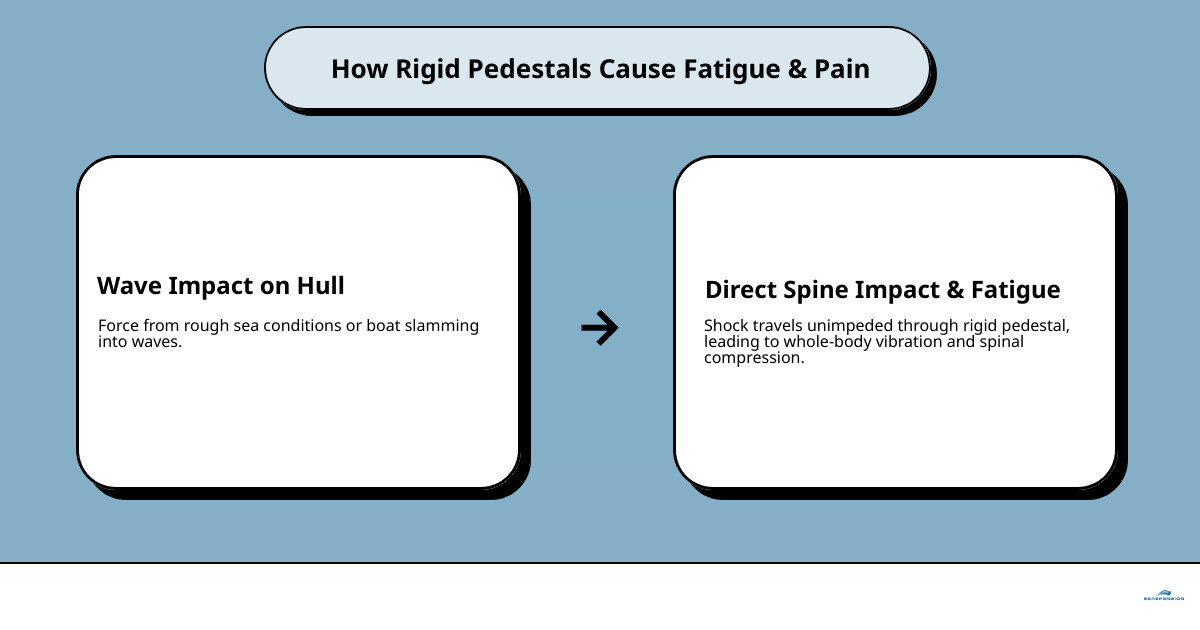
Every time your boat slams into a wave, that impact travels straight up through your pedestal and into your spine. Most boat owners assume that soreness and fatigue are just part of boating in rough water. They're not.
The real problem isn't the seat cushion or your posture. It's the rigid connection between the hull and your body. A standard pedestal does nothing to reduce shock forces—it simply transfers them directly to you.
This causes:
- Whole-body vibration exposure
- Spinal compression with each impact
- Cumulative fatigue that shortens your time on the water
- Long-term discomfort that makes boating less enjoyable
Professional anglers and commercial operators figured this out years ago. They started replacing standard pedestals with shock-absorbing systems because they needed to stay on the water longer without breaking down physically. Now that same technology is available for recreational boaters.
The difference between a rigid pedestal and a suspension pedestal isn't subtle. One protects your body from impact forces. The other doesn't.
I'm Ian Milligan, owner of Seaspension, and I've guided hundreds of boat owners through boat seat pedestal replacement decisions that reduced their fatigue and extended their time on the water. What follows is a practical breakdown of when to replace your pedestal, what options actually work, and how to install them correctly.
When we experience rough water, the boat's hull impacts the waves, generating significant force. With a traditional, rigid boat seat pedestal, this force is directly transmitted up through the seat and into the occupant's body. This constant jarring leads to whole-body vibration, which can cause muscle fatigue, back pain, and even spinal compression over time. It's not just discomfort; it's a physical toll that can significantly reduce your endurance and enjoyment on the water.
This issue is particularly pronounced in conditions where waves are frequent, causing repetitive impacts. Without any mechanism to absorb these shocks, every jolt accumulates, leading to operator fatigue. This fatigue can impair judgment, reduce reaction times, and ultimately make boating less safe. For many, it means cutting short a fishing trip or avoiding certain conditions altogether. Understanding The Impact of Rough Sea Conditions and the Role of SeaSpension is crucial for any boater who spends significant time on the water.
For readers who want a broader background on the health effects of whole-body vibration, resources such as Whole-body vibration provide a useful technical overview of how repeated impacts affect the spine and joints over time.
When to Replace Your Boat Seat Pedestal
Knowing when to replace your boat seat pedestal is more than just a matter of aesthetics; it's about safety, comfort, and the longevity of your boating experience. We often see pedestals that have outlived their safe operational life, leading to instability or discomfort.
Boat seat pedestals are designed to meet ABYC standards, ensuring safety and compliance for various boating conditions. These standards classify seats into Type A and Type B. Type A seats are designed for occupancy while the vessel is underway at any speed, requiring robust construction and secure locking mechanisms. Type B seats, conversely, are intended for occupancy only at speeds not exceeding 5 miles per hour, often seen in more casual seating arrangements. Understanding these distinctions is vital when considering a boat seat pedestal replacement, especially if you're upgrading or changing the intended use of a seating position.
If you want to review the broader safety framework these guidelines sit within, the summary on American Boat and Yacht Council standards is a good starting point.
Signs You Need a Boat Seat Pedestal Replacement
The indicators for a necessary boat seat pedestal replacement are often clear to the experienced eye.
- Corrosion: Saltwater environments are harsh. Over time, metal components can corrode, weakening the pedestal's structural integrity. This is especially true for materials not adequately protected or maintained.
- Wobble: A wobbly seat is not just annoying; it's a safety hazard. This can indicate loose fasteners, a worn-out base, or internal component failure.
- Seized Adjustments: If your adjustable pedestal is stuck at one height or refuses to swivel, its internal mechanisms may be corroded or damaged. This renders the adjustability feature useless and can be a sign of deeper issues.
- Visible Damage: Cracks in the base, bent posts, or deformed mounting plates are all immediate red flags that require attention.
- Unsafe Operation: Any of the above issues can lead to an unsafe boating experience, particularly in rough conditions.
- Lack of Adjustability or Poor Ride Quality: If your current pedestal doesn't offer the height, swivel, or shock absorption you need, it's impacting your comfort and potentially your health. Many boaters find that a simple seat swap isn't enough; they need to Compare with conventional boat seating to truly understand the benefits of an upgraded pedestal.
These signs point not just to wear and tear, but to a compromised boating experience. When you notice these issues, it's time to consider a boat seat pedestal replacement.
Proactive Upgrades vs. Reactive Repairs
Many boaters wait until a pedestal completely fails before considering a replacement. However, a proactive approach offers significant advantages. Investing in a quality pedestal, particularly a shock-absorbing one, can prevent injury, improve comfort, and even increase the value of your boat. It’s about more than just fixing a broken part; it’s about upgrading your entire boating experience.
By choosing a proactive upgrade, you are investing in your long-term comfort and safety on the water. This can be especially important for those who spend many hours fishing or cruising. A robust, durable pedestal ensures you're protected from the repetitive impacts that lead to fatigue and pain. It's an investment that pays dividends in enjoyment and physical well-being. For many, it's a smart decision to View boat upgrades for your wishlist before problems arise. A boat seat pedestal replacement can truly revitalize your vessel, making it feel new again.
A Practical Comparison of Pedestal Types
When it comes to boat seat pedestal replacement, you have several options, each with its own benefits and drawbacks. Understanding these types is key to making an informed decision for your vessel.

Fixed Height Pedestals
These are the most basic and often the most economical option. Fixed height pedestals offer simplicity in design and installation, with a post that maintains a consistent height from the deck. They are typically chosen for their low cost and minimal moving parts, which can translate to fewer maintenance concerns.
However, their lack of adjustability means they provide basic support without any customization for different users or varying conditions. They are best suited for calmer waters where seat height and position are less critical, or for auxiliary seating where occupants are not constantly exposed to significant impacts. A common fixed height might be around 11 inches.
Adjustable & Swivel Pedestals
Adjustable pedestals offer more versatility than their fixed counterparts. These can come in various forms:
- Manual Adjustment: Some pedestals allow for height changes through a pin-lock system or a threaded mechanism.
- Gas-Powered Lift: Many modern adjustable pedestals use a gas-powered cylinder, similar to an office chair, allowing for smooth, effortless height adjustments. These can range from 13 to 17 inches or more.
- Fore-and-Aft Slide: Many pedestals incorporate a slide mechanism, allowing the seat to move forward and backward, which is useful for different body types or activities like driving and fishing.
- 360-Degree Swivel: Almost all adjustable pedestals include a swivel feature, allowing the seat to rotate freely. Some even have an "Auto Lock" handle that automatically locks the seat forward when released, which is a crucial safety feature for helm seats while underway.
These features significantly improve comfort and functionality, allowing boaters to customize their seating position for optimal visibility and ergonomic support.
Shock-Absorbing Pedestals
This category represents the pinnacle of comfort and safety in boat seat pedestal replacement. Shock-absorbing pedestals are engineered to mitigate the impacts and vibrations that cause fatigue and pain. They achieve this through various mechanisms:
- Hydraulic Systems: These systems use hydraulic cylinders to dampen vertical movement, absorbing energy from wave impacts. Seaspension’s independently operating hydraulic system is designed specifically for this kind of marine shock load.
- Air-Ride Systems: Some pedestals incorporate air springs or airbags that compress to absorb shock, often allowing for adjustable air pressure to fine-tune the ride based on occupant weight. The effectiveness depends heavily on how the air volume is managed and how well rebound is controlled.
The primary benefit of shock-absorbing pedestals is significantly reduced impact on the occupant's body, leading to less fatigue and increased time on the water. They are particularly beneficial for rough water conditions, long trips, or for individuals with back issues. Learn more about the benefits of a shock absorbing seat pedestal.
Here's a quick comparison:
| Pedestal Type | Comfort in Rough Water | Safety (Impact Protection) | Performance (Fatigue Reduction) |
| Fixed Height | Low | Low | Low |
| Adjustable/Swivel | Moderate | Moderate | Moderate |
| Shock-Absorbing | High | High | High |
The Complete Guide to Boat Seat Pedestal Replacement
Undertaking a boat seat pedestal replacement project can significantly improve your boating experience. To ensure success, planning and proper execution are key.
Choosing the Right Pedestal for Your Boat
Selecting the correct pedestal involves several critical considerations:
- Determining Height: The ideal sitting height is crucial for comfort and safety. A good starting point, including the seat, is often around 15-1/2 inches above the deck. However, this can vary based on your boat's design, your height, and the specific activities you perform while seated. Always measure your desired sitting position while on the boat to ensure optimal visibility and ergonomics. Many manufacturers provide height selection guides to help you determine the correct height, taking into account the seat thickness.
- Material Choice: Marine environments demand durable materials.
- Aluminum: Often aircraft-grade, aluminum is favored for its strength-to-weight ratio and corrosion resistance. Anodized aluminum provides an extra layer of protection.
- Stainless Steel: Known for its superior corrosion resistance, especially in saltwater, stainless steel is a premium choice for critical components.
- Base Mounting Patterns: Most pedestals adhere to standard mounting patterns, such as a universal 5x5 inch square or a six-bolt pattern. Before purchasing, verify your existing bolt pattern or measure the available deck space to ensure compatibility. Some pedestals also use socket bases or bell and socket designs, which require specific deck cutouts.
- Weight Capacity: Ensure the chosen pedestal can safely support the maximum expected occupant weight. Many high-performance pedestals are designed to accommodate rider weights up to 400 lbs or more, indicating robust construction.
For a comprehensive approach to selection, refer to resources like Choosing the Right SeaSpension Model for Your Boat: A Comprehensive Guide.
Step-by-Step Installation for your boat seat pedestal replacement
Proper installation is paramount for safety and performance. Here's a general guide:
Essential Tools and Materials:
- Drill with appropriate bit sizes (e.g., 5/16" for mounting holes, larger for epoxy plugs)
- Marine adhesive sealant (e.g., 3M 5200 or 4200)
- Marine-grade epoxy resin
- Stainless steel fasteners (bolts, washers, nuts, typically 1/4"-20 or #10 diameter or larger)
- Backing plate (aluminum or stainless steel recommended)
- Measuring tape, pencil or china marker
- Masking tape
- Wrenches and screwdrivers
- Personal protective equipment (gloves, eye protection)
Installation Steps:
- Remove the Old Pedestal: Carefully unbolt the old pedestal from the deck. If the fasteners are seized, you may need penetrating oil or a grinder. Clean the deck area thoroughly, removing any old sealant or debris.
- Prepare the Deck: If you're reusing existing holes, inspect them for damage. If drilling new holes, position the new pedestal base and mark the screw hole locations. For through-bolting, ensure the location allows access from underneath the deck.
- Drilling and Sealing Holes:
- Drill holes slightly larger than your fasteners (e.g., 1 inch diameter) where mounting bolts will penetrate the deck. This allows for a proper epoxy plug.
- Fill these drilled holes with marine epoxy resin and allow it to cure completely (at least three days is recommended to ensure full strength and watertightness). This prevents water intrusion into the deck's core, which can lead to rot.
- Once cured, drill pilot holes (half the size of your mounting screws) in the center of the cured resin patches.
- Using Backing Plates: For optimal strength and to distribute the load, we strongly recommend using an aluminum or stainless steel backing plate underneath the deck. This is critical, especially for seats that will experience high loads or impacts.
- Secure the New Pedestal:
- Apply a generous bead of marine adhesive sealant around the bottom edge of the new pedestal base and over the prepared holes.
- Position the pedestal, ensuring proper orientation (e.g., for auto-locking swivel mechanisms, the base slot should be opposite the auto-lock handle side).
- Insert your stainless steel fasteners (bolts, washers, and nuts for through-bolting) and hand-tighten until snug.
- Allow the sealant to set for at least 24 hours before fully tightening the fasteners. This allows the sealant to cure with minimal stress.
- Attach the Seat: Mount your boat seat to the top of the pedestal using marine-grade stainless steel screws and washers. Ensure the screws engage adequately with the seat's T-nuts (typically 3/8" thread length). If the seat lacks T-nuts, through-bolt it securely.
- Final Check: Test the seat's stability, swivel, and any adjustment mechanisms. Ensure all fasteners are tight and the seat operates smoothly.
For a detailed visual guide, refer to specific instructions like How to Install a SeaSpension Shock Absorbing Pedestal. Always follow the manufacturer's instructions for your specific pedestal model.
What Actually Works: Understanding True Shock Mitigation
When we talk about shock mitigation in boat seats, we're not just talking about a spring. A simple spring or basic shock absorber might go down when you hit a wave, but the critical question is: how does it come back up? Does it rebound just as fast, creating a catapult effect? True shock mitigation is far more sophisticated.
Effective systems incorporate advanced engineering principles:
- Rebound Control: This is essential to prevent the "eject or catapult feeling" that can occur with poorly designed suspension. A good system manages the speed at which the seat returns to its original position after compression.
- Velocity-Sensitive Damping: High-quality shock absorbers use a velocity-sensitive shimmed dampening system. This means the resistance of the shock absorber changes based on the speed of the impact. A harder, faster impact will generate more damping force, while slower movements will have less resistance, resulting in a smoother, more controlled ride.
- Hydraulic Systems: Hydraulic systems, like those we use, excel at converting kinetic energy from impacts into heat, effectively dissipating the shock. They offer consistent performance regardless of temperature fluctuations and provide precise control over both compression and rebound.
- Air-Ride Concepts: Some marine seating systems use air springs or airbags. When they are properly engineered—with controlled air volume and damping—they can help absorb shock and allow adjustment for occupant weight. The key is how well the design manages both compression and rebound, not just the presence of air alone.
What sets a truly effective system apart, like our independently operating hydraulic system, is its ability to absorb impacts and provide optimal comfort and safety for varying occupant weights. This means the system intelligently adapts to the load, ensuring consistent performance whether a lightweight angler or a heavier crew member is seated. It's the science behind the smoothness. Dive deeper into The Science Behind Shock Absorption: Elevating Your Boating Experience with SeaSpension.
Long-Term Pedestal Maintenance for Lasting Performance
Just like any other piece of marine equipment, your boat seat pedestal requires regular maintenance to ensure its longevity and optimal performance. Neglecting it can lead to premature wear, reduced functionality, and even safety hazards.
- Routine Inspection: Make it a habit to periodically inspect your pedestals for any signs of wear, corrosion, or damage. Check the base, post, and any moving parts (swivel, slide, height adjustment). Look for cracks, bent components, or excessive play.
- Checking Fasteners: Vibrations and constant movement on the water can loosen fasteners over time. Periodically check all mounting bolts and screws for proper tightness. This is critical for maintaining stability and safety. If you have an adjustable pedestal, ensure all locking mechanisms engage securely.
- Cleaning Procedures: Clean your pedestal and mount with mild soap and fresh water. Avoid harsh or abrasive cleansers, as these can damage finishes, seals, or protective coatings. A soft brush or cloth should be sufficient to remove salt residue, dirt, and grime.
- Anodized Aluminum Care: Anodized aluminum components benefit from regular rinsing with fresh water to prevent salt buildup, which can degrade the anodized layer over time.
- Stainless Steel Care: While highly corrosion-resistant, stainless steel can still develop "tea staining" or surface rust in marine environments if not properly maintained. Regular cleaning and occasional polishing with a marine-grade stainless steel cleaner will keep it looking good and prevent pitting.
- Warranty Considerations: Always be aware of your pedestal's warranty. Many reputable manufacturers offer substantial warranties, such as a 6-year full replacement warranty for their products. Understand what the warranty covers and any conditions for maintaining it. Proper installation and maintenance are often prerequisites for warranty claims. Always keep your purchase records. When dealing with marine components, adherence to standards, such as those outlined in ABYC compliance documents, is often expected. Always refer to the manufacturer's product manual for detailed standards and installation requirements.
By adhering to these simple maintenance practices, you can significantly extend the life of your boat seat pedestal and ensure it continues to provide a safe and comfortable ride for years to come.
Conclusion: A Smarter Investment for Your Time on the Water
We've covered the pervasive issue of impact fatigue from rough waters, the critical need for boat seat pedestal replacement when signs of wear appear, and the distinct advantages of various pedestal types. It's clear that a rigid connection between your body and the boat deck isn't just uncomfortable; it's detrimental to your long-term health and enjoyment on the water.
The marine industry is a significant market, projected to reach $137.1 billion by 2027, underscoring the demand for quality boat parts and accessories. Replacement boat seats and hardware are a considerable part of boat restoration and upgrades, with many boaters recognizing the value of investing in their vessel's comfort and safety. The average cost of a boat seat pedestal package, ranging from $165.95 to over $359.99, reflects the diverse features available, particularly for adjustable and shock-absorbing options.
Investing in a high-quality, shock-mitigating pedestal isn't just about a comfortable ride; it's about investing in your safety, endurance, and overall boating experience. It’s about preventing the cumulative effects of whole-body vibration and spinal compression, allowing you to spend more time doing what you love without the pain and fatigue. This kind of upgrade can truly make your old boat feel new again, changing every trip into a smoother, more enjoyable adventure. If you're looking to revitalize your vessel, explore how to How to Make Your Old Boat Feel New Again: Best 2025 Upgrades That Help You Keep Doing What You Love.
We believe in making informed decisions. By understanding the options and the science behind true shock mitigation, you can choose a boat seat pedestal replacement that meets your needs and exceeds your expectations. For those seeking the ultimate in comfort and protection, we invite you to Explore low-profile suspension pedestal options designed to lift your boating experience.
Why Your Current Boat Seat Is Causing Fatigue and Pain
Boat seat pedestal replacement is the process of removing your existing seat post and installing a new one—whether to fix a damaged mount, upgrade to adjustable height, or add shock-absorbing suspension. Here's what you need to know:
Quick Answer: Boat Seat Pedestal Replacement Basics
- Identify your need: Corrosion, wobble, seized adjustments, or lack of shock absorption
- Choose pedestal type: Fixed height, adjustable/swivel, or shock-absorbing
- Verify mounting pattern: Most use standard 5x5" or 6-bolt patterns
- Select proper height: Account for deck height and seat thickness (typically 10-16")
- Install correctly: Use marine sealant, backing plates, and stainless fasteners
- Consider ABYC standards: Type A seats for underway use, Type B for low-speed only
Every time your boat slams into a wave, that impact travels straight up through your pedestal and into your spine. Most boat owners assume that soreness and fatigue are just part of boating in rough water. They're not.
The real problem isn't the seat cushion or your posture. It's the rigid connection between the hull and your body. A standard pedestal does nothing to reduce shock forces—it simply transfers them directly to you.
This causes:
- Whole-body vibration exposure
- Spinal compression with each impact
- Cumulative fatigue that shortens your time on the water
- Long-term discomfort that makes boating less enjoyable
Professional anglers and commercial operators figured this out years ago. They started replacing standard pedestals with shock-absorbing systems because they needed to stay on the water longer without breaking down physically. Now that same technology is available for recreational boaters.
The difference between a rigid pedestal and a suspension pedestal isn't subtle. One protects your body from impact forces. The other doesn't.
I'm Ian Milligan, owner of Seaspension, and I've guided hundreds of boat owners through boat seat pedestal replacement decisions that reduced their fatigue and extended their time on the water. What follows is a practical breakdown of when to replace your pedestal, what options actually work, and how to install them correctly.
When we experience rough water, the boat's hull impacts the waves, generating significant force. With a traditional, rigid boat seat pedestal, this force is directly transmitted up through the seat and into the occupant's body. This constant jarring leads to whole-body vibration, which can cause muscle fatigue, back pain, and even spinal compression over time. It's not just discomfort; it's a physical toll that can significantly reduce your endurance and enjoyment on the water.
This issue is particularly pronounced in conditions where waves are frequent, causing repetitive impacts. Without any mechanism to absorb these shocks, every jolt accumulates, leading to operator fatigue. This fatigue can impair judgment, reduce reaction times, and ultimately make boating less safe. For many, it means cutting short a fishing trip or avoiding certain conditions altogether. Understanding The Impact of Rough Sea Conditions and the Role of SeaSpension is crucial for any boater who spends significant time on the water.
For readers who want a broader background on the health effects of whole-body vibration, resources such as Whole-body vibration provide a useful technical overview of how repeated impacts affect the spine and joints over time.
When to Replace Your Boat Seat Pedestal
Knowing when to replace your boat seat pedestal is more than just a matter of aesthetics; it's about safety, comfort, and the longevity of your boating experience. We often see pedestals that have outlived their safe operational life, leading to instability or discomfort.
Boat seat pedestals are designed to meet ABYC standards, ensuring safety and compliance for various boating conditions. These standards classify seats into Type A and Type B. Type A seats are designed for occupancy while the vessel is underway at any speed, requiring robust construction and secure locking mechanisms. Type B seats, conversely, are intended for occupancy only at speeds not exceeding 5 miles per hour, often seen in more casual seating arrangements. Understanding these distinctions is vital when considering a boat seat pedestal replacement, especially if you're upgrading or changing the intended use of a seating position.
If you want to review the broader safety framework these guidelines sit within, the summary on American Boat and Yacht Council standards is a good starting point.
Signs You Need a Boat Seat Pedestal Replacement
The indicators for a necessary boat seat pedestal replacement are often clear to the experienced eye.
- Corrosion: Saltwater environments are harsh. Over time, metal components can corrode, weakening the pedestal's structural integrity. This is especially true for materials not adequately protected or maintained.
- Wobble: A wobbly seat is not just annoying; it's a safety hazard. This can indicate loose fasteners, a worn-out base, or internal component failure.
- Seized Adjustments: If your adjustable pedestal is stuck at one height or refuses to swivel, its internal mechanisms may be corroded or damaged. This renders the adjustability feature useless and can be a sign of deeper issues.
- Visible Damage: Cracks in the base, bent posts, or deformed mounting plates are all immediate red flags that require attention.
- Unsafe Operation: Any of the above issues can lead to an unsafe boating experience, particularly in rough conditions.
- Lack of Adjustability or Poor Ride Quality: If your current pedestal doesn't offer the height, swivel, or shock absorption you need, it's impacting your comfort and potentially your health. Many boaters find that a simple seat swap isn't enough; they need to Compare with conventional boat seating to truly understand the benefits of an upgraded pedestal.
These signs point not just to wear and tear, but to a compromised boating experience. When you notice these issues, it's time to consider a boat seat pedestal replacement.
Proactive Upgrades vs. Reactive Repairs
Many boaters wait until a pedestal completely fails before considering a replacement. However, a proactive approach offers significant advantages. Investing in a quality pedestal, particularly a shock-absorbing one, can prevent injury, improve comfort, and even increase the value of your boat. It’s about more than just fixing a broken part; it’s about upgrading your entire boating experience.
By choosing a proactive upgrade, you are investing in your long-term comfort and safety on the water. This can be especially important for those who spend many hours fishing or cruising. A robust, durable pedestal ensures you're protected from the repetitive impacts that lead to fatigue and pain. It's an investment that pays dividends in enjoyment and physical well-being. For many, it's a smart decision to View boat upgrades for your wishlist before problems arise. A boat seat pedestal replacement can truly revitalize your vessel, making it feel new again.
A Practical Comparison of Pedestal Types
When it comes to boat seat pedestal replacement, you have several options, each with its own benefits and drawbacks. Understanding these types is key to making an informed decision for your vessel.
Fixed Height Pedestals
These are the most basic and often the most economical option. Fixed height pedestals offer simplicity in design and installation, with a post that maintains a consistent height from the deck. They are typically chosen for their low cost and minimal moving parts, which can translate to fewer maintenance concerns.
However, their lack of adjustability means they provide basic support without any customization for different users or varying conditions. They are best suited for calmer waters where seat height and position are less critical, or for auxiliary seating where occupants are not constantly exposed to significant impacts. A common fixed height might be around 11 inches.
Adjustable & Swivel Pedestals
Adjustable pedestals offer more versatility than their fixed counterparts. These can come in various forms:
- Manual Adjustment: Some pedestals allow for height changes through a pin-lock system or a threaded mechanism.
- Gas-Powered Lift: Many modern adjustable pedestals use a gas-powered cylinder, similar to an office chair, allowing for smooth, effortless height adjustments. These can range from 13 to 17 inches or more.
- Fore-and-Aft Slide: Many pedestals incorporate a slide mechanism, allowing the seat to move forward and backward, which is useful for different body types or activities like driving and fishing.
- 360-Degree Swivel: Almost all adjustable pedestals include a swivel feature, allowing the seat to rotate freely. Some even have an "Auto Lock" handle that automatically locks the seat forward when released, which is a crucial safety feature for helm seats while underway.
These features significantly improve comfort and functionality, allowing boaters to customize their seating position for optimal visibility and ergonomic support.
Shock-Absorbing Pedestals
This category represents the pinnacle of comfort and safety in boat seat pedestal replacement. Shock-absorbing pedestals are engineered to mitigate the impacts and vibrations that cause fatigue and pain. They achieve this through various mechanisms:
- Hydraulic Systems: These systems use hydraulic cylinders to dampen vertical movement, absorbing energy from wave impacts. Seaspension’s independently operating hydraulic system is designed specifically for this kind of marine shock load.
- Air-Ride Systems: Some pedestals incorporate air springs or airbags that compress to absorb shock, often allowing for adjustable air pressure to fine-tune the ride based on occupant weight. The effectiveness depends heavily on how the air volume is managed and how well rebound is controlled.
The primary benefit of shock-absorbing pedestals is significantly reduced impact on the occupant's body, leading to less fatigue and increased time on the water. They are particularly beneficial for rough water conditions, long trips, or for individuals with back issues. Learn more about the benefits of a shock absorbing seat pedestal.
Here's a quick comparison:
| Pedestal Type | Comfort in Rough Water | Safety (Impact Protection) | Performance (Fatigue Reduction) |
| Fixed Height | Low | Low | Low |
| Adjustable/Swivel | Moderate | Moderate | Moderate |
| Shock-Absorbing | High | High | High |
The Complete Guide to Boat Seat Pedestal Replacement
Undertaking a boat seat pedestal replacement project can significantly improve your boating experience. To ensure success, planning and proper execution are key.
Choosing the Right Pedestal for Your Boat
Selecting the correct pedestal involves several critical considerations:
- Determining Height: The ideal sitting height is crucial for comfort and safety. A good starting point, including the seat, is often around 15-1/2 inches above the deck. However, this can vary based on your boat's design, your height, and the specific activities you perform while seated. Always measure your desired sitting position while on the boat to ensure optimal visibility and ergonomics. Many manufacturers provide height selection guides to help you determine the correct height, taking into account the seat thickness.
- Material Choice: Marine environments demand durable materials.
- Aluminum: Often aircraft-grade, aluminum is favored for its strength-to-weight ratio and corrosion resistance. Anodized aluminum provides an extra layer of protection.
- Stainless Steel: Known for its superior corrosion resistance, especially in saltwater, stainless steel is a premium choice for critical components.
- Base Mounting Patterns: Most pedestals adhere to standard mounting patterns, such as a universal 5x5 inch square or a six-bolt pattern. Before purchasing, verify your existing bolt pattern or measure the available deck space to ensure compatibility. Some pedestals also use socket bases or bell and socket designs, which require specific deck cutouts.
- Weight Capacity: Ensure the chosen pedestal can safely support the maximum expected occupant weight. Many high-performance pedestals are designed to accommodate rider weights up to 400 lbs or more, indicating robust construction.
For a comprehensive approach to selection, refer to resources like Choosing the Right SeaSpension Model for Your Boat: A Comprehensive Guide.
Step-by-Step Installation for your boat seat pedestal replacement
Proper installation is paramount for safety and performance. Here's a general guide:
Essential Tools and Materials:
- Drill with appropriate bit sizes (e.g., 5/16" for mounting holes, larger for epoxy plugs)
- Marine adhesive sealant (e.g., 3M 5200 or 4200)
- Marine-grade epoxy resin
- Stainless steel fasteners (bolts, washers, nuts, typically 1/4"-20 or #10 diameter or larger)
- Backing plate (aluminum or stainless steel recommended)
- Measuring tape, pencil or china marker
- Masking tape
- Wrenches and screwdrivers
- Personal protective equipment (gloves, eye protection)
Installation Steps:
- Remove the Old Pedestal: Carefully unbolt the old pedestal from the deck. If the fasteners are seized, you may need penetrating oil or a grinder. Clean the deck area thoroughly, removing any old sealant or debris.
- Prepare the Deck: If you're reusing existing holes, inspect them for damage. If drilling new holes, position the new pedestal base and mark the screw hole locations. For through-bolting, ensure the location allows access from underneath the deck.
- Drilling and Sealing Holes:
- Drill holes slightly larger than your fasteners (e.g., 1 inch diameter) where mounting bolts will penetrate the deck. This allows for a proper epoxy plug.
- Fill these drilled holes with marine epoxy resin and allow it to cure completely (at least three days is recommended to ensure full strength and watertightness). This prevents water intrusion into the deck's core, which can lead to rot.
- Once cured, drill pilot holes (half the size of your mounting screws) in the center of the cured resin patches.
- Using Backing Plates: For optimal strength and to distribute the load, we strongly recommend using an aluminum or stainless steel backing plate underneath the deck. This is critical, especially for seats that will experience high loads or impacts.
- Secure the New Pedestal:
- Apply a generous bead of marine adhesive sealant around the bottom edge of the new pedestal base and over the prepared holes.
- Position the pedestal, ensuring proper orientation (e.g., for auto-locking swivel mechanisms, the base slot should be opposite the auto-lock handle side).
- Insert your stainless steel fasteners (bolts, washers, and nuts for through-bolting) and hand-tighten until snug.
- Allow the sealant to set for at least 24 hours before fully tightening the fasteners. This allows the sealant to cure with minimal stress.
- Attach the Seat: Mount your boat seat to the top of the pedestal using marine-grade stainless steel screws and washers. Ensure the screws engage adequately with the seat's T-nuts (typically 3/8" thread length). If the seat lacks T-nuts, through-bolt it securely.
- Final Check: Test the seat's stability, swivel, and any adjustment mechanisms. Ensure all fasteners are tight and the seat operates smoothly.
For a detailed visual guide, refer to specific instructions like How to Install a SeaSpension Shock Absorbing Pedestal. Always follow the manufacturer's instructions for your specific pedestal model.
What Actually Works: Understanding True Shock Mitigation
When we talk about shock mitigation in boat seats, we're not just talking about a spring. A simple spring or basic shock absorber might go down when you hit a wave, but the critical question is: how does it come back up? Does it rebound just as fast, creating a catapult effect? True shock mitigation is far more sophisticated.
Effective systems incorporate advanced engineering principles:
- Rebound Control: This is essential to prevent the "eject or catapult feeling" that can occur with poorly designed suspension. A good system manages the speed at which the seat returns to its original position after compression.
- Velocity-Sensitive Damping: High-quality shock absorbers use a velocity-sensitive shimmed dampening system. This means the resistance of the shock absorber changes based on the speed of the impact. A harder, faster impact will generate more damping force, while slower movements will have less resistance, resulting in a smoother, more controlled ride.
- Hydraulic Systems: Hydraulic systems, like those we use, excel at converting kinetic energy from impacts into heat, effectively dissipating the shock. They offer consistent performance regardless of temperature fluctuations and provide precise control over both compression and rebound.
- Air-Ride Concepts: Some marine seating systems use air springs or airbags. When they are properly engineered—with controlled air volume and damping—they can help absorb shock and allow adjustment for occupant weight. The key is how well the design manages both compression and rebound, not just the presence of air alone.
What sets a truly effective system apart, like our independently operating hydraulic system, is its ability to absorb impacts and provide optimal comfort and safety for varying occupant weights. This means the system intelligently adapts to the load, ensuring consistent performance whether a lightweight angler or a heavier crew member is seated. It's the science behind the smoothness. Dive deeper into The Science Behind Shock Absorption: Elevating Your Boating Experience with SeaSpension.
Long-Term Pedestal Maintenance for Lasting Performance
Just like any other piece of marine equipment, your boat seat pedestal requires regular maintenance to ensure its longevity and optimal performance. Neglecting it can lead to premature wear, reduced functionality, and even safety hazards.
- Routine Inspection: Make it a habit to periodically inspect your pedestals for any signs of wear, corrosion, or damage. Check the base, post, and any moving parts (swivel, slide, height adjustment). Look for cracks, bent components, or excessive play.
- Checking Fasteners: Vibrations and constant movement on the water can loosen fasteners over time. Periodically check all mounting bolts and screws for proper tightness. This is critical for maintaining stability and safety. If you have an adjustable pedestal, ensure all locking mechanisms engage securely.
- Cleaning Procedures: Clean your pedestal and mount with mild soap and fresh water. Avoid harsh or abrasive cleansers, as these can damage finishes, seals, or protective coatings. A soft brush or cloth should be sufficient to remove salt residue, dirt, and grime.
- Anodized Aluminum Care: Anodized aluminum components benefit from regular rinsing with fresh water to prevent salt buildup, which can degrade the anodized layer over time.
- Stainless Steel Care: While highly corrosion-resistant, stainless steel can still develop "tea staining" or surface rust in marine environments if not properly maintained. Regular cleaning and occasional polishing with a marine-grade stainless steel cleaner will keep it looking good and prevent pitting.
- Warranty Considerations: Always be aware of your pedestal's warranty. Many reputable manufacturers offer substantial warranties, such as a 6-year full replacement warranty for their products. Understand what the warranty covers and any conditions for maintaining it. Proper installation and maintenance are often prerequisites for warranty claims. Always keep your purchase records. When dealing with marine components, adherence to standards, such as those outlined in ABYC compliance documents, is often expected. Always refer to the manufacturer's product manual for detailed standards and installation requirements.
By adhering to these simple maintenance practices, you can significantly extend the life of your boat seat pedestal and ensure it continues to provide a safe and comfortable ride for years to come.
Conclusion: A Smarter Investment for Your Time on the Water
We've covered the pervasive issue of impact fatigue from rough waters, the critical need for boat seat pedestal replacement when signs of wear appear, and the distinct advantages of various pedestal types. It's clear that a rigid connection between your body and the boat deck isn't just uncomfortable; it's detrimental to your long-term health and enjoyment on the water.
The marine industry is a significant market, projected to reach $137.1 billion by 2027, underscoring the demand for quality boat parts and accessories. Replacement boat seats and hardware are a considerable part of boat restoration and upgrades, with many boaters recognizing the value of investing in their vessel's comfort and safety. The average cost of a boat seat pedestal package, ranging from $165.95 to over $359.99, reflects the diverse features available, particularly for adjustable and shock-absorbing options.
Investing in a high-quality, shock-mitigating pedestal isn't just about a comfortable ride; it's about investing in your safety, endurance, and overall boating experience. It’s about preventing the cumulative effects of whole-body vibration and spinal compression, allowing you to spend more time doing what you love without the pain and fatigue. This kind of upgrade can truly make your old boat feel new again, changing every trip into a smoother, more enjoyable adventure. If you're looking to revitalize your vessel, explore how to How to Make Your Old Boat Feel New Again: Best 2025 Upgrades That Help You Keep Doing What You Love.
We believe in making informed decisions. By understanding the options and the science behind true shock mitigation, you can choose a boat seat pedestal replacement that meets your needs and exceeds your expectations. For those seeking the ultimate in comfort and protection, we invite you to Explore low-profile suspension pedestal options designed to lift your boating experience.


