What is an Air ride boat?
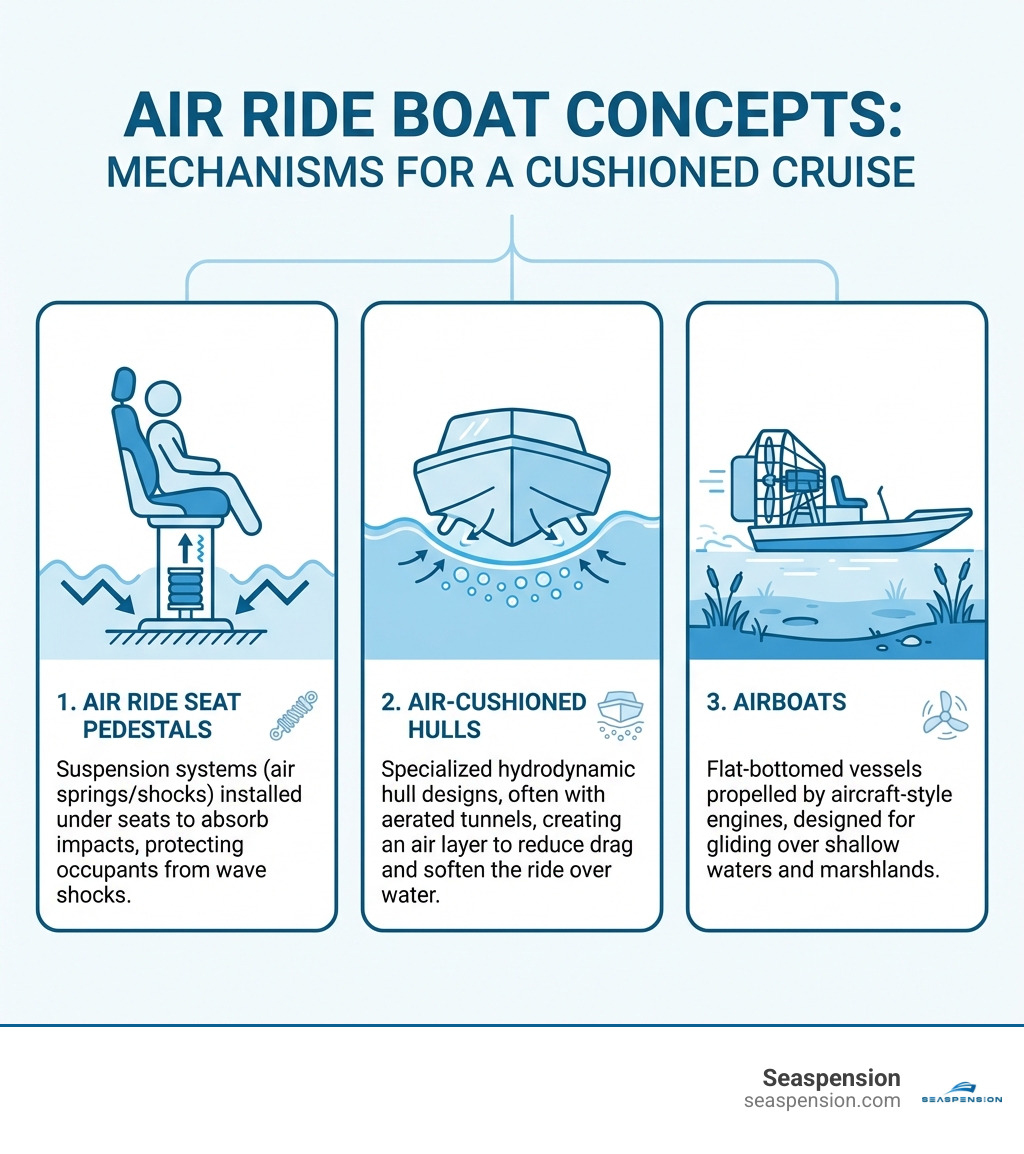
An Air ride boat refers to a vessel or its components designed to provide a smoother, more comfortable experience by mitigating impacts and vibrations. This can involve:
The relentless pounding of waves can turn a great day on the water into a painful experience. For many boaters, constant impacts lead to fatigue, back pain, and overall discomfort. This physical toll often cuts short trips and makes longer journeys undesirable.
The concept of an Air ride boat emerges from this challenge. It describes any boat, or more commonly, its seating system, engineered to soften the ride. The goal is simple: isolate you from the harsh realities of rough water. By doing so, an air ride system transforms your time on the water, allowing for longer, more comfortable, and safer trips.
I'm Ian Milligan, owner and managing principal of SeaSpension. My work focuses on developing durable, practical solutions that make time on the water more comfortable and productive by addressing the physical strain of rough conditions, ultimately enhancing the Air ride boat experience for all.
When we spend time on the water, especially in choppy conditions, our bodies are subjected to continuous impacts. These forces, often referred to as Whole Body Vibration (WBV), are not just uncomfortable; they can have significant long-term effects on our health. Imagine your spine absorbing hundreds, if not thousands, of jarring shocks over a day. This constant impact can lead to chronic back pain, joint issues, and increased muscle fatigue. It's the hidden force of boating, silently wearing down our bodies.
We understand this toll because we live it. It's why we're dedicated to finding solutions that soften the blow, allowing us to enjoy the water we love without paying a physical price. The goal isn't just comfort; it's about preserving our health and extending our time on the water. We believe that a truly comfortable ride is a safer ride, reducing fatigue and improving focus, which are critical for safe navigation. You can learn more about how these impacts affect you in our article, The Hidden Force of Boating: Why Your Body Feels the Impact and How SeaSension Softens the Blow.
The term "Air ride boat" can be a bit of a chameleon, meaning different things depending on who you ask. For some, it might conjure images of boats literally floating on a cushion of air, while for others, it's about a smooth, comfortable experience in rough seas. Let's clear up some common misconceptions and focus on what truly delivers an "air ride" experience for the boater.
As we discussed in the introduction, the term can broadly refer to airboats, air-cushioned hulls, or, most commonly and relevant to us, seat suspension systems. While airboats offer a unique experience in specific environments like the Florida Everglades, they are a niche application. Similarly, air-cushioned hulls employ advanced design principles to achieve a smoother ride for the entire vessel. However, for most boaters looking to improve their comfort and safety, the true "air ride boat" experience comes down to effective seat suspension.

Some boat designs aim to create an "air ride" effect through their hull shape. These are often referred to as air-cushioned or cathedral hulls. The idea is to reduce the wetted surface of the hull or to create a cushion of air between the hull and the water, reducing impact and drag.
Designs might incorporate features like twin aerated tunnels or specific hull bottom deadrise angles to achieve a softer, drier ride. These hydrodynamic principles allow the boat to glide more smoothly over the water, providing improved stability and performance, especially at higher speeds in varying sea conditions. While these hull designs can significantly improve the overall ride of the vessel, they are a fundamental part of the boat's design and cannot be retrofitted.
For most boat owners, achieving an "air ride boat" experience is about isolating the occupant from the impacts of the waves. This is where shock-mitigating seat pedestals come into play. Instead of the entire boat riding on air, you ride on air (or a hydraulic equivalent) within your seat. This approach offers a practical way to upgrade existing boats and directly addresses the physical jarring that causes discomfort and fatigue.
The difference between the boat's ride and your body's ride is crucial. A boat might handle rough seas well, but if your seat isn't absorbing the vertical impacts, your body still takes a beating. Shock-absorbing pedestals tackle this head-on, ensuring that even if the boat is pitching and rolling, you remain stable and comfortable. This is why we believe that the most impactful "air ride boat" upgrade for recreational and commercial boaters alike is through high-quality seat suspension. To understand the profound shift this makes, consider SeaSension vs. Conventional Boat Seating: Why Make the Switch?.
At its core, a shock-absorbing pedestal is designed to dampen the vertical motion caused by waves and impacts, preventing that energy from transferring directly to your body. Think of it like the suspension system in your car, but optimized for the unique forces encountered on the water.
The basic mechanics involve a shock absorber working in conjunction with a spring mechanism. When your boat hits a wave, the pedestal compresses, absorbing the upward force. The spring component (which can be a mechanical spring, an air spring, or a hydraulic system) then extends, returning the seat to its original position. Crucially, the shock absorber controls both the compression and rebound, preventing a bouncy or "catapult" feeling. This controlled vertical travel significantly reduces G-force impacts on your spine and joints. The science behind this is fascinating and critical to a truly comfortable experience; we dig deeper into it in The Science Behind Shock Absorption: Elevating Your Boating Experience with SeaSension.

When we talk about shock-absorbing pedestals for an Air ride boat, we're primarily looking at three main types of suspension technologies. Each has its own characteristics regarding performance, maintenance, adjustability, and cost.
| Suspension Type | Performance | Maintenance | Adjustability | Cost Range |
|---|---|---|---|---|
| Mechanical (Simple Springs) | Basic shock absorption, often bouncy rebound | Minimal, but springs can wear out | Limited, usually by spring stiffness | Low |
| Air-Dampened | Good shock absorption, adjustable for weight | Requires air pressure checks, seals | Highly adjustable via air pressure (0-200psi) | Medium |
| Hydraulic | Superior, controlled damping, consistent | Very low, sealed systems | Often self-adjusting or easily tuned | Medium-High |
We've observed that many systems on the market rely on simple springs or air-dampened designs. While these offer some improvement over rigid pedestals, they often lack the sophisticated damping control needed for truly smooth performance in varying conditions. For example, some air-dampened systems might use an air spring over a hydraulic shock absorber, allowing for weight adjustment. While effective, the focus on air often means a less refined damping mechanism compared to dedicated hydraulic systems.
Our experience and engineering have led us to focus on robust hydraulic suspension. Why? Because while air-dampened systems can be adjusted for weight, they sometimes struggle with consistent damping, leading to a bouncier ride or a feeling of being "ejected" in rough seas. Our independently operating hydraulic shock-absorbing system offers optimal comfort and safety for boaters, even with varying occupant weights, by providing a controlled and consistent response to impacts. We believe our patented technology truly leaves air-dampened seats in the wake, as explored in Patented in the USA: Why SeaSension’s Tech Leaves Air-Dampened Seats in the Wake. For a deeper dive into this comparison, see Hydraulic vs. Air Suspension for Boats: What Most Boaters Don't Know.
When evaluating an Air ride boat seat pedestal, we look for specific features that indicate durability, performance, and long-term value. These are the hallmarks of a system that truly improves your boating experience:
These features collectively contribute to what we consider the Best Shock Absorbing Boat Seat Pedestal.
Investing in an Air ride boat seat pedestal isn't just about comfort; it's about changing your entire boating experience. The benefits extend far beyond simply feeling less jarring.
An Air ride boat seat pedestal contributes to a safer and more comfortable boating experience by turning a punishing ride into a pleasure.
Choosing and installing the right Air ride boat seat pedestal requires careful consideration of your specific needs, your boat's characteristics, and the conditions you typically encounter. It's not a one-size-fits-all decision, but with a bit of planning, you can find the perfect fit.
First, assess your needs. What kind of boat do you have—a center console, a pilot house, a RIB, or something else? What are the typical water conditions you steer? Are you frequently in choppy offshore waters, or more often on calmer inland lakes? How heavy are the primary operators and passengers? These factors will influence the type and robustness of the suspension system you need. We've seen the importance of proper support firsthand, as highlighted in Anchoring Your Comfort: A Deep Dive into Boat Seat Pedestals and Bases.
When selecting an Air ride boat seat pedestal, several practical considerations come into play:
Installing an Air ride boat seat pedestal can often be a DIY project for those with basic mechanical skills, but it depends on the complexity of the system and your comfort level.
Most pedestals are designed to use standard mounting patterns, making them relatively straightforward to install. You'll typically need basic tools like wrenches, a drill, and marine-grade fasteners. The process generally involves:
Many manufacturers provide detailed installation guides and videos. For example, you can find helpful resources like How To Install a Pedestal on Vimeo, or our own guides on How to Install a SeaSension Shock Absorbing Pedestal and How to Install a Boat Seat Pedestal to Your Recreational Boat.
However, if your boat requires custom fabrication, complex wiring (for powered air-dampened systems), or if you're uncomfortable with drilling into your deck, it's always best to call a professional marine technician. We recommend ensuring the installation maintains the structural integrity of your boat and complies with all safety standards.
The typical cost range for Air ride boat seat pedestals varies significantly based on the technology, materials, features, and manufacturer. We've seen prices from around $800 to several thousand dollars per pedestal. For example, a basic air-dampened system might start around $895, while a more advanced hydraulic system with robust marine-grade construction could be considerably more. Full boat stabilization systems, like the Seakeeper Ride 600, which levels a 31-36-foot vessel by eliminating up to 70% pitch and roll, can retail for $10,500 or more, but it's important to remember these are whole-boat systems, not just seat pedestals.
While the initial investment might seem substantial, we view it as an investment in your safety, health, and overall enjoyment of boating. When you consider the cost of potential medical bills from back injuries, or simply the lost joy from cutting short trips due to discomfort, a high-quality shock-absorbing pedestal offers immense value. It's a long-term investment that pays dividends in comfort, well-being, and extended time on the water. You can explore our offerings in the Boat Suspension Pedestal category.
The problem of wave shock and its physical toll on boaters is a real and often unspoken challenge. But as we've explored, it's a solvable one. The concept of an Air ride boat, particularly through advanced seat suspension, offers a powerful solution to transform your boating experience.
We've seen how these systems work to isolate you from impacts, the critical differences between various suspension technologies, and the key features that define a high-quality product. The benefits—from reduced fatigue and improved safety to protecting your long-term health and simply extending your joy on the water—are undeniable. Leading manufacturers, including ourselves, are continuously innovating to provide robust and reliable solutions for every boater, whether recreational, commercial, or military. Our independently operating hydraulic shock-absorbing systems are designed for durability and consistent performance across various occupant weights and challenging conditions.
Choosing an Air ride boat seat pedestal is a decision to invest in your well-being. It's about making every moment on the water more comfortable, more enjoyable, and safer. It allows you to continue doing what you love, without the physical repercussions. We encourage you to explore the options available and consider how such an upgrade can revolutionize your time afloat.
View our complete line of boat pedestal seat posts to find the right fit for your vessel.
Boat seat comfort isn't just about cushions and upholstery — it's about protecting your body from the repetitive impacts that occur every time your hull meets a wave. Poor seating can lead to long-term back pain, pinched nerves, compressed spines, and chronic fatigue. The industry is full of boaters who walk with a lurch, sport scars from back surgery, or cut their time on the water short because their body can't handle it anymore.
Quick Answer: How to Maximize Boat Seat Comfort
Key factors that contribute to real boat seat comfort:
| Factor | Why It Matters |
|---|---|
| Shock absorption | Reduces G-forces from wave impacts that cause spinal compression |
| Controlled motion | Prevents ejection or catapult feeling when bottoming out |
| Durability | Marine environments demand corrosion-resistant materials and sealed systems |
| Adjustability | Allows customization for different operator weights and sea conditions |
| Installation quality | Poor mounting leads to flex, noise, and premature failure |
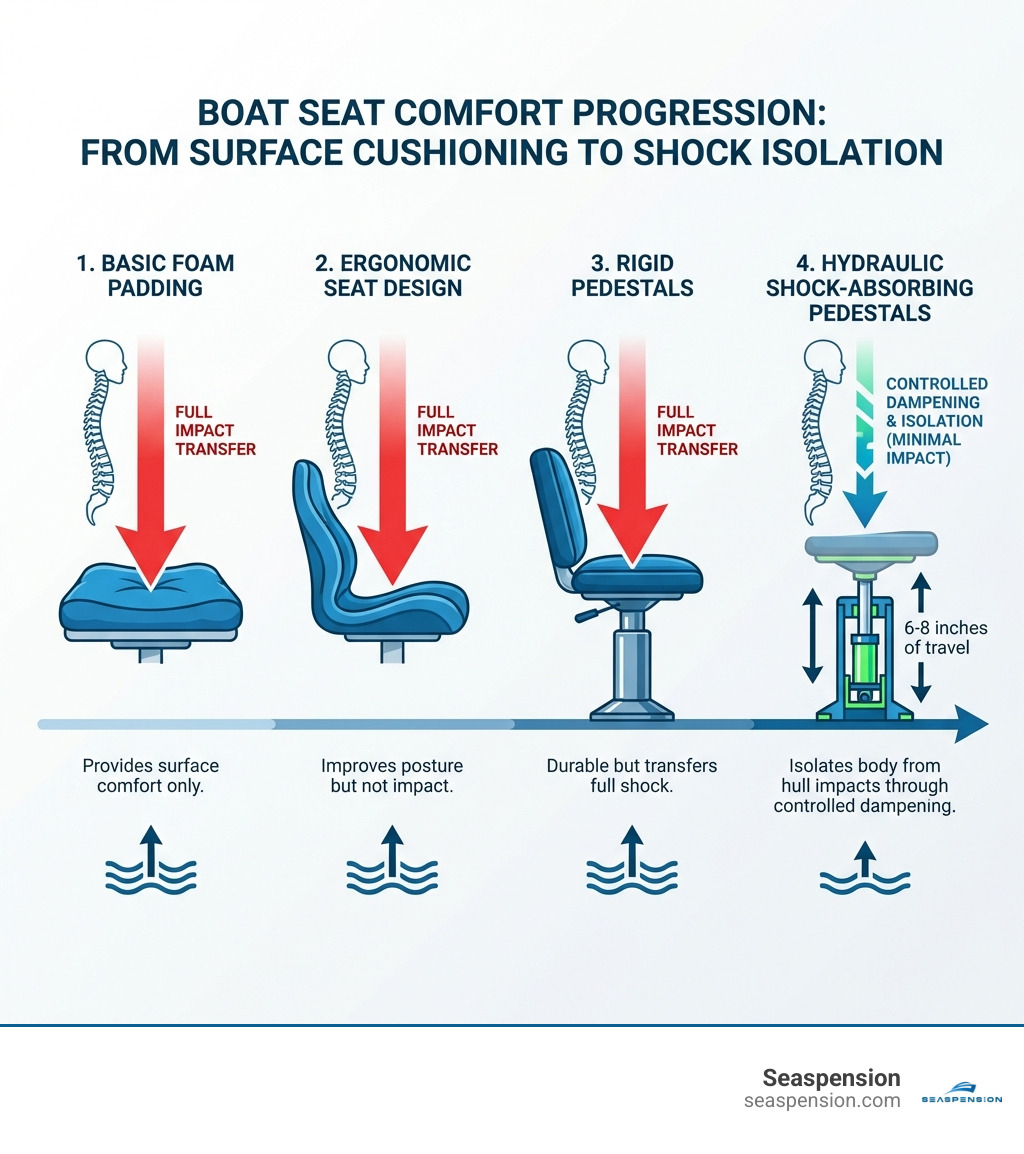
Most boaters focus on the wrong things when trying to improve comfort. They upgrade to premium helm chairs with better cushioning, add lumbar support, or invest in high-end materials — but still experience back pain and fatigue after a day on rough water. The reason is simple: cushions and upholstery address surface comfort, not impact forces. A plush seat on a rigid pedestal still transfers every wave strike directly into your body.
The solution isn't more padding. It's isolating your body from the hull through proper shock mitigation. This means understanding how suspension systems work, what types of dampening are most effective, and how to match a shock-absorbing pedestal to your specific boating conditions.
I'm Ian Milligan, owner of Seaspension, a marine technology company specializing in hydraulic shock-absorbing boat seat pedestals for recreational and commercial vessels. Over the past several years, I've worked with boaters dealing with fatigue and injury from inadequate boat seat comfort solutions, and I've seen what works in real-world marine conditions.
Boating is a passion for many of us, but it often comes with an unspoken cost: the physical toll it takes on our bodies. Every time our boat encounters a wave, the impact force travels directly through the hull, up through the seat, and into our spine. This constant jarring, known as whole-body vibration, can accumulate over hours, days, and decades on the water.
We've all seen or experienced it: the boater who steps off their vessel with an aching back, or the seasoned marine professional whose gait tells a story of years spent enduring rough conditions. The statistics bear this out: boaters can experience long-term back pain, pinched nerves, and compressed spines due to decades of riding in boats with poor seating. The marine industry is unfortunately full of individuals who walk with a lurch, have hunchbacks, and sport ugly scars from back surgery, often due to this chronic exposure. This is the hidden force of boating, and it's why addressing boat seat comfort goes far beyond superficial padding. It's about protecting your long-term health and enhancing your safety. You can learn more about this impact on your body and how it can be softened by reading our article, The Hidden Force of Boating: Why Your Body Feels the Impact and How Seaspension Softens the Blow.
The consequences of this repetitive impact are severe and extend beyond mere discomfort. We're talking about pinched nerves, compressed spinal discs, and chronic back pain that can lead to significant medical interventions, including surgery. Many boaters, after years of enduring rough rides, find themselves facing these very real and debilitating issues. The scars from back surgery are a stark reminder of the physical toll that neglecting proper shock mitigation can exact.
Beyond the pain, there's another critical factor: reduced focus. When your body is constantly bracing for impact, or when you're distracted by discomfort, your ability to concentrate on navigation, watch for hazards, or react quickly diminishes. This isn't just about personal comfort; it's a significant safety concern. Elevating your boating experience by reducing fatigue and improving focus on the water is essential, and you can find more insights in our guide, Seaspension and Safety: Elevating Your Boating Experience by Reducing Fatigue and Improving Focus on the Water.
Fatigue on the water is more insidious than simply feeling tired at the end of the day. It directly impacts your cognitive and physical performance. We've seen how prolonged exposure to whole-body vibration and the constant physical strain of a rough ride can lead to reduced reaction time, poor decision-making, and an increased risk of accidents. When your body is exhausted from absorbing impacts, your mind isn't as sharp, and your reflexes are dulled.
This isn't just about end-of-day soreness; it's about the safety implications for everyone on board. A fatigued captain is a less safe captain. For those who have already experienced back injuries or even undergone surgery, returning to boating can be a challenge. Investing in solutions that mitigate these impacts allows us to enjoy longer, safer, and more comfortable days on the water. Learn how we can help you get back on the water after an injury in Boating After Back Surgery: How Seaspension Can Help You Get Back on the Water.

It's easy to fall into the trap of thinking that a plush, well-upholstered seat automatically means superior boat seat comfort. We see many boaters invest heavily in what appear to be high-end helm seats, complete with luxurious materials and ergonomic designs, only to find themselves still experiencing discomfort after a long day. This is a common misconception, as these "surface-level solutions" often fail to address the root cause of impact and vibration.
The problem isn't the seat itself, but the rigid connection it has to the boat's hull. Conventional seating, no matter how well-padded, transmits virtually every jarring impact directly to the occupant. The limitations of this traditional approach become painfully clear the moment you hit a chop. It's why we advocate for a fundamental shift in how boaters approach seating comfort, moving beyond mere aesthetics to true impact mitigation. We've explored this in detail in Seaspension vs Conventional Boat Seating: Why Make the Switch?.
When we talk about upholstery and padding, we're typically discussing materials like marine-grade vinyl and closed-cell foam. These materials are indeed crucial for surface comfort and durability in the harsh marine environment. Marine-grade vinyl is robust, water-resistant, easy to clean, and designed to endure harsh weather and UV rays, preventing fading and resisting mildew. Closed-cell foam is chosen because it doesn't absorb water, which helps prevent mildew and keeps the seat dry. Features like UV resistance and antimicrobial properties are vital for the longevity and cleanliness of your boat seats.
However, these materials, while excellent for their intended purpose, do very little to absorb the significant impact forces generated by waves. A thick cushion might momentarily soften the initial blow, but it quickly "bottoms out," transferring the remaining force directly to your body. Worse, some foams can have a "rebound effect," pushing you back up after impact, which can be just as jarring. This is why, even with the best marine-grade vinyl and foam, if the seat is rigidly mounted, you're still going to feel every bump. Different types of boat seats offer varying levels of comfort; you can explore them further in 7 Types of Boat Seats and How to Select Your Seating.
Many boaters confuse ergonomic design with shock absorption. Helm chairs, leaning posts, flip-up bolsters, and armrests are all excellent features that contribute to improved posture, support, and convenience. For example, flip-up bolsters allow a captain to easily switch between sitting and standing, which is great for visibility and comfort during long runs. Adjustable bases that move fore/aft and up/down, along with features like flip-down toe rests, allow for personalized positioning and reduce strain. We've seen how important these features are, particularly for center console helm seats, as highlighted in What to Look For In Center-Console Helm Seats | Boating Mag.
However, while these ergonomic considerations significantly improve overall comfort and reduce fatigue from poor posture, they do not, by themselves, mitigate the shock from wave impacts. An ergonomically perfect seat on a rigid pedestal will still transmit damaging forces to your spine. True boat seat comfort in rough conditions requires isolating the occupant from these impacts, a function that traditional seat designs simply aren't built to provide.

The real solution to maximizing boat seat comfort and protecting your body lies in shock mitigation through suspension systems. Instead of simply cushioning the impact, these systems actively absorb and dissipate the energy from wave strikes, preventing it from reaching your body. The core principle is to isolate the seat, and therefore the occupant, from the hull's motion.
By effectively reducing G-forces—the measure of acceleration force—that your body experiences, shock-absorbing pedestals dramatically lessen the impact on your spine and joints. This isn't about making the ride feel "softer" in the traditional sense; it's about making it safer and more sustainable for your body. The science behind this shock absorption is critical to elevating your boating experience, as we detail in The Science Behind Shock Absorption: Elevating Your Boating Experience with Seaspension.
At the heart of effective shock mitigation for boat seats is the hydraulic shock-absorbing pedestal. Unlike simpler designs that might rely on basic springs or air bladders, a well-engineered hydraulic system provides controlled motion. When a wave impact occurs, the hydraulic dampening system compresses smoothly, absorbing the energy. This controlled compression prevents the jarring "bottoming out" feeling that rigid seats or inadequate suspension systems can cause.
Crucially, hydraulic systems also manage the rebound. Instead of "ejecting" or "catapulting" the occupant upwards after an impact, the hydraulic dampening controls the return motion, ensuring a smooth and gentle recovery. This controlled movement, combined with ample shock travel (typically 6-8 inches in high-performance systems), means your body remains relatively stable even when the boat is moving violently beneath you. This precise engineering is why you don't get jiggled with the best boat seat suspension systems, a topic we cover in Don't Get Jiggled: Choosing the Best Boat Seat Suspension System.
While every boater can appreciate improved comfort, certain individuals and applications benefit most profoundly from a suspension upgrade. We've seen the transformative effect our pedestals have on:
Anyone who spends significant time on the water, especially in rough conditions, will find a hydraulic shock-absorbing pedestal to be one of the most impactful upgrades for their boat seat comfort. Our systems are designed to benefit a wide array of boating activities, from fishing to cruising and more, as detailed in How Seaspension Benefits Different Boating Activities: Fishing, Cruising, and More.
Deciding to upgrade your boat's seating system with shock-absorbing pedestals is a significant step towards maximizing your boat seat comfort and extending your time on the water. However, it's not simply a matter of swapping out one pedestal for another. Proper installation, careful measurement, and a focus on long-term durability and maintenance are all crucial to realizing the full benefits.
This upgrade isn't just about adding a new piece of equipment; it's about enhancing your entire boating experience, making your vessel feel new again. We believe that the best upgrades are those that allow you to keep doing what you love, comfortably and safely. Find out more about how to revitalize your boat in How to Make Your Old Boat Feel New Again: Best 2025 Upgrades That Help You Keep Doing What You Love.
When selecting and installing a shock-absorbing pedestal, precision is key. We always advise careful measurement to ensure a perfect fit for your boat and your existing seat.
While many boaters are comfortable with DIY projects, we offer detailed installation guides and support to ensure correct setup. When in doubt, a professional marine installer can ensure optimal performance and safety. For a step-by-step guide, refer to How to Install a Seaspension Shock-Absorbing Boat Seat Pedestal.
The difference between basic boat seats and premium options, particularly those with integrated suspension, goes far beyond price. It's rooted in construction quality, materials, and rigorous testing.
Basic seats might offer minimal padding and a rigid frame, providing little to no impact absorption. Premium options, on the other hand, incorporate advanced engineering. When evaluating true boat seat comfort, we look at:
Maximizing your boat seat comfort is about more than just a softer ride; it's about enhancing your safety, extending your time on the water, and protecting your body from the cumulative effects of wave impacts. We've seen how ignoring these forces can lead to long-term physical ailments and reduce the enjoyment of boating.
By understanding the limitations of conventional seating and embracing the proven benefits of hydraulic shock-absorbing pedestals, you can mitigate impact, reduce fatigue, and significantly improve your boating experience. Our hydraulic solutions are engineered for real-world durability and controlled motion, ensuring that you can steer rough waters with greater confidence and comfort.
Don't let discomfort cut your boating adventures short. Invest in a solution that truly protects your body and allows you to fully accept the open water. We encourage you to Explore our full range of shock-absorbing boat seats and pedestals to find the perfect upgrade for your vessel.
Boat seat pedestal accessories are the components that connect, adjust, and secure your boat seat to its pedestal—including swivel tops, seat slides, locking mechanisms, mounting bases, and hardware. These accessories determine how your seat moves, locks, and adapts to different conditions on the water.
Core Boat Seat Pedestal Accessories:
If you've spent a day on choppy water, you know the feeling. Every wave sends a jolt through the deck, up through your seat, and straight into your spine. You brace. You shift. You stand up to stretch your lower back. By the time you're back at the dock, you're exhausted—not from the activity, but from the impact.
Most boaters focus on the seat itself—the cushion, the upholstery, the backrest. But the real problem isn't comfort. It's shock transfer. And that starts with what's between your seat and the deck: the pedestal and its accessories.
The pedestal is the structural link between your boat and your body. A basic pedestal just holds the seat in place. But the right pedestal system—with the right accessories—can swivel, slide, lock, and in some cases, absorb the forces that cause fatigue and injury. The difference between a long, painful day and a productive one often comes down to what's bolted to your deck.
I'm Ian Milligan, owner of Seaspension, a Florida-based company that specializes in shock-absorbing pedestal systems for recreational and commercial boaters. Since 2021, I've worked with operators across the country to reduce impact fatigue through engineered suspension solutions, and I've seen how the right boat seat pedestal accessories can transform time on the water.
When we talk about boat seat pedestal accessories, it's important to first understand the foundation: the pedestals themselves. Pedestals come in various forms, each designed to serve different purposes and offer distinct advantages. The choice often depends on your boating activity, the type of boat you have, and your personal comfort needs.
We see a global marine seating market valued at over a billion dollars, projected to grow significantly. This growth reflects increasing boat ownership and recreational activities, driving demand for better seating solutions, including advanced pedestals.
Fixed-height pedestals are the simplest and most cost-effective option. They provide a static elevation for your boat seat, maintaining a consistent height above the deck. These are commonly found on smaller boats or in positions where height adjustment isn't critical. Their main benefits are their straightforward design, durability, and minimal maintenance. While they lack adjustability, their solid construction ensures stability.
For those who need more flexibility, adjustable height pedestals are a popular choice. These pedestals allow you to change the seat's height, accommodating different users or adapting to varying conditions on the water.
The primary difference between a fixed and adjustable boat seat pedestal lies in this ability to change height. Adjustable pedestals typically come in two main types:
Adjustable pedestals offer a range of height options, with common ranges including 13-19 inches and 18-25 inches, catering to diverse user needs and boat configurations. This versatility is invaluable for ensuring comfort and clear sightlines for different operators or passengers.
This is where we focus our expertise. Traditional pedestals, whether fixed or adjustable, transmit the full force of wave impacts directly to the occupant. Our shock-absorbing pedestals are engineered to mitigate these forces. They incorporate advanced suspension systems, often hydraulic, that absorb vertical impacts, cushioning the ride significantly. This is particularly beneficial in rough water conditions, reducing fatigue and protecting occupants from the physical toll of constant jarring. We'll dig deeper into the mechanics of shock absorption later, but for now, understand that these pedestals are designed for superior comfort and safety. You can learn more about our shock-absorbing pedestals here.
Removable pedestals use a socket base installed flush with the deck. The pedestal post can be inserted or removed as needed, offering flexible deck space. This is ideal for boats where the seating arrangement needs to change, or where you want to clear the deck for fishing or other activities. When removed, the deck remains clear, reducing tripping hazards and making cleaning easier.
Beyond the pedestal itself, the right boat seat pedestal accessories are crucial for optimizing your seating experience. These components improve functionality, comfort, and safety.

To better understand how these parts work together, it can help to look at how a typical swivel seat mount functions in other applications. The same basic principles apply on the water, but with far higher loads and harsher environmental conditions, which is why marine-grade construction and proper standards matter.
What features should you look for in a boat seat pedestal system? It often comes down to how you use your boat.
The marine environment is harsh, with constant exposure to saltwater, UV rays, and vibrations. Therefore, the materials used for boat seat pedestal accessories are critical for longevity and performance. Many boat seat pedestals are constructed from marine-grade nylon or aluminum alloy, materials chosen for their corrosion resistance and durability.
Selecting and properly installing your boat seat pedestal and its accessories is fundamental to a safe and comfortable boating experience.
Choosing the right height for your boat seat pedestal is more than just comfort; it's about safety and control.
We've compiled an extensive FAQ to help you steer these choices and more, ensuring you get the most out of your setup. Find answers to common questions about height selection and other topics in Everything You Need to Know About SeaSpenSion: FAQs for a Smoother Ride.
Installing a boat seat pedestal correctly is critical for safety and performance. Here's a general overview of the process:
For a detailed, step-by-step guide, we've outlined the process for our systems. You can find comprehensive instructions on How to Install a Boat Seat Pedestal to Your Recreational Boat. Always remember to abide by all ABYC and U.S. Coast Guard regulations for marine installations.
Proper maintenance of your boat seat pedestal and its accessories is key to ensuring their longevity, reliable operation, and continued safety on the water.
Taking these simple steps will significantly extend the life of your boat seat pedestal accessories and keep your seating system performing optimally. We believe in providing solutions that last, and proper care is a big part of that. Learn more about the long-term ownership benefits of quality marine accessories on our Why Buy page.
We've discussed various pedestals and accessories, but it's crucial to address the fundamental problem that drives many boaters to seek upgrades: the relentless impact of waves.
Many boat owners try to solve discomfort with simple fixes:
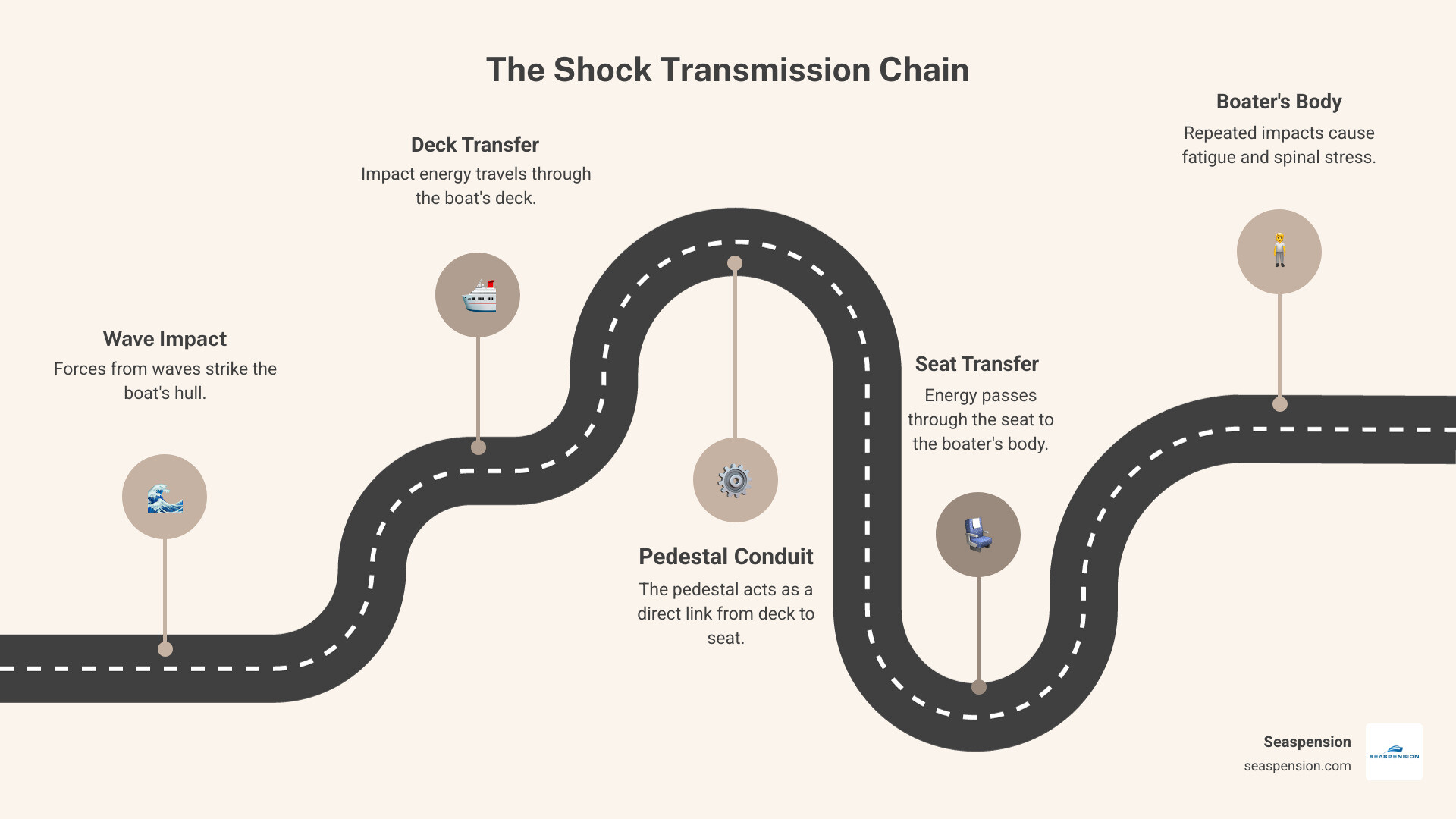
The human body is not designed to absorb repetitive, high-force impacts. When your boat hits a wave, the force travels from the hull, through the deck, up the pedestal, and into your body. This causes:
We dig into the mechanics of this impact and its effect on your body in The Hidden Force of Boating: Why Your Body Feels the Impact and How SeaSpenSion Softens the Blow.
True shock mitigation goes beyond a simple spring. It's about a controlled absorption of energy. Our pedestals use an independently operating, high-performance hydraulic shock-absorbing system.
This technology isn't just about comfort; it's about extending your time on the water, enhancing your safety, and protecting your long-term health.
As we've explored, boat seat pedestal accessories is far more than just nuts and bolts. It's a critical aspect of your overall boating experience, directly impacting your comfort, safety, and endurance on the water.
The pedestal, often an overlooked component, is the vital link between you and your vessel. Choosing the right type—whether fixed, adjustable, or especially, a shock-absorbing system—along with essential accessories like swivels, slides, and locking mechanisms, transforms your ride. It's an investment in minimizing the physical toll of boating, allowing you to enjoy more time doing what you love.
For those who regularly steer rough waters, the benefits of advanced, high-performance systems like ours are undeniable. By actively mitigating the jarring impacts and whole-body vibrations, we help reduce fatigue, prevent discomfort, and improve focus, making every outing more enjoyable and safer.
We invite you to explore our range of advanced boat suspension pedestals and find how a truly effective shock-absorbing system can make a profound difference in your boating life. It’s not just an upgrade; it’s an investment in your well-being on the water. Explore our advanced boat suspension pedestals here.
A Marine suspension pedestal is a shock-absorbing boat seat base that uses hydraulic technology to isolate the occupant from hull impacts, significantly reducing fatigue and spinal strain during rough water operation.
Key Benefits of Marine Suspension Pedestals:
If you've ever finished a day on the water with a sore back, tight shoulders, or that bone-tired feeling that comes from constant jarring, you already understand the problem. Every wave slap travels directly from the hull through a rigid seat post and into your body. Over time, that adds up.
Most boaters try thicker cushions or just accept the discomfort. But those approaches don't address the root cause: rigid pedestals transfer impact directly to the occupant.
Marine suspension pedestals solve this by introducing a hydraulic shock absorber between the deck and the seat. The pedestal compresses and rebounds in a controlled way, dissipating energy that would otherwise travel straight into your spine.
This isn't about luxury. It's about staying in control, reducing injury risk, and making time on the water sustainable — especially for operators who spend hours at the helm.
I'm Ian Milligan, owner of Seaspension, where we design hydraulic Marine suspension pedestal systems for recreational and commercial vessels. Since 2021, we've focused on building durable, retrofit-capable solutions that address the real physical strain boaters face in rough water.
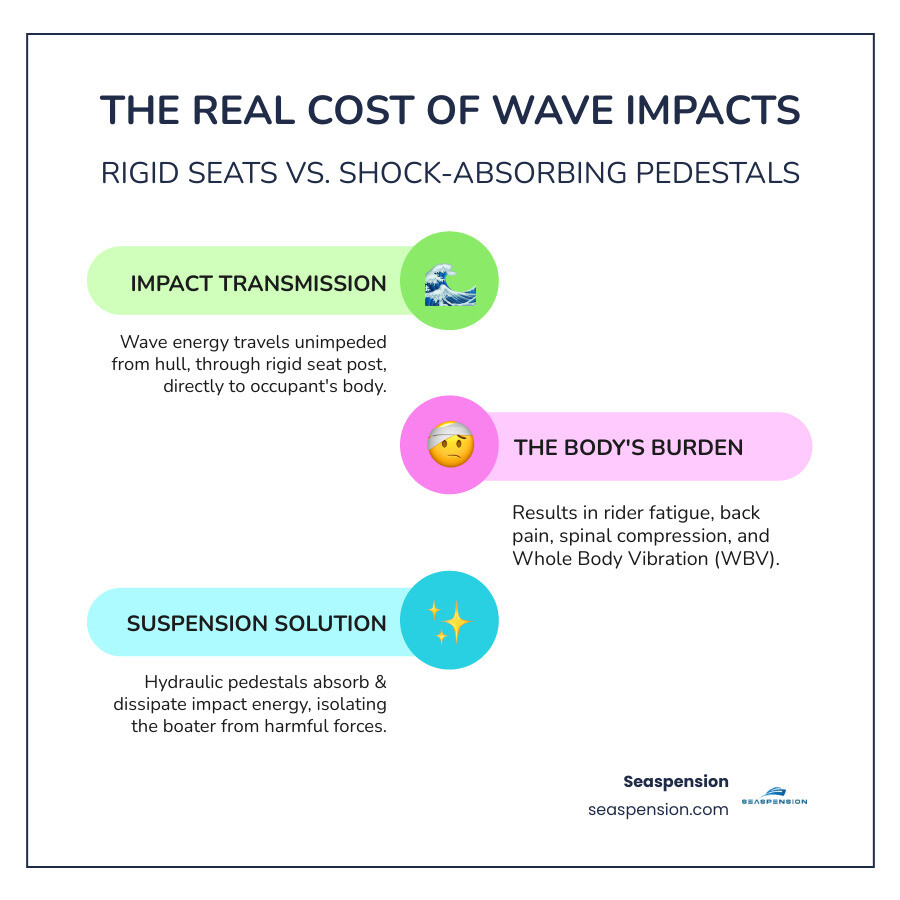
When we talk about the "cost" of a rough ride, we're not just referring to wear and tear on the boat. The most significant cost is often paid by the people on board. Repeated impacts from waves, even seemingly minor ones, accumulate over a day or a season. This constant jarring leads to what we call Whole Body Vibration (WBV).
WBV can manifest in several ways:
We've all heard the stories, or experienced it ourselves: the 'eject or catapult feeling' that comes from hitting a wave unprepared. Or the need to 'hold on for dear life' when the water gets rough. This isn't how boating should feel. It affects your ability to concentrate, your reaction time, and your overall safety. For those of us in Pinellas Park, FL, or along the coasts of Washington and Massachusetts, encountering choppy conditions is a regular part of boating, and these impacts are a constant reality.
To understand why a Marine suspension pedestal is so effective, we first need to understand the limitations of a standard boat seat pedestal. Most traditional pedestals are essentially rigid posts. They connect your seat directly to the boat's deck. While they provide a stable mounting point, they offer no mechanism for absorbing energy.
When your boat encounters a wave, especially during what we call "hull slap," a significant amount of force is generated. This force, or G-force, travels directly from the hull, through the deck, up the rigid pedestal, and into the seat. From there, it's transferred straight into the occupant's body. There's no buffer, no dampening, just a direct transmission of shock.
This is the essence of Whole Body Vibration (WBV). It's not just a gentle rocking; it's a series of sharp, sudden movements that the body has to contend with. The impact differs significantly from simple vibration. Vibration might be a continuous, low-amplitude movement. Impact, however, is a sudden, high-amplitude, high-force event. Imagine the difference between driving on a gravel road (vibration) and hitting a pothole (impact). A standard pedestal handles neither well, but it's the impacts that cause the most physical strain and discomfort.
Many boat owners, faced with the discomfort of a rough ride, often turn to what seem like logical solutions. However, these rarely address the root cause of impact transmission.
One common approach is to add thicker seat cushions. While a plush cushion might feel good at the dock, it offers minimal protection against significant wave impacts. A cushion primarily distributes pressure; it doesn't absorb the kinetic energy of a sharp jolt. The force still travels through the cushion, albeit slightly softened, and into your body. It's like putting a pillow on a concrete slab – it's still a concrete slab underneath.
Another strategy is standing while operating the boat in rough water. This allows your legs to act as natural shock absorbers. While effective for short bursts, it's not sustainable for long periods. Standing reduces stability, increases fatigue in your legs and back, and compromises your ability to maintain full control of the helm, especially in unpredictable conditions. The safety risk of not being securely seated at the helm is considerable; a sudden, unexpected wave could throw you off balance or even overboard.
Similarly, padded upholstery might improve the aesthetic appeal and initial comfort of a seat, but it offers no real shock-absorbing capabilities. The underlying structure remains rigid, and the impacts are still transmitted. These methods fail to absorb significant shock because they don't introduce a mechanism for energy dissipation. They're cosmetic or superficial fixes to a fundamental mechanical problem. For serious boaters, especially those navigating the challenging waters off Alaska or the Pacific Northwest, these stop-gap measures simply don't cut it.
A Marine suspension pedestal fundamentally changes the interaction between the boat's deck and the occupant. Instead of a rigid connection, it introduces a sophisticated mechanism designed to absorb and dissipate the kinetic energy of wave impacts. This is achieved through a controlled system of compression and rebound.

At its core, a suspension pedestal works by isolating the occupant from the deck. When the boat hits a wave, the impact force is no longer directly transferred. Instead, the pedestal's internal components, primarily a hydraulic shock absorber, move to absorb that energy. The pedestal compresses, taking the brunt of the upward force, and then rebounds in a controlled manner, preventing the "eject" sensation. This controlled movement is crucial for maintaining comfort and stability.
The key here is energy dissipation. Rather than the energy of the impact being transmitted to your body, it's converted and released within the hydraulic system. This process is far more effective than any amount of padding. We're talking about up to 8 inches of suspension travel in some systems, specifically designed to absorb significant wave impacts. This is a crucial difference from a simple spring, which might absorb some energy but often lacks the controlled dampening necessary to prevent a harsh rebound. A spring alone can still lead to a bouncy, uncontrolled ride. Hydraulic systems, however, offer precise control over both compression and rebound.
Our focus at Seaspension is on hydraulic suspension technology, and for good reason. These systems are inherently robust and reliable, making them ideal for the harsh marine environment. Unlike other systems, hydraulic components are less susceptible to the corrosive effects of saltwater and constant exposure to the elements.
A hydraulic system works by forcing fluid through a series of valves and orifices. When an impact occurs, the fluid resists rapid movement, converting kinetic energy into heat, which is then safely dissipated. This is the essence of shock absorption and dampening.
In a marine environment, performance is paramount. Hydraulic systems maintain consistent performance across a wide range of temperatures and conditions, from the cold waters of Alaska to the warm currents off Florida. They are self-contained, meaning less fuss and fewer external components that can fail.
Maintenance for hydraulic systems is typically minimal. We design our pedestals for durability and longevity, requiring only basic care like freshwater rinsing after use and periodic inspection. Their robust construction and sealed components protect against the ingress of salt and contaminants, contributing to a longer service life. This reliability is a major advantage for both recreational boaters and commercial operators.
The true advantage of a high-quality Marine suspension pedestal lies in its tuned hydraulic system. This isn't just about having a hydraulic component; it's about how that system is engineered to respond to varying forces and conditions. We use principles of hydraulic fluid dynamics and velocity-sensitive dampening to achieve optimal performance.
What does "velocity-sensitive dampening" mean in practical terms? It means the hydraulic system automatically adjusts its resistance based on how quickly an impact occurs. A slow, gentle roll will meet less resistance, allowing for comfortable movement. A sharp, fast impact, like hitting a large wave, will encounter greater resistance, effectively absorbing the shock and preventing a harsh bottoming out or a jarring rebound. This intelligent response is key to a smooth and controlled ride.
A self-contained hydraulic unit is a significant benefit. It eliminates the need for external pumps, air lines, or complex adjustments typically associated with other suspension types. This simplifies installation, reduces potential points of failure, and ensures consistent performance without constant fiddling. Once installed and properly tuned for the occupant's weight, the system largely takes care of itself.
Our Seaspension pedestals are a prime example of a purpose-built, weight-tuned hydraulic system. Each pedestal is engineered to provide optimal comfort and safety, even with varying occupant weights. We ask for the general weight of the primary seat occupant because each pedestal is tuned for ideal performance based on that information. This ensures that the system provides the right amount of dampening and travel for the specific user, leading to a truly refined experience. This tuning is critical for achieving that "nice smooth ride" that prevents the constant jarring of the spine.
Choosing the right Marine suspension pedestal is a decision that impacts your comfort, safety, and overall enjoyment on the water. It's not a one-size-fits-all product, and several factors should guide your selection.

(Image of a marine suspension pedestal installed on a boat's deck, viewed from the side)
We've learned a lot about what boaters need from our experiences serving customers from the family-owned Fisheries Supply in Seattle to individual boaters worldwide.
The first step is always to consider the occupant and the boat itself.
The marine environment is notoriously harsh. Saltwater, UV exposure, and constant motion demand materials and construction techniques that can withstand these challenges.
Integrating a Marine suspension pedestal into your boat should be a straightforward process. We design our systems for ease of installation.
While recreational boaters gain immense benefits from Marine suspension pedestals, their utility extends far beyond leisure. These systems are a critical component in enhancing safety and performance across various marine sectors.
A Marine suspension pedestal is not just a comfort item; it's a fundamental safety and operational improvement for anyone spending significant time on the water, especially in challenging conditions.
We often hear similar questions from boaters considering a suspension upgrade. Here are some of the most common ones:
The price of a Marine suspension pedestal can vary based on technology, materials, and specific features. You'll find a range of options on the market, but as a general guideline, Seaspension hydraulic shock-absorbing pedestals start at $825. This price reflects the robust construction, advanced hydraulic technology, and marine-grade materials required for reliable performance in harsh conditions. When you're investing in your comfort and safety, considering the build quality and the type of shock absorption is crucial.
The core difference between a Marine suspension pedestal and a standard pedestal is simple: one is rigid, and the other is active. A standard pedestal is a fixed, rigid post that directly transmits every jolt and impact from the boat's hull to the occupant. There's no mechanism to absorb or dissipate energy.
In contrast, a suspension pedestal incorporates an active shock absorber, typically a hydraulic mechanism. This internal system acts as a buffer. When the boat hits a wave, the suspension pedestal compresses, absorbing the impact force before it reaches your body. It then rebounds in a controlled manner, preventing you from being thrown upwards. This process effectively isolates the occupant from the deck, turning a jarring impact into a smooth, controlled movement. The role of an internal hydraulic mechanism is to manage this energy transfer efficiently and consistently.
A Marine suspension pedestal significantly reduces fatigue on long trips by absorbing repetitive shock. Every time your boat encounters a wave, your body, if seated on a rigid pedestal, has to absorb that impact. This means your muscles constantly tense and relax, your spine compresses, and your joints take a beating. Over hours, this cumulative strain leads to physical exhaustion, muscle soreness, and mental fatigue.
A suspension pedestal intervenes in this process. By actively absorbing and dampening these impacts, it prevents the majority of that shock from reaching your body. This means your muscles don't have to work as hard to brace yourself, your spine isn't subjected to constant compression, and your overall physical system experiences less stress. The result is a dramatic reduction in cumulative strain on the spine and muscles. You arrive at your destination feeling much fresher and more relaxed, able to enjoy the post-boating activities. This also allows operators to remain seated and in control longer, which is vital for safety and effective navigation on extended journeys.
The decision to install a Marine suspension pedestal is more than just an upgrade; it's an investment in your health, safety, and the longevity of your passion for boating. We've seen how these systems transform the boating experience, turning bone-jarring rides into smooth, comfortable journeys.
By providing superior shock absorption and isolating you from the harsh realities of rough waters, a hydraulic suspension pedestal significantly reduces fatigue and discomfort. This means more time on the water, more enjoyment, and a greater ability to remain focused and in control, which is a fundamental safety upgrade.
Don't let the bounce dictate your time on the water. Experience the difference a properly engineered hydraulic system can make. We invite you to explore our shock-absorbing boat suspension pedestals and redefine your boating experience.
A boat seat mounting plate is the critical connection point between your seat and pedestal, designed to distribute weight and stress evenly across the seat base. Without a proper mounting plate, you risk wobble, cracked seat bases, and accelerated hardware failure—especially in rough water.
Key functions of a boat seat mounting plate:
A stable seat starts with a solid connection to the pedestal. The mounting plate's main job is to distribute weight and stress across the seat base, preventing cracks and instability. In rough water, a weak or poorly installed plate can lead to wobble, fatigue, and even seat failure.
Most boaters don't think about their mounting plate until something goes wrong. A loose seat. Hardware that won't stay tight. Stress cracks forming around bolt holes. These aren't just annoyances—they're safety issues that can turn a good day on the water into an expensive repair job or worse.
The right boat seat mounting plate matters because it's the foundation of your entire seating system. Whether you're running a center console through three-foot chop or spending long days at the helm of a fishing boat, that small piece of hardware carries every impact, every shift in weight, and every stress load your body puts on the seat.
I'm Ian Milligan, owner of Seaspension, where we've seen how proper mounting plate selection and installation affects the performance and longevity of boat seating systems. A quality boat seat mounting plate is the first step toward a stable, reliable seat—though it's only part of the solution for reducing the physical toll of rough water.
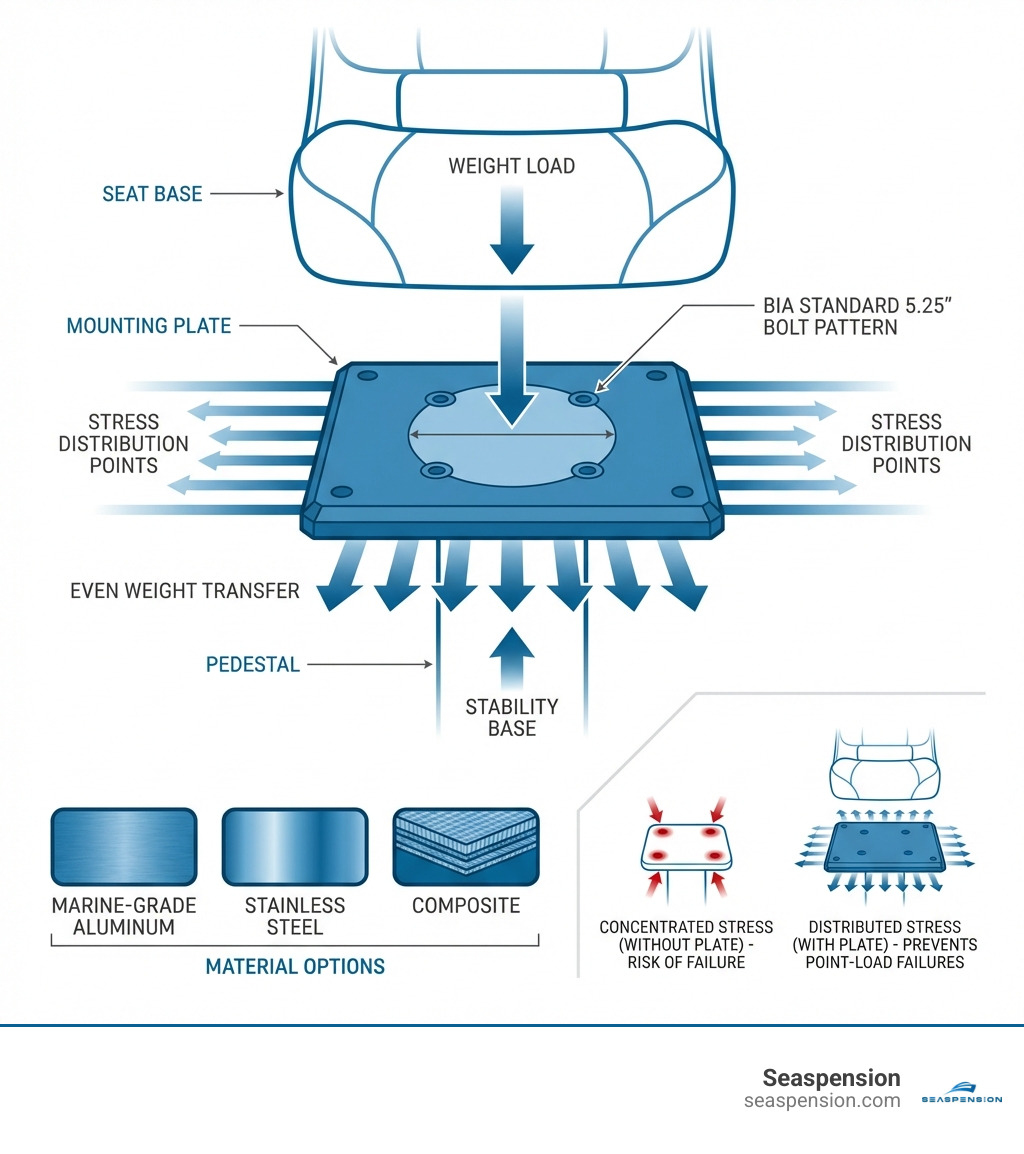
When a boat seat lacks a properly chosen and installed boat seat mounting plate, the consequences can range from minor irritations to serious safety hazards. We often see several common issues arise.
Selecting a mounting plate is about compatibility and durability in the marine environment—not about chasing brands. Focus on fit, material, and how the plate will perform in real-world conditions. This decision lays the groundwork for a stable, long-lasting seat system, whether you're cruising the Florida Keys or fishing off the coast of Massachusetts.

The material of your boat seat mounting plate dictates its strength, corrosion resistance, and lifespan. The design, particularly its bolt pattern, determines its compatibility.
Here's a comparison of common mounting plate materials:
| Material | Pros | Cons | Marine Suitability | Typical Cost |
|---|---|---|---|---|
| Composite | Lightweight, excellent corrosion resistance, non-conductive | Can be less rigid than metal, may crack under extreme stress/impacts | Good for freshwater and saltwater, often used for lighter seats or as backer plates on roto-molded seats | Low to Moderate |
| Aluminum | Strong, lightweight, good corrosion resistance (anodized/coated) | Can corrode if not properly treated or if dissimilar metals are used | Excellent for saltwater and freshwater, common in many applications, good balance of performance and cost | Moderate |
| Stainless Steel | Superior strength, excellent corrosion resistance, very durable | Heavier, more expensive, can be prone to galvanic corrosion if not isolated | Best for harsh saltwater environments, high-stress applications, long-term durability is key | Moderate to High |
Ensuring your boat seat mounting plate is compatible with your seat and pedestal is paramount. A mismatch can lead to instability, hardware failure, or an inability to install the seat at all.
A reliable installation prevents future headaches like corrosion, leaks, and loose hardware. Preparation and the right materials are key. A properly installed boat seat mounting plate ensures your seat remains secure, even when you're hitting chop in the Gulf of Alaska or navigating busy waterways off New Jersey.
Before you begin, gather everything you need. This isn't a job you want to stop halfway through because you're missing a washer.
Once you have everything ready, follow these steps for a secure installation of your boat seat mounting plate.
Even straightforward jobs can present challenges. Here’s how to address the most common problems encountered with boat seat mounting plate installation, ensuring your time on the water, whether in California or New Jersey, is safe and comfortable.
Mismatched holes are a common frustration, and a wobbly seat is not just annoying—it's a sign of instability that needs immediate attention.
Corrosion and water intrusion are the silent enemies of marine hardware, leading to premature failure and costly repairs. Taking preventative measures during installation is far easier than fixing the damage later.
A solid boat seat mounting plate is fundamental for safety and stability. It ensures your seat is securely attached to its pedestal. However, a robust mounting plate, by itself, doesn't address the primary cause of boater fatigue and discomfort: the relentless vertical shock from waves.
A fixed mount, even with the best boat seat mounting plate, provides only static stability. It locks your seat rigidly to the boat's structure. While this prevents lateral movement and seat failure, it means every jarring impact from waves is transmitted directly through the seat, up the pedestal, and into your body.
Imagine driving a truck with no suspension over a bumpy dirt road. That's essentially what a fixed boat seat does to your body in rough water. These repeated vertical impacts lead to:
For us, building trust means being honest about what a boat seat mounting plate does and doesn't do. It's a critical safety component, but it's not a comfort solution for rough water.
A suspension pedestal, however, fundamentally changes this equation. It's designed to absorb vertical impacts before they reach the occupant. Instead of your body absorbing the shock, the pedestal does.
Hydraulic systems, such as those used in Seaspension pedestals, are specifically engineered for this purpose. Unlike simple spring mechanisms or air shocks that can be "springy" or sensitive to temperature changes, a hydraulic suspension pedestal provides a controlled, smooth dampening effect. It reduces physical strain and extends your time on the water—independently of the mounting plate. We focus on an independently operating shock-absorbing system that offers optimal comfort and safety for boaters, even with varying occupant weights, which is crucial for charter captains and commercial operators across the United States and worldwide.
A quality boat seat mounting plate provides the secure base, but a Seaspension shock-mitigating pedestal provides the ride quality that truly protects you from the harsh realities of rough water. When both are properly selected and installed, you get a system that offers both unwavering stability and unparalleled comfort. Learn how a true boat suspension pedestal works and how it can transform your boating experience.
Learn how Seaspension reduces impact in rough water and see installation options for your boat.
Boat seats for rough water are designed to absorb the repeated shocks and impacts that occur when a vessel moves through choppy conditions, protecting the operator and passengers from fatigue, discomfort, and long-term injury.
Quick Answer: What to Look for in Boat Seats for Rough Water
If you spend time on the water in anything other than calm conditions, you already know the feeling. Every wave sends a jolt through your spine. Your legs brace constantly. Your lower back aches after an hour at the helm. You cut trips short not because you want to, but because your body can't take it anymore.
Standard boat seats — even expensive ones — weren't designed to solve this problem. They're built for looks, storage, or basic comfort in flat water. When conditions get rough, foam cushions compress and bottom out. Rigid pedestals transfer every impact directly into your body. The result is fatigue, soreness, and over time, real injury risk.
The solution isn't more padding. It's true shock mitigation — a system that absorbs impact energy before it reaches your body, then returns smoothly without throwing you upward. That's what proper boat seats for rough water are engineered to do.
I'm Ian Milligan, owner of Seaspension, where we've spent years helping boaters reduce the physical toll of rough water through hydraulic shock-absorbing pedestals. Whether you're running offshore, fishing in choppy conditions, or operating commercially, the right seating system makes a measurable difference in comfort and safety.
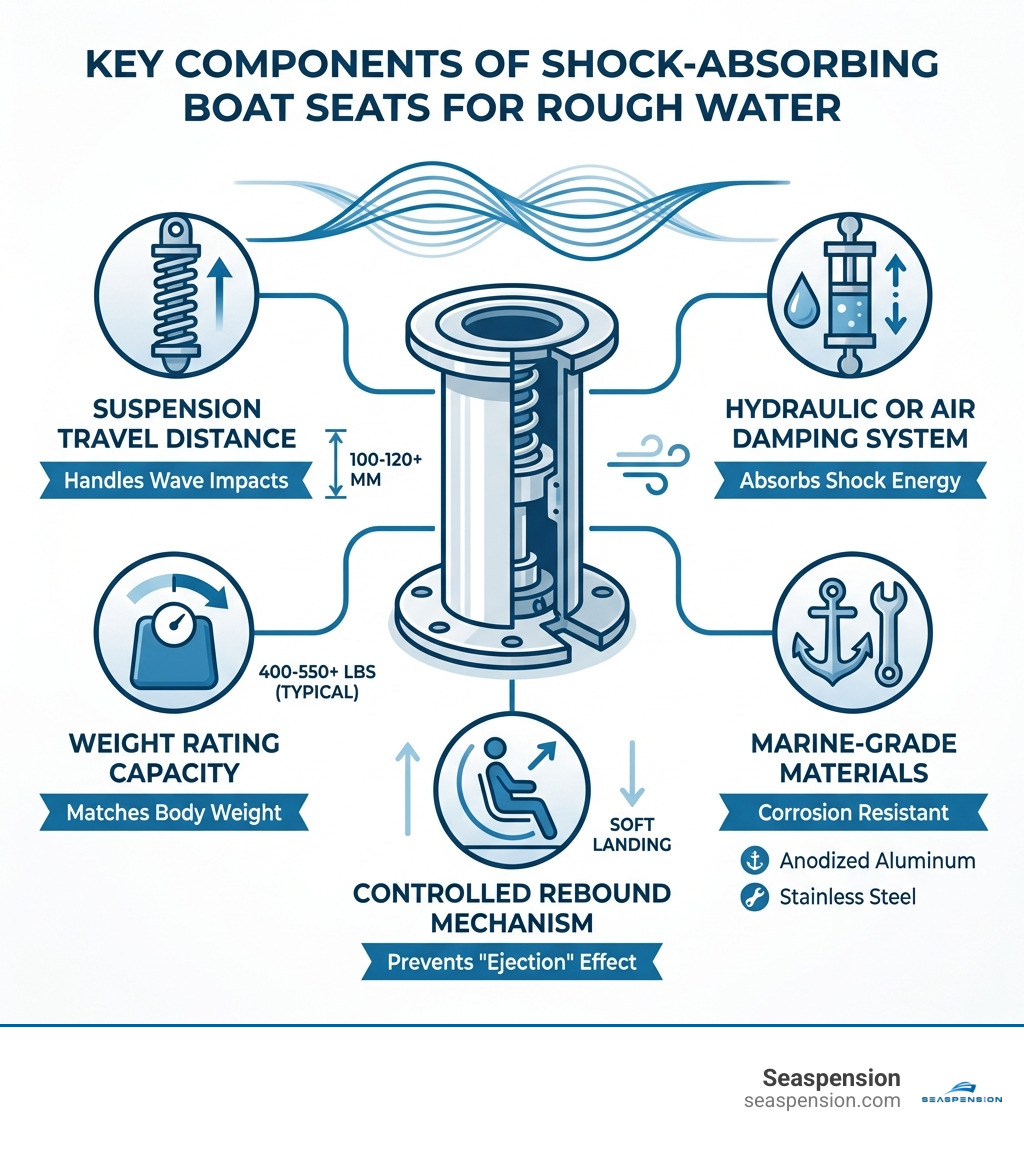
Boating in rough water isn't just about getting wet or having your coffee spill. It's about constant, jarring impacts that take a significant physical toll on everyone aboard. Imagine hitting hundreds of small potholes, one after another, for hours. That's what your body experiences in choppy seas.
These repetitive impacts lead to:
We understand these challenges firsthand. The constant G-forces experienced when a boat slams into a wave can be intense, far exceeding what the human body is designed to comfortably absorb.
The physical consequences of rough water extend far beyond simple discomfort. It's a serious health concern for frequent boaters, leading to potential long-term injuries and chronic issues.
The primary culprit is Whole Body Vibration (WBV) and repetitive impacts. When your boat pounds through waves, your body is subjected to forces that can lead to:
We've explored the hidden force of boating and why your body feels the impact in detail, and the science behind shock absorption is clear: mitigating these forces is crucial for your health and enjoyment on the water. The science behind shock absorption isn't just about comfort; it's about protecting your long-term well-being.
Many boaters, understandably, try to alleviate the pain of rough water with what seems like common sense solutions. However, most of these approaches fall short because they don't address the fundamental problem of impact absorption.

Why do these solutions fail? Because vibration dampening alone falls short. A cushion might reduce some minor vibrations, but it can't absorb the large, sudden impacts that cause spinal compression and fatigue. These are temporary fixes that don't address the core issue of impact energy transfer. As we've seen, conventional boat seating simply doesn't compare when it comes to true shock mitigation.
True shock mitigation goes beyond mere padding. It involves a sophisticated system designed to absorb and dissipate the energy from wave impacts, preventing it from reaching your body. Think of it like the suspension in your car, but engineered for the unpredictable forces of the marine environment.
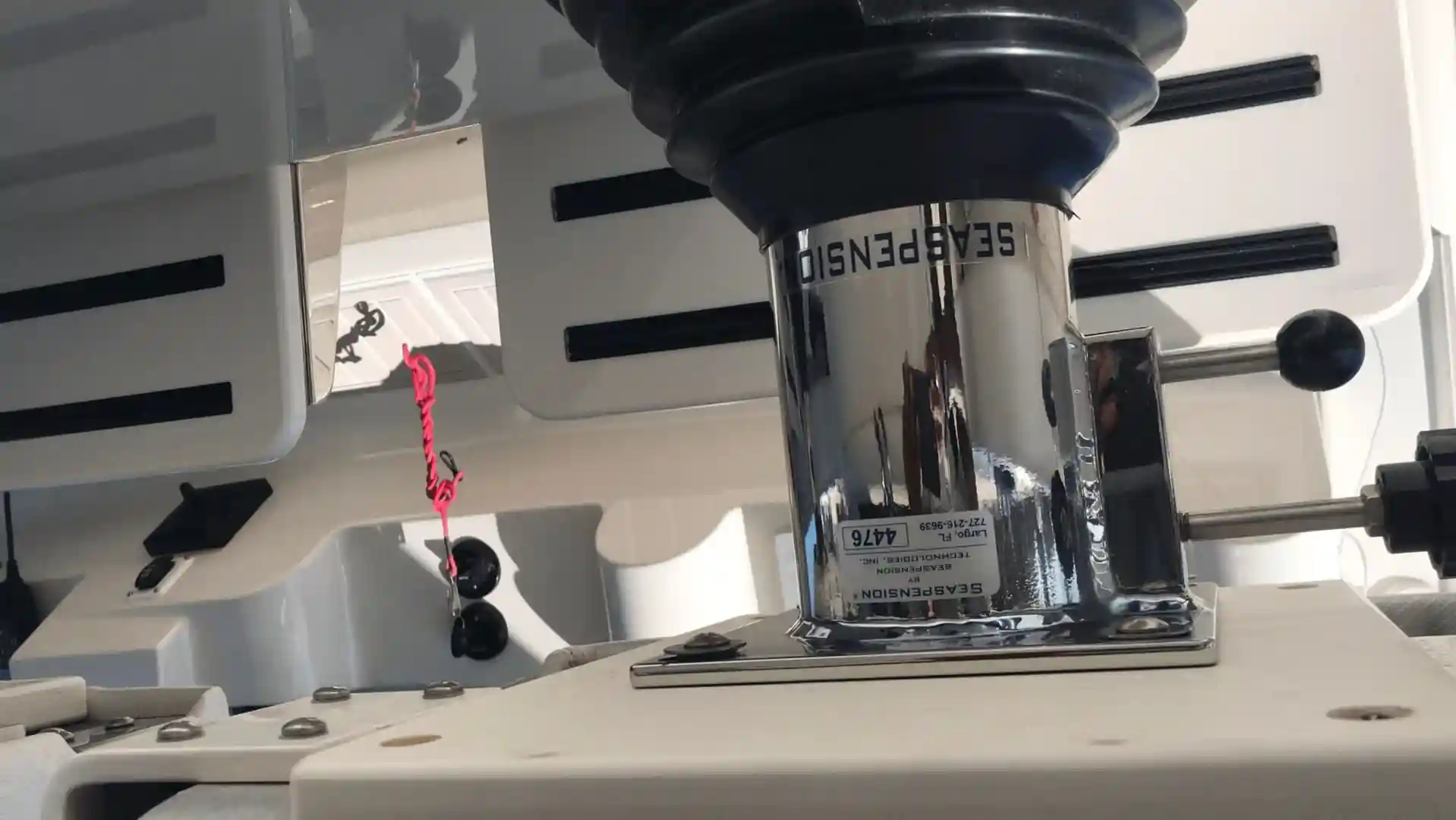
At its core, shock mitigation works through:
The goal is to provide a smooth ride on the water, without that back-jarring experience you get with a non-suspension seat. It's about making sure your boat seats save your back, allowing you to enjoy your time on the water without the physical toll. Read more about how boat seats can save your back.
When considering boat seats for rough water, you'll encounter a few primary types of shock-absorbing systems. The most robust and reliable for the marine environment are hydraulic shock-absorbing pedestals. These use fluid (oil) to dampen motion, much like the shock absorbers in a car, offering excellent control over both compression and rebound for a consistently smooth ride. Our experience shows that hydraulic systems are exceptionally durable and require minimal maintenance.
While other mechanical or pressure-based systems exist, they often introduce complexity and maintenance issues, or lack the controlled rebound needed to prevent a jarring, bouncy ride. It’s important to understand the distinctions between different technologies. What most boaters don't know about hydraulic vs. air suspension for boats can significantly impact their choice and long-term satisfaction.
When upgrading your boat seats for rough water, you generally have two main options: replacing your existing pedestal with a shock-absorbing one, or installing a fully integrated shock-absorbing seat.
Shock-Absorbing Pedestals: This is often the most practical and cost-effective solution for many boaters. Pedestals replace your existing rigid seat post, allowing you to keep your current seat top (unless you want to upgrade that too).
Integrated Shock-Absorbing Seats: These units combine the seat top and the suspension mechanism into a single, cohesive system. They are often found in new boats designed for rough conditions or in high-performance applications.
For most recreational and many commercial boaters looking to improve their ride in rough water, a high-quality shock-absorbing pedestal offers an excellent balance of performance, cost, and ease of installation. We believe our best boat seat pedestals offer a superior solution for most applications.
Choosing the right boat seats for rough water is an investment in your comfort, safety, and enjoyment. It requires a practical evaluation of several key features to ensure you make an informed decision.
When comparing different shock mitigation systems, whether they are full seats or just pedestals, pay close attention to these critical specifications:
These features ensure that your boat seats for rough water aren't just comfortable initially, but remain effective and reliable for years to come.
The ideal shock-absorbing system depends on your boat type and how you use it. One size doesn't fit all when it comes to boat seats for rough water.
We've seen how SeaSpension benefits different boating activities, proving that it's a valuable upgrade for nearly any boater who ventures into rough water.
Getting the correct pedestal height is crucial for both comfort and safety. An improperly sized pedestal can negate many of the benefits of a shock-absorbing system.
Here’s how to determine the right height for your boat seats for rough water:
Some manufacturers provide detailed guides or videos to help you determine the correct height. For example, some suggest watching a video to learn how to determine the height of the shock-absorbing boat seat pedestal to order. We offer a comprehensive guide to choosing the right SeaSpension model for your specific needs.
Investing in boat seats for rough water is a smart move, but understanding the installation process and long-term maintenance is key to maximizing your investment.
For many boaters, installing a shock-absorbing pedestal can be a manageable DIY project.
We've put together a detailed guide on how to install a SeaSpension shock-absorbing pedestal to help you through the process, whether you're doing it yourself or guiding a professional. For recreational boats, our tips on how to install a boat seat pedestal can be very helpful.
One of the significant advantages of well-engineered shock-absorbing systems, particularly hydraulic ones, is their relatively low maintenance.
Proper maintenance, while minimal for our systems, ensures that your boat seats for rough water continue to provide optimal comfort and protection for many seasons to come. Don't forget to include these checks in your winterize your boat checklist.
When it comes to boat seats for rough water, we believe in providing a solution that is not just effective, but also practical and built to last. Our approach at Seaspension is rooted in real-world marine experience and a deep understanding of what boaters truly need.
Our unique selling proposition revolves around our patented hydraulic shock absorption system. It provides consistent, reliable performance without the fuss of systems that require pressure adjustments and can be prone to pressure loss. This is why our patented in the USA technology leaves air-dampened seats in the wake.
Here's what sets us apart:
We understand that you're looking for solutions that work, without the hype. That's why we focus on delivering a product that offers a practical, proven way to reduce impact, protect occupants from jolts, and ultimately improve your boating experience. We invite you to explore why buy Seaspension for your rough water needs.
The days of white-knuckling it through choppy water don't have to be your reality. Investing in proper boat seats for rough water is one of the most impactful upgrades you can make to your vessel. It's about changing your boating experience from a test of endurance to one of pure enjoyment.
We hear countless stories from boaters who tell us the relief they feel after installing SeaSpension on their boat. It's not just about a smoother ride; it's about getting back to doing what you love without the pain.
Ready to make your next trip truly enjoyable? Explore our shock-absorbing boat suspension pedestals and find the difference true shock mitigation can make.
Air suspension boat seats are designed to absorb shock and vibration from waves, reducing physical strain on boaters. They work by using either an air spring system (with adjustable pressure) or a hydraulic shock absorber to cushion impacts, protecting your back, neck, and spine during rough water conditions.
Key Options for Shock-Absorbing Boat Seats:
| System Type | How It Works | Best For |
|---|---|---|
| Air Suspension | Airbag compresses under impact; adjustable via hand pump or compressor | Lighter loads, adjustable comfort preferences |
| Hydraulic Suspension | Coil spring over hydraulic damper; velocity-sensitive shock absorption | Consistent performance, low maintenance, controlled rebound |
| Mechanical Spring | Basic spring compression (older technology) | Budget-conscious buyers; limited shock control |
Every boater who spends time in rough water knows the feeling: you're tired, your lower back aches, and your neck feels stiff hours after you've left the dock. One angler who had undergone three spinal surgeries noted that a hydraulic boat seat allowed him to "compete after three spinal surgeries" and "fish in large waves with absolutely no discomfort."
That discomfort isn't just about a long day. It's about repeated impact. When your boat slams through chop, the force travels through the hull, into your seat, and directly into your body. Over time, this constant jarring wears you down—and it can lead to real, lasting pain.
Standard boat seats don't solve this problem. A thick cushion might feel comfortable at the dock, but it does almost nothing when you hit a wave at speed. The foam compresses, then rebounds—often making the impact worse. Without true shock absorption, you're absorbing every hit with your spine.
As Ian Milligan, owner of Seaspension, I've spent years working with boaters who need reliable, low-maintenance solutions for rough water conditions. Our hydraulic suspension pedestals are built to manage impact and rebound in real-world marine environments, helping operators stay comfortable and in control.
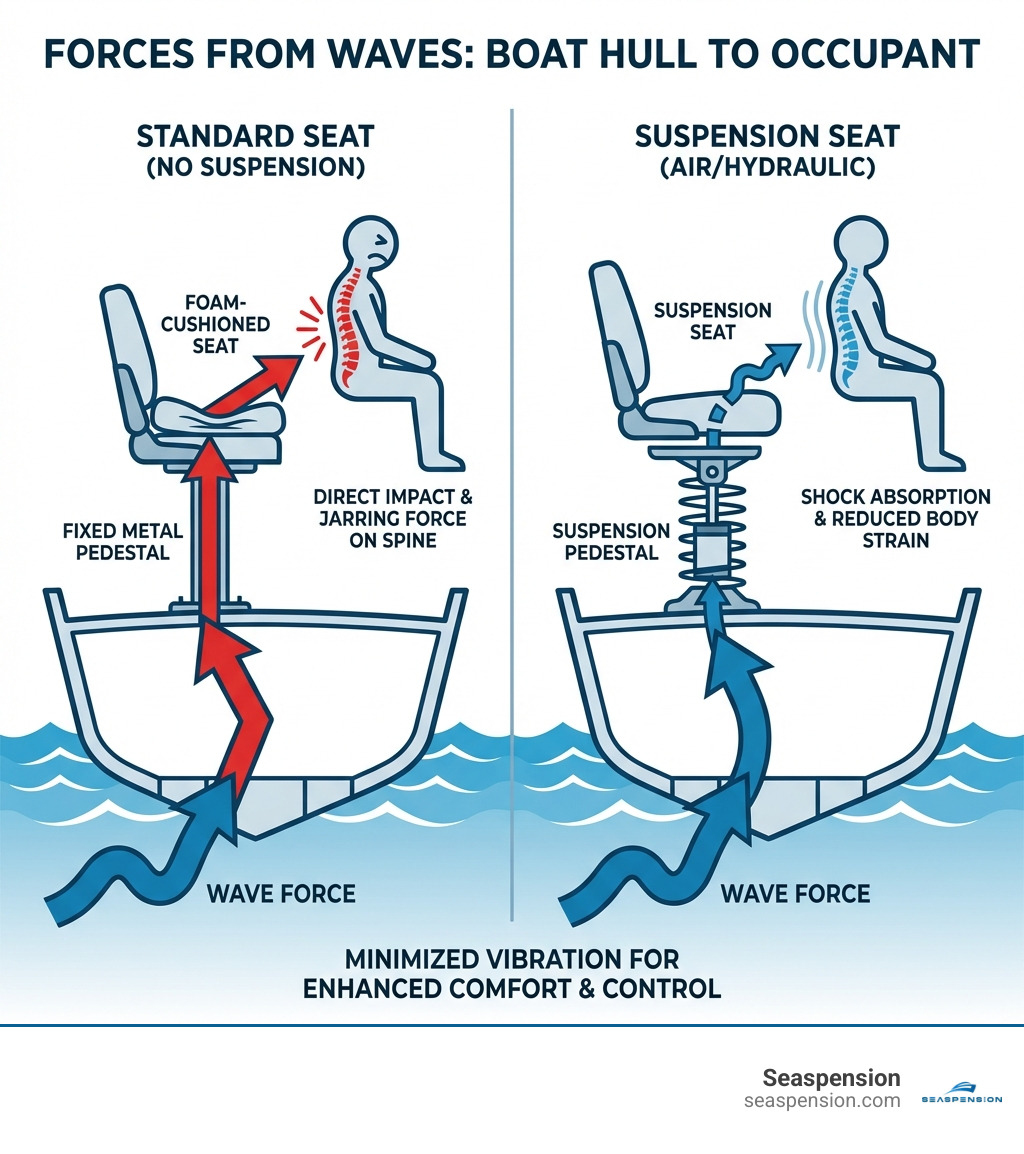
When you're out on the water, especially in choppy conditions, your boat isn't just gliding; it's constantly moving, pitching, and slamming into waves. A standard boat seat, typically mounted on a fixed pedestal with a basic foam cushion, acts like a direct conduit for all these forces. There's no buffer, no mechanism to dissipate the energy.
These seats offer minimal protection. While a thick foam cushion might initially feel soft, it quickly compresses under impact. This isn't true shock absorption; it's merely a temporary deformation. Once compressed, the foam often rebounds quickly, contributing to a harsh "bottoming out" sensation that can be as jarring as the initial impact. This lack of controlled damping means that every jolt and bump from the water is transmitted directly to your body, leading to constant jarring of the spine.
We've heard accounts of boaters experiencing severe discomfort, even to the point of injury, from prolonged exposure to these impacts. The consistent pounding can lead to physical fatigue, back pain, neck strain, and even more serious issues over time. A standard seat simply cannot provide the necessary isolation from the boat's movement to prevent these problems.

To truly mitigate the impact of rough water, we need to separate the seat from the boat's direct motion. This is where suspension pedestals come into play. The core principle behind effective shock mitigation is a combination of a spring and a damper. The spring absorbs the initial energy of an impact (compression), while the damper controls the release of that energy, preventing a harsh rebound.
This controlled movement is crucial. Without proper damping, a spring alone would simply bounce you up and down, potentially leading to a "catapult" or "eject" feeling. Effective suspension systems manage both the upward and downward forces, providing a smooth, controlled ride even in challenging conditions.
For example, a device used in a vehicle to reduce the effects of traveling on a rough surface is a shock absorber, and the same principle applies to marine suspension. These specialized systems are purpose-built for medium-duty usage in the marine environment, constructed with premium materials. They are designed to manage the constant pounding from hitting waves, which can take its toll on boaters.
Air suspension boat seats use a compressible air chamber, often an airbag, as their primary spring mechanism. When the boat hits a wave, the air in the chamber compresses, absorbing the impact. This mechanism is designed to take the hit for you.
A key benefit of air suspension is its adjustability. The air pressure within the chamber can be fine-tuned to accommodate different occupant weights and preferences. This adjustment can be made with a simple hand pump for basic systems, allowing you to personalize your comfort setting. More advanced air suspension boat seats may feature integrated compressors that can be activated with the touch of a button, eliminating the need for a manual pump. These compressors often require a 12V power source, either plugged into an outlet or hardwired into the boat's electrical system.
The way air absorbs and releases energy is unique. Some systems, for instance, use a black airbag that pushes air into a manifold and then into an accumulator tube. This design aims for a controlled up and down motion, preventing an "eject or catapult feeling" and delivering a smooth ride. An easily adjustable air chamber can provide a "bottomless feel" and accommodate a wide range of rider weights, with some systems allowing for 0-200psi of air spring preload to handle occupants up to 400 lbs or more. This type of system is built for comfort and designed to last, reducing constant jarring of the spine.
Another highly effective method for marine shock mitigation involves hydraulic shock absorption systems. These systems typically pair a robust coil spring with a hydraulic damper. The coil spring absorbs the initial impact, similar to an air spring, but the hydraulic damper is where the precision comes in.
A hydraulic damper uses fluid resistance to control the rate at which the suspension compresses and extends. This is known as velocity-sensitive damping: the faster the impact (e.g., hitting a large wave), the more resistance the damper provides. This progressive resistance ensures that the energy from the impact is smoothly dissipated, preventing both harsh bottoming out and uncontrolled rebound.
The result is a highly controlled ride, more akin to the suspension found on a dirt bike. The hydraulic system actively slows the rate of rise and fall, smoothing out the jolts without the "catapult" effect that can occur with less sophisticated suspension. Hydraulic systems are often praised for their mechanical simplicity and robust nature, making them a reliable choice for the demanding marine environment. We've seen hydraulic seats enable individuals to continue fishing in large waves with absolutely no discomfort, even after multiple spinal surgeries. They are often considered simpler, lighter, and more compact than some air ride systems, offering a superior ride for many boaters.
When considering suspension for your boat, understanding the distinctions between air and hydraulic systems is crucial. Both aim to reduce impact, but they achieve it through different mechanisms, leading to varying performance characteristics in the harsh marine environment.
Here's a comparison to help illustrate the differences:
| Feature | Air Suspension | Hydraulic Suspension |
|---|---|---|
| Rebound Control | Can be smooth, but simpler systems may lack precise, progressive damping. Some advanced designs use accumulators for better control. | Offers precise, velocity-sensitive damping, actively slowing both compression and rebound for a highly controlled motion. |
| Maintenance Needs | May involve checking air pressure, potential for leaks in air bladders or lines. Systems with compressors have electrical components. | Generally low maintenance due to sealed, self-contained hydraulic dampers. Focus is on mechanical integrity. |
| System Complexity | Ranges from simple airbag with hand pump to more complex systems with manifolds, accumulators, and integrated compressors. | Mechanically simpler, relying on the sophisticated design of the hydraulic damper to manage forces. Fewer electrical components. |
| Performance in Choppy Water | Excellent for cushioning impacts and providing a "soft" ride. Can be tuned for various weights. May be overwhelmed by rapid, successive large impacts if not optimally designed. | Excels in consistently controlling fast, repeated impacts due to progressive damping. Provides a stable platform by actively managing boat motion. |
| Long-Term Durability | Relies on the integrity of air bladders, seals, and O-rings. Electrical components (compressors) can be points of failure. | Highly durable in marine environments, often constructed with robust materials. Fewer moving electrical parts reduce potential failure points. |
For those seeking more in-depth information, we have a comprehensive article dedicated to exploring the nuances of Hydraulic vs. Air Suspension for Boats: What Most Boaters Don't Know.
Choosing the right suspension pedestal for your boat involves more than just picking the first option you see. It requires careful consideration of your specific boating habits, the conditions you typically encounter, and the needs of those on board.
First, think about your boat type and size. A small skiff used in calm bays will have different requirements than an offshore fishing vessel tackling large swells off the coast of Alaska or California. The typical water conditions you face—whether it's mild chop, significant waves, or sustained rough seas—will heavily influence the type and robustness of the suspension you need.
The operator's weight range is also critical. A good suspension system should be adjustable to accommodate different occupants, ensuring everyone gets the benefit of the shock absorption. For example, some systems can adjust for weights up to 350 lbs, while others can handle 400 lbs or more.
Finally, consider the balance between budget and long-term value. While initial cost is always a factor, investing in a durable, effective suspension system can save you money (and pain) in the long run by extending your time on the water and protecting your body.
Suspension travel refers to how much the seat can move up and down to absorb an impact. Generally, more travel, typically ranging from 4 to 8 inches, means the system can absorb larger and more severe impacts effectively. This is vital for reducing the harshness of hitting big waves.
Adjustability is another key feature. Whether it's through air pressure settings (0-200psi for some systems) or mechanical adjustments, the ability to fine-tune the suspension to the occupant's weight is paramount. This ensures that a 120lb passenger and a 270lb passenger both experience the intended smooth ride. Many systems are designed to accommodate a wide range of rider weights, often up to 350 lbs or even 400 lbs or more.
Beyond shock absorption, comfort features like 360-degree swivel and fore/aft slide functions allow for optimal positioning, sightlines, and ease of movement at the helm. Finally, proper sizing for the correct seat height is essential for ergonomics and safety. Pedestals come in various heights (e.g., 10, 12, 14, 16 inches) to ensure your seat is at the right level once the suspension is installed. You'll need to measure from the bottom of your seat cushion to the boat floor to determine the appropriate pedestal size.
The marine environment is notoriously harsh, with constant exposure to saltwater, UV rays, and vibrations. Therefore, the materials and construction of your suspension pedestal are paramount for long-term durability and performance.
Look for marine-grade materials such as aircraft-grade aluminum, stainless steel, and powder-coated steel. These materials offer high strength, lightweight properties, and excellent corrosion resistance. For instance, some pedestals use aircraft-grade aluminum with a hard-anodized finish to reduce friction and improve durability. Others feature salt water-resistant powder-coated steel and a protective rubber boot to shield internal components.
Critical moving parts, like the main shaft, might have a super hard chrome finish to further reduce friction, while seals and O-rings are specifically designed for friction reduction and extended lifespan. These details contribute to a system that is built to last and withstand the rigors of boating in areas like Florida, Washington, or the open waters off Alaska.
Regular maintenance is key to extending the lifespan of any marine equipment. While hydraulic systems are often praised for being low maintenance due to their sealed nature, all suspension components benefit from periodic inspection and care. For a deeper dive into maintaining your system and answering common questions, explore Everything You Need to Know About SeaSension: FAQs for a Smoother Ride.
Installing a new suspension pedestal can seem daunting, but many systems are designed for straightforward integration. Most modern suspension pedestals use industry-standard six-bolt patterns, which allows for easy installation and retrofitting to existing boat seats.
For those comfortable with basic tools, a DIY installation is often feasible. The process typically involves unbolting your current seat and pedestal, then bolting the new suspension pedestal into the existing mounting pattern. Some manufacturers provide detailed installation videos and guides to walk you through each step. For example, you can watch How To Install a Pedestal for a visual guide. We also offer specific instructions on How to Install a SeaSension Shock Absorbing Pedestal.
However, if you're unsure, lack the necessary tools, or prefer to ensure a perfect fit, professional installation by a marine technician is always a wise choice. This is especially true for more complex systems or if your boat requires custom modifications.
The investment in quality marine suspension seating translates directly into tangible benefits for every boater, especially those who frequent the waters off Pinellas Park, Florida, or Homer, Alaska.
The most immediate benefit is significantly reduced fatigue. When your body isn't constantly bracing for impact, you expend less energy, allowing for longer, more comfortable trips. This means you can get offshore faster, farther, and more comfortably, extending your time on the water without feeling completely worn out at the end of the day.
For individuals with pre-existing back or neck issues, suspension seats are a game-changer. They provide a crucial layer of protection, absorbing waves so your back doesn't have to. We've heard countless stories of boaters, even those who have undergone spinal surgeries, finding immense relief and the ability to continue their passion without discomfort. As one boater aptly put it, preventing back and neck pain is easier than treating it.
Beyond personal comfort, suspension seats can improve overall vessel control. By keeping the operator stable and comfortable, they can maintain better focus and control of the boat, enhancing safety in rough seas. This is particularly important for commercial operators and recreational boaters who prioritize safety for themselves and their passengers.
We've explored the differences between air suspension boat seats and hydraulic systems. While air systems offer adjustability and cushioning, hydraulic systems often provide a more consistent and precisely controlled damping experience, particularly in rapid, successive impacts. For serious boaters, commercial operators, or anyone who regularly faces challenging marine conditions, controlled damping and robust durability are paramount.
At Seaspension, we focus on providing a simple, robust, and highly effective solution. Our independently operating hydraulic shock-absorbing system is engineered to deliver reliable performance and safety for demanding boaters. We understand that in the real world, you need equipment that works, day in and day out, with minimal fuss. Our pedestals are built to manage both impact and rebound effectively, offering optimal comfort and safety for boaters, even with varying occupant weights.
If you're ready to experience a smoother, more comfortable, and safer ride on the water, we invite you to explore our range of solutions. Learn more about how our technology can transform your boating experience by visiting Discover SeaSension's Shock-Absorbing Boat Seats.
Boat suspension seats are shock-absorbing pedestal systems that reduce the jarring impact of waves and rough water, protecting your body from repetitive stress and fatigue during extended time on the water.
Key Types of Boat Suspension Seats:
| Suspension Type | How It Works | Best For |
|---|---|---|
| Hydraulic Pedestal | Uses fluid-filled dampers to absorb and control shock with minimal rebound | Offshore, commercial, high-speed applications |
| Air Suspension Pedestal | Uses adjustable air chambers (0-200 psi) to cushion impacts | Recreational boating, lighter conditions |
| Integrated Suspension Seat | Complete seat with built-in suspension mechanism | Retrofitting existing helm layouts |
Typical specifications: 4-8 inches of suspension travel, 400+ lb weight capacity, marine-grade corrosion-resistant materials.
Every time your boat slams into a wave, the force travels through the hull and into your body. This repetitive shock leads to spinal compression, chronic back pain, and fatigue that shortens your boating days. The problem is a measurable force known as whole-body vibration (WBV), which medical research links to long-term musculoskeletal damage. Your hull may be built for rough seas, but your spine isn't.
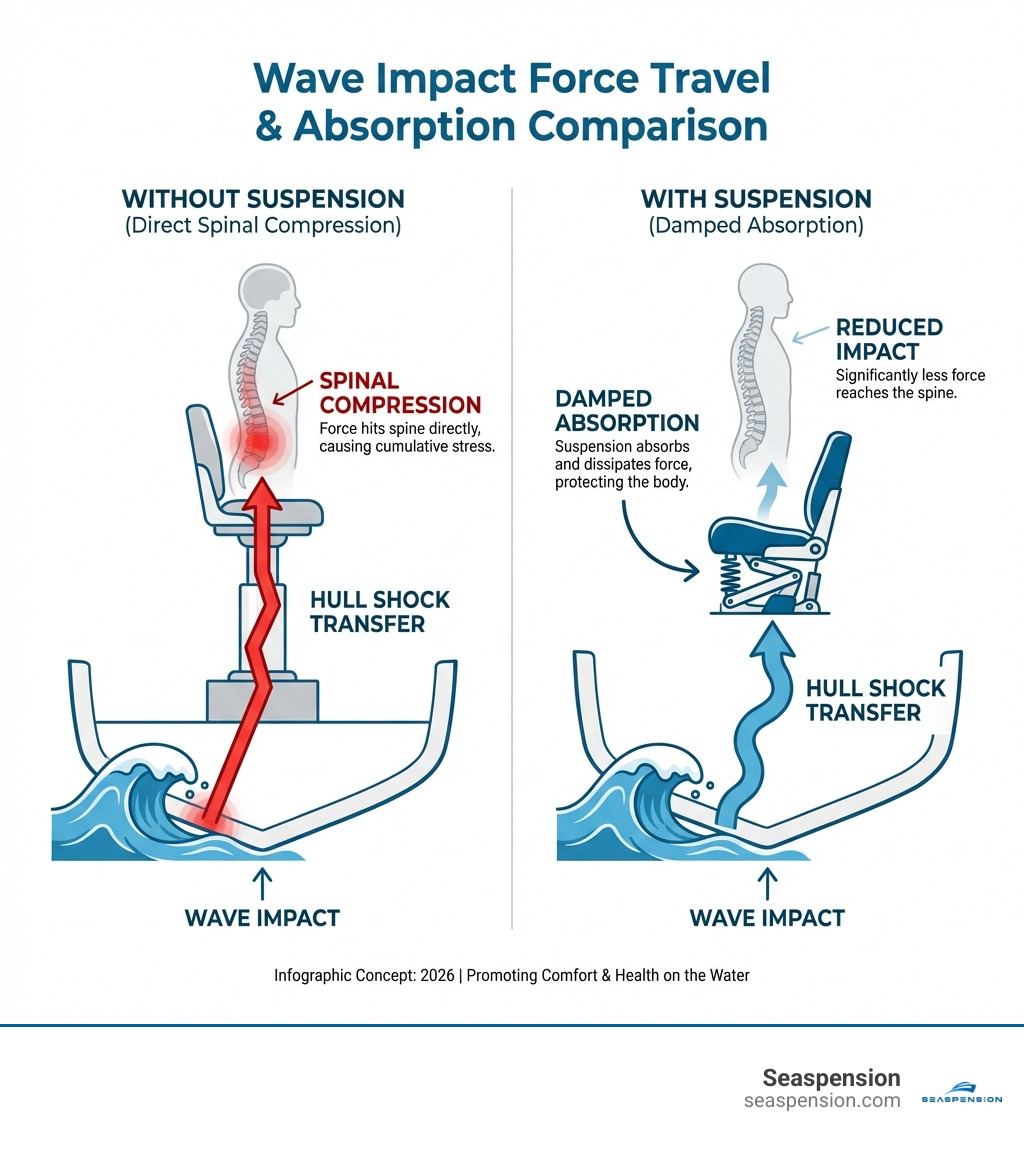
These constant, unmitigated shocks are the real reason for the soreness many boaters attribute to simply "a long day on the water." Understanding this impact is the first step toward a smoother, more enjoyable boating experience. For more on this, explore The Hidden Force of Boating: Why Your Body Feels the Impact and How Seaspension Softens the Blow.
Most boaters try to solve rough-water fatigue with thicker seat cushions or by relying on their boat's hull design. These common fixes fall short because they don't address the core problem: the direct transfer of impact forces from the boat to your body. A plush cushion on a rigid seat is like a pillow on a jackhammer—the shock still gets through. Even advanced hulls can only reduce, not eliminate, wave impacts.
What actually works is shock mitigation at the point of contact: the seat itself. A properly engineered suspension system absorbs the vertical force before it reaches your body, damping the rebound and preventing the "ejection seat" effect that leaves you airborne between waves.
I'm Ian Milligan, owner of Seaspension, and I've spent years helping recreational and commercial boaters reduce fatigue and extend their time on the water through hydraulic boat suspension seat pedestals designed for real-world marine conditions. This guide walks through what actually matters when choosing a suspension seat — the technology, the trade-offs, and how to match the right system to your boat and the water you run.
We've seen countless boaters, from those with small skiffs to large cruisers, experience the same fatigue and discomfort because these passive solutions simply fall short. For a deeper dive into the science, see The Science Behind Shock Absorption: Elevating Your Boating Experience with Seaspension.
The core principle behind effective boat suspension seats is shock mitigation. This isn't just about cushioning; it's about actively managing and dissipating the energy from impacts. When your boat hits a wave, a significant amount of kinetic energy is generated. A traditional seat simply transfers this energy directly to your body. A suspension system, however, intercepts this energy.
It works by allowing the seat to move independently of the boat's deck. This movement absorbs the vertical forces, much like a car's suspension absorbs bumps in the road. The system then controls the rebound, preventing the seat from springing back too quickly and causing a secondary jolt – often referred to as the "ejection seat effect." Proper damping is critical here, ensuring a smooth, controlled compression and return, so you stay comfortably in your seat rather than being thrown around. This fundamental difference is why switching to a suspension seat is a game-changer for comfort and safety. You can read more about this change at Seaspension vs. Conventional Boat Seating: Why Make the Switch?.
When we talk about boat suspension seats, we're primarily looking at a few key technologies designed to absorb those jarring impacts. Each has its own characteristics, suited for different boating styles and budgets.
Hydraulic Suspension Systems: Using fluid-filled dampers similar to vehicle shock absorbers, these systems excel at controlling both compression and rebound. The fluid resistance provides consistent, predictable performance, making them durable and precise. They are preferred for demanding offshore or commercial use, offering a controlled ride with minimal bounce.
Air Suspension Pedestals: These use an adjustable air chamber (0-200 psi) that compresses to absorb shock. They allow adjustment for rider weight and offer excellent cushioning, but damping quality can vary. Advanced systems integrate mechanisms to control rebound. They are popular for their customizable feel.
Mechanical Suspension Systems: These simpler systems use springs or elastomers. While an improvement over rigid seats, they often lack the fine-tuned damping of hydraulic or advanced air systems. They are a budget-friendly option for less demanding conditions.
The choice between these systems often comes down to the level of control and performance required. For maximum comfort and impact protection, especially in rough offshore conditions, a well-engineered hydraulic system or an advanced air system with superior damping is generally preferred. Understanding these differences is crucial for selecting the right boat suspension seat for your needs. For a detailed comparison, check out Hydraulic vs. Air Suspension for Boats: What Most Boaters Don't Know.
Choosing a high-quality boat suspension seat isn't just about getting a softer ride; it's about investing in durability, performance, and long-term comfort. Here are the key features and specifications we advise our customers to prioritize:
Suspension Travel: This is the distance the seat moves to absorb an impact, typically 4 to 8 inches. More travel means better absorption of large impacts. While 4 inches is good for moderate chop, 7-8 inches is more effective for serious offshore use and provides a noticeably smoother ride in rough conditions.
Adjustable Preload: This feature lets you tune the suspension's stiffness for your weight or conditions, often by adjusting air pressure (e.g., 0-200 psi). Proper adjustment is crucial to prevent bottoming out (too soft) or ineffective absorption (too stiff). A versatile system accommodates a wide range of weights, often up to 400 lbs or more.
Rider Weight Capacity: Ensure the boat suspension seat is rated for your weight plus gear. Quality systems support up to 400 lbs or more, ensuring the suspension operates within its intended range without bottoming out.
Marine-Grade Materials: The harsh marine environment demands materials like marine-grade aluminum and stainless steel for corrosion resistance. Finishes like Cerakote or hard-anodized aluminum improve durability. Waterproof, UV-stable, and mold-resistant upholstery is also essential.
Corrosion Resistance: This is critical. All components, from fasteners to pivot points, must resist rust in a saltwater environment. Look for designs that prioritize long-term reliability in marine conditions.
Standardized Bolt Patterns: An industry-standard bolt pattern (like the 5x5 inch or six-bolt pattern for pedestals) ensures compatibility with a wide range of seats and mounts, simplifying installation.
These features collectively contribute to a boat suspension seat that not only performs well but also lasts for years in the challenging marine environment. For detailed specifications on our range, please visit our Specs page.
Selecting the ideal boat suspension seat isn't a one-size-fits-all decision. It requires careful consideration of your specific boat, how you use it, and your personal preferences.
Boat Type: A suspension solution can integrate with nearly any boat, from small skiffs to large cruisers and commercial vessels. The critical factors are available space and the existing helm layout. Our pedestals are versatile enough for installations on high-speed fishing boats, military craft, and more.
Intended Use:
Helm Layout Integration: Consider how the boat suspension seat will fit your helm. Some systems are direct pedestal replacements, while others are integrated units. Look for options with adjustable height, swivel, and sliders to optimize your seating position and sightlines.
Budget Considerations: Boat suspension seats are an investment in comfort and health. Prices vary by technology and materials. While mechanical options are more affordable, premium hydraulic and advanced air systems offer superior performance and durability, justifying the cost for serious boaters.
For a comprehensive guide on selecting the right model for your specific vessel, consult Choosing the Right Seaspension Model for Your Boat: A Comprehensive Guide. If you're weighing options for commercial versus recreational use, our insights at Commercial vs. Recreational Marine Seating: Why Seaspension Works for Every Kind of Boater can also be very helpful.
When upgrading to a boat suspension seat, you generally have two main approaches: integrating a suspension pedestal with your existing seat, or opting for a complete, all-in-one suspension seat system.
Upgrading Existing Seats with Suspension Pedestals: This is often the most flexible and cost-effective option. A suspension pedestal replaces your standard pedestal, letting you keep your preferred seat. This approach is excellent for turning "any boat seat into a shock absorbing seat," as our pedestals use industry-standard bolt patterns for high compatibility.
All-in-One Seat Systems: These are complete units with an integrated seat and suspension. They are designed for cohesive performance and may offer advanced features, but they typically cost more and limit your choice of seat style.
Pedestal Versatility: A key advantage of pedestals is adaptability. They can be mounted flush or recessed, and many offer optional height adjusters, swivels, and sliders. This modularity allows you to tailor the setup for optimal sightlines and comfort without changing your preferred seat. Find more about selecting the best pedestals for your boat at Best Boat Seat Pedestals.
Installing a boat suspension seat or pedestal is a practical upgrade that many boat owners can tackle themselves, though professional help is always an option for complex setups.
Installation Requirements:

Maintenance:
Quality boat suspension seats are designed for durability, requiring minimal maintenance.
By following these simple steps, you can ensure your boat suspension seat provides years of reliable, comfortable service.
The most compelling reason to invest in a boat suspension seat is the profound impact it has on your real-world boating experience. This isn't about luxury; it's about practicality, endurance, and safety.
Reduced Fatigue: By absorbing wave impacts, a suspension seat dramatically lessens physical strain. Instead of constantly bracing, your muscles can relax, leaving you feeling fresh instead of sore. For anglers who spend over 100 days a year on the water, this means more effective fishing time and less recovery. This improved comfort keeps you out on the water longer.
Improved Safety and Focus: When your body isn't fighting impacts, your mind stays sharper. Reduced physical fatigue improves mental focus, which is critical for safe navigation in challenging conditions. You can better concentrate on the water, monitor instruments, and react quickly. This improved focus is a significant safety advantage. Explore more about the safety aspects at Seaspension and Safety: Elevating Your Boating Experience by Reducing Fatigue and Improving Focus on the Water.
Extending Boating Days: A boat suspension seat allows you to run your boat farther and for more hours without the usual aches. Boaters who previously cut trips short due to discomfort find they can enjoy their passion longer, whether chasing fish offshore or exploring distant coves.
Enabling Boating After Injury: For those with back injuries or chronic pain, a boat suspension seat can be a lifeline. By cushioning impacts, it allows many to get back on the water comfortably and safely. We've worked with boaters post-surgery who returned to fishing in large waves with no discomfort. This is about enabling people to continue doing what they love. For those navigating boating after surgery, we offer specific insights at Boating After Back Surgery: How Seaspension Can Help You Get Back on the Water.
A high-quality hydraulic boat suspension seat pedestal acts as a shock absorber for your back and neck, turning a "white-knuckle race" to your destination into a refined, comfortable experience. It's an investment in your well-being and extends the lifespan of your boating enjoyment.
The price for a boat suspension seat can vary significantly, ranging from a few hundred dollars for a basic mechanical pedestal to several thousand for a complete hydraulic or advanced air system.
The ideal amount of suspension travel depends heavily on your boating environment.
More travel generally equates to better absorption of large impacts. Consider the roughest water you realistically expect to encounter when making your choice. For more insights on navigating rough waters, see Getting a Smooth Ride in Rough Seas.
When investing in a boat suspension seat, a robust warranty and reliable customer support are indicators of a quality product.
Always register your product if required, as this often activates your warranty. You can find our warranty details and registration information at Warranty Registration.
Upgrading to a boat suspension seat is more than just buying a new piece of equipment; it's a strategic investment in your health, comfort, and overall boating experience. We've seen time and again how this single upgrade transforms a boater's ability to enjoy their passion.
The science is clear: reducing the impact of wave forces on your body minimizes whole-body vibration, significantly lessens fatigue, and helps prevent the aches and pains that typically cut short a day on the water. This means you can spend more time doing what you love, whether it's chasing the bite offshore or cruising with family. It also means improved safety, as a less fatigued operator remains more focused and alert.
For serious boaters, charter captains, and commercial operators, a boat suspension seat is not a luxury—it's a practical necessity that improves endurance, protects against injury, and ultimately extends your active years on the water. It's a choice for longevity, comfort, and unwavering performance in real-world marine conditions.
Ready to experience the difference? View our shock-absorbing boat seat pedestals and find how a smoother ride can lift your entire boating journey.
How to install a boat seat correctly determines whether your mounting system stays secure, your deck stays dry, and your body stays protected from wave impact. A poorly installed seat can leak, crack your deck, or fail when you need it most.
Quick Answer: Basic Boat Seat Installation Steps
The actual installation takes about 30 minutes for a basic pedestal mount, but the preparation and attention to detail make the difference between a secure, watertight fit and a future repair project. Many DIY boaters find that getting fasteners aligned perfectly, choosing the right hardware for their deck type, and creating a proper seal requires more than just running screws through holes.
According to industry guidance, the most common mistakes include drilling without checking what's underneath the deck, using inadequate fasteners, and failing to seal penetrations properly—which can lead to water intrusion, cored deck rot, and mounting failure. Bass boat owners working with thin fiberglass platforms face different challenges than pontoon boat owners mounting furniture to aluminum rails, and center console operators installing pedestal systems need to account for both structural support and ergonomic positioning.
But even a flawless installation of a rigid seat mount only solves half the problem. A standard pedestal transfers every wave impact directly into your spine. Over time, that constant shock leads to fatigue, discomfort, and cumulative strain—especially on rough water or during long runs. The foundation you create during installation determines whether your seat stays attached, but the pedestal system you choose determines whether your body pays the price for every wave.
As Ian Milligan, owner of Seaspension, I've worked with hundreds of boat owners and commercial operators who initially focused solely on installation—only to realize that how their seat absorbs impact matters far more than how it's bolted down. Understanding how to install a boat seat properly is essential, but pairing that solid foundation with a shock-absorbing pedestal transforms your time on the water from endurance test to sustainable comfort.
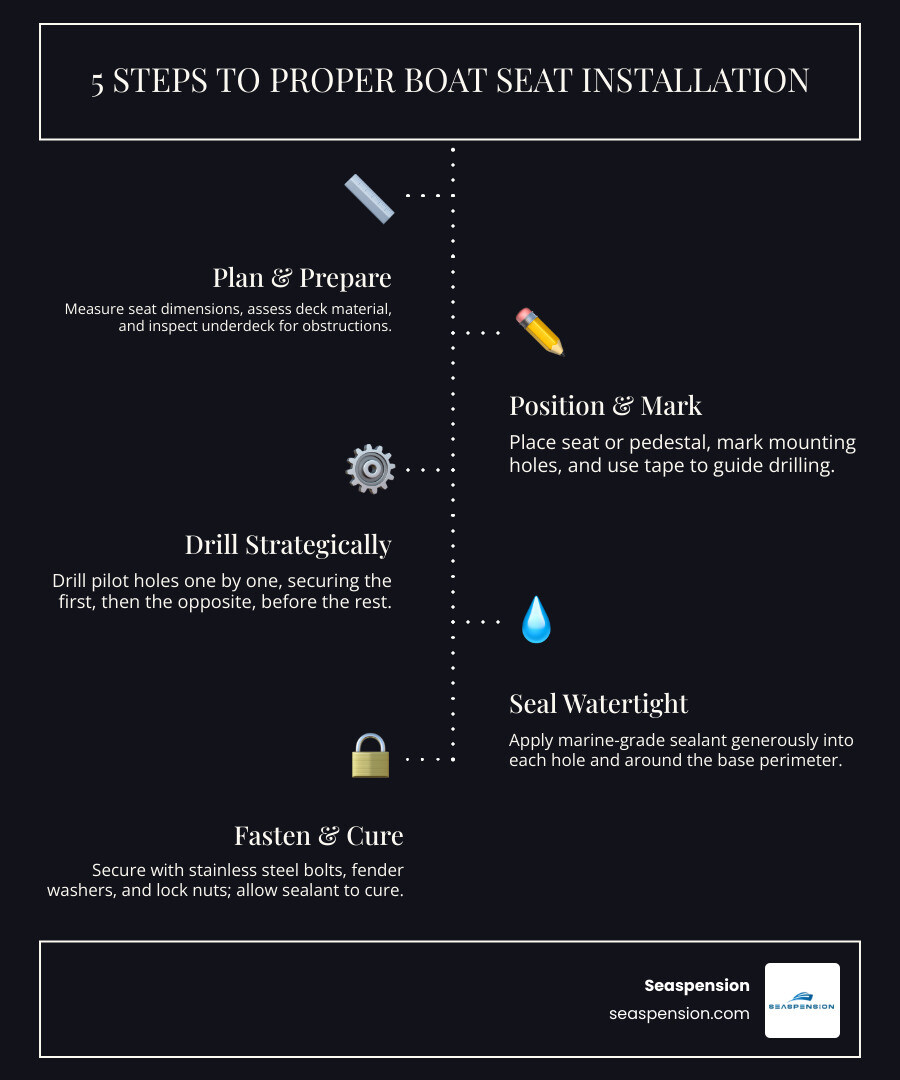
Before we even pick up a drill, careful planning is crucial when we set out to install a boat seat. This phase ensures not just a successful installation but also the longevity of our boat's deck and the safety of its occupants. It's about understanding what we're working with and what we need to get the job done right.
Whether we're replacing an old seat or adding a new one, accurate measurements are our first step. For bench, bucket, or pedestal seats, we need to know the dimensions of the seat itself and the available deck space.
If we're replacing existing seats, we'll want to save the old mounting hardware, as new seats often don't include it. We also consider the existing deck layout and any bracing to ensure compatibility and avoid obstructions.
For pontoon boats, measuring is a bit more involved. We need to measure the distance between the port and starboard rails, the distance between the rear rail and the side gate, and the distance between the front rail and the side gate. It's also important to account for rail support braces when measuring. For corner seats, we might even need to determine the railing's corner radius to ensure a snug fit. Most pontoon boats typically measure 89" to 93" inside the fence railing.
Bass boats usually feature a seating platform that accommodates driver and passenger seats, along with two fishing seats (a rear fold-down or flip-down, and a smaller bike seat for stand-up fishing). Our replacement bass boat seats are designed to fit any style bass boat or fishing boat, making the process of finding compatible seats much easier. Bench seats, for example, can fill platforms up to 68" in width and as small as 46" when combined with bucket seats.
Understanding our boat's decking is paramount. Decks can be made of various materials, such as fiberglass, plywood, or aluminum. Each material has its own characteristics for fastener retention and structural integrity. Plywood, for instance, generally offers better screw retention than fiberglass.
We always check for the solidity and any flex in the deck where the seat will be mounted. It's especially important to determine if the deck is cored (has a lightweight material sandwiched between two layers). If water gets into a cored deck, it can lead to rot and structural damage, so proper sealing is non-negotiable.
Before drilling, we must double-check the area underneath our mounting spot. We're looking to make sure we won’t be drilling into anything we could damage, like wires, fuel tanks, or plumbing. If we don't have direct under-deck access, using an inspection port can help us assess the situation and plan for bolts with backing washers and nuts. In some cases, like reinforcing a bench seat for a new pedestal base, custom modifications like adding plywood and vinyl wrap might be necessary, especially if we're accommodating heavier occupants.
Having the correct tools and hardware on hand makes all the difference for a secure and long-lasting installation.
Our essential tools typically include:
When it comes to hardware, we always opt for stainless steel to resist corrosion in the marine environment. The choice between bolts and screws is critical. Bolts, especially with substantial backing washers and nuts, offer superior security and allow for tightening over time. Screws, conversely, can gradually work loose and weaken the decking, particularly under stress from boat pounding.
We emphasize the importance of using wide 'fender' washers to prevent the deck from cracking, especially with fiberglass. Nylon lock nuts are also vital to keep the seat from wiggling loose over time. Finally, selecting a high-quality marine-grade adhesive/sealant is non-negotiable for creating a watertight seal and preventing water intrusion into the deck.
Once we've planned carefully and gathered our tools, we're ready to proceed with the actual installation. Following these steps carefully will ensure a secure and watertight boat seat installation.
First, we begin by removing any old seats and hardware. Then, we thoroughly clean the deck area where the new seat will be installed. This ensures proper adhesion for any sealants and a clean work surface.
Next, we carefully position the new seat or seat base in its desired location. We consider ergonomics, reach to steering controls, and standing positions. Once satisfied with the placement, we use a pencil or a fine-tipped marker to mark the exact locations for our mounting holes. For added precision and to prevent the drill bit from slipping, we often use painter’s tape to define the installation area and mark our drill points.
For basic bench or bucket seats, the process is straightforward. Many replacement bass boat seats come with pre-installed plastic bars with mounting blocks on the seat backs. We position the backrest against the rear wall of the seating platform and drill small pilot holes into the boat's back wall. This prevents damage to the fiberglass. Then, we drive #14 x 2” stainless screws into each plastic mounting bar to secure the backrest. Assuming a 3/4” thick back wall, these 2” screws will protrude approximately 1/4” through.
Next, we line up the seat cushion with the installed backrest. Many seat cushions come with hinges that allow us to adjust the seat forward or back depending on the platform's depth. We then screw the hinge and a matching vinyl piece to the platform to attach the seat cushion. We use the included hardware or appropriate marine-grade fasteners, ensuring they are stainless steel. When installing fishing seats, metal t-nuts are inserted into the plastic frames, so we start bolts by hand before using a screwdriver to prevent misthreading.
Installing a boat seat with a pedestal base requires a bit more finesse to ensure perfect alignment and stability. First, we position the base for optimal ergonomics, considering the driver's or passenger's comfort and access to controls.
The key to preventing crooked screws and uneven stress is our drilling technique. We drill a single pilot hole through one of the base's mounting holes. Without caulking, we run a bolt or screw into this first hole, securing the base loosely. Then, we drill a second hole on the opposite side of the base and insert another fastener. With these two fasteners holding the base firmly in place, we can confidently drill all the remaining holes. This method prevents the base from shifting and ensures all holes are perfectly aligned.
This step is critical for preventing water intrusion and potential damage to our boat's deck, especially if it’s cored. Once all the holes are drilled and the base has been dry-fitted, we remove the base and thoroughly clean off all shavings and dust from the deck surface and inside the holes.
Next, we apply a generous amount of marine caulk or adhesive/sealant into each screw hole. It's good practice to also apply a bead of sealant around the perimeter of the base's footprint. This creates a complete barrier against water.
We then carefully re-install the seat base, aligning the holes, and drive in all the fasteners (bolts with fender washers and lock nuts are preferred). We tighten the hardware securely, but we're careful not to over-torque, which could damage the deck or the fasteners. After installation, we always wait for the caulk or adhesive/sealant to completely cure as per the manufacturer's instructions before using our boat. This ensures a durable and watertight seal.
Beyond the basic steps, there are several advanced considerations that lift a good installation to a superior one. These factors ensure long-term durability, compliance with safety standards, and improved comfort on the water.
When we talk about how to install a boat seat, we often focus on the physical attachment, but the type of pedestal we choose significantly impacts the experience. We have various types of pedestals, including fixed posts, which offer a static height, and swivel pedestals, which allow for rotation.
Safety standards are paramount in marine seating. The American Boat & Yacht Council (ABYC) has categorized boat seat pedestals since 1996 to ensure safety. Class A pedestals (AD for Driver, AP for Passenger) are designed for use at any speed and must meet specific torque and static load resistance requirements (e.g., sustaining a 300 lbs static load for 3 minutes). Class B pedestals are for use at speeds of 5 mph or less. These standards ensure our seats are secure under various operating conditions.
Beyond just holding the seat, the role of shock absorption in a pedestal cannot be overstated. A quality shock-absorbing pedestal actively reduces boater fatigue and prevents injury by mitigating the constant impacts from waves. This is especially true for us who regularly experience rough water.
The specifics of how to install a boat seat can vary considerably depending on the type of boat.
Even seasoned boaters can make mistakes during seat installation. Here are some common pitfalls we strive to avoid:
By being mindful of these considerations, we ensure a safe, secure, and durable seat installation that will serve us well for many years on the water.
We've covered the crucial steps for how to install a boat seat securely and watertight. But a flawless installation of a rigid seat mount is only the beginning. For those of us who spend significant time on the water, especially in less-than-ideal conditions, the real difference in comfort and safety comes from the pedestal itself.
Imagine a long day on the water, cruising through choppy seas or enduring the constant pounding of waves. Every jolt, every impact, is transferred directly through a static seat mount to our bodies. This constant vibration and shock take a physical toll.
Operator fatigue is a significant concern on long runs. When our bodies are constantly absorbing impacts, our muscles tense up, leading to discomfort, back pain, and even cumulative strain over time. This isn't just about discomfort; it can affect our ability to react quickly and safely. A rigid mount acts like a direct conduit, sending every wave impact straight into the occupant’s spine and joints. It's an endurance test, not a comfortable ride.
This is where a true shock-absorbing pedestal transforms our boating experience. Instead of simply holding a seat in place, a suspension system actively dissipates impact forces before they reach us. It turns a harsh ride into a smooth glide, even in challenging conditions.
There's a significant difference between a simple spring mechanism and a sophisticated hydraulic damper. A basic spring might offer some cushioning, but it often rebounds, creating a "pogo stick" effect. A hydraulic damper, however, controls both compression and rebound, effectively absorbing the energy of an impact and preventing it from being transferred to the occupant.
Our Seaspension pedestals feature an independently operating shock-absorbing system. This unique design ensures optimal comfort and safety for boaters, even with varying occupant weights. It's engineered to reduce impact and protect us from jolts, allowing for a safer, more comfortable ride in rough conditions. This focus on shock mitigation means we can enjoy our time on the water longer, with less fatigue and greater control. We've seen the relief boaters feel after upgrading to a Seaspension system.
A successful boat seat installation depends on careful preparation, the right hardware, and a meticulous sealing process. This ensures your seat is safe and your deck remains structurally sound. However, the installation is only the foundation. For real comfort and to reduce the physical impact of rough water, the pedestal you choose makes the biggest difference. A system designed to absorb shock transforms a simple seat into a component that actively improves your experience on the water.
Ready to install a system that provides comfort and safety in real marine conditions? Learn more with our detailed guide: How to Install a Seaspension Shock-Absorbing Pedestal.

Decommissioned navy ships for sale are available through limited channels, and the process is far more complex than buying a commercial vessel. Here's what you need to know:
Where to Find Them:
Common Vessel Types Available:
Price Range:
Critical Reality:
Most vessels are sold "as is, where is" — often stripped of engines, electronics, and key systems. Refitting costs typically exceed purchase price by 3–10x.
The dream of owning a former warship collides with a harsh reality. These vessels aren't on typical boat-selling sites and come with legal, regulatory, and financial problems that stop most buyers. Acquiring one means navigating government bureaucracy, demilitarization rules, and massive refitting costs that often dwarf the purchase price.
I'm Ian Milligan, owner of SeaSpension. I specialize in shock mitigation systems and have worked with operators converting former military craft for civilian use. Understanding the realities of decommissioned navy ships for sale is critical before signing a contract. This guide covers the process, from finding vessels to making them seaworthy.
Finding decommissioned navy ships for sale isn't like browsing classifieds. These vessels enter a complex disposition process after service. The first step is knowing where to look—government channels, specialized brokers, and commercial marketplaces—while setting realistic expectations about what is truly available.
Government auctions are a primary source for decommissioned military assets. Agencies like GovPlanet, Government Liquidation, and the Defense Logistics Agency (DLA) Disposition Services sell surplus property, which occasionally includes smaller marine craft. These platforms sell assets no longer needed by the military, from equipment to boats.
For example, GovPlanet lists used commercial marine vessels, some with former government ties. Government Liquidation has auctioned significant naval assets, often for scrap. The USS Long Beach, the first nuclear-powered surface warship, was auctioned for its scrap metal in 2012 with a minimum bid of just $150. This highlights that many sales are for dismantlement, not for repurposing a functional vessel. Buyers are often professional scrap dealers recovering materials.
The auction process is typically online. Vessels are sold "as is" and require extensive demilitarization, meaning sensitive military equipment, weapons, and sometimes propulsion systems are removed. This often leaves the vessel a shell of its former self.
You can explore these offerings at marketplaces like Used Commercial Marine Vessels for sale - GovPlanet.
Some governments manage direct sales of naval assets through specialized defense authorities. These are often complex, government-to-government (G2G) deals, not public auctions.
The UK Ministry of Defence, through its Defence Equipment Sales Authority (DESA), issues notices for the sale of former naval vessels for "further use or recycling." The former HMS Atherstone, a minehunter, was offered by DESA with the notice specifying it was "as is," sound for towing but not running, and stripped of engines and other components. This illustrates that even a ship offered for "further use" requires a substantial project for the buyer. These sales often target industries or foreign military partners, not private individuals.
Such sales aim to reduce maintenance costs for inactive fleets and ensure responsible disposal. The UK has sold platforms like HMS Ocean to other nations, typically in a G2G framework rarely open to the public.
For more on such offerings, you can review notices like the Notice of the potential sale of the Former HMS Atherstone.
While large warships are rare on commercial marketplaces, specialized brokers and international listing sites can be a source for smaller, more accessible decommissioned navy ships for sale. These include patrol boats, landing craft, and workboats with prior military service.
Websites like Apollo Duck serve as international marketplaces where you might find former military patrol boats awaiting conversion. These are typically smaller vessels (15-70 meters) that are more manageable for private or small commercial buyers to refit.
These brokers connect sellers with buyers and often have expertise in the unique challenges of former military craft. While Seaboats.net is another platform to watch, current availability can fluctuate.
You can browse such listings on platforms like International Boats for sale on Apollo Duck.
When considering decommissioned navy ships for sale, the reality of what's available might surprise you. Forget a fully operational destroyer; the market typically offers smaller, specialized craft in "as is, where is" condition.
The most common types we encounter are:
Larger warships like frigates or destroyers are rarely sold to private buyers due to their immense size, complexity, and cost. They are typically sold to foreign navies, become museums, or are sold for scrap, like the USS Long Beach.

The phrase "as is, where is" is the fundamental truth of this market. A decommissioned vessel has reached the end of its military service life, meaning it's no longer militarily viable. Before sale, vessels are often stripped of key components like engines, electronics, and weapons to support active fleets or prevent technology transfer. You are often buying a bare hull.
Many vessels are "mothballed" before sale, a preservation state that is not the same as active maintenance. Systems degrade and corrosion sets in. Maintenance records, if available, are in military format and difficult to translate to civilian standards.
The key distinction is between structural integrity and operational readiness. A hull might be sound for towing and conversion, but it will almost certainly not be operational. The vessel's new lifespan depends entirely on the quality of the refit. A professional refit can give a naval hull decades of new life, but cutting corners will lead to endless problems.
Prices for decommissioned navy ships for sale vary wildly, but the purchase price is just the tip of the iceberg. At one end, vessels are sold for scrap. The USS Long Beach had a minimum bid of $150, essentially a fee for the right to dismantle it.
For smaller vessels like patrol boats, prices typically range from $110,000 to $450,000. Larger vessels, like a 67.55m icebreaker from the Royal Danish Navy, can command prices of EUR 4 million (approx. $4.2 million USD).
However, the hidden costs are where most projects fail, often exceeding the purchase price by 3 to 10 times. These include:
Here’s a general overview of what you might find:
| Vessel Type | Typical Size (LOA) | Estimated Price Range (USD) | Common Repurposing Ideas |
|---|---|---|---|
| Patrol Boat | 15-70m | $110,000 - $450,000+ | Expedition yacht, charter boat, dive support, private cruiser |
| Landing Craft (LCT) | 40-100m | $50,000 - $2.5 million+ | Cargo transport, work platform, houseboat, floating event space |
| Tug | 10-40m | $2,500 - $2.25 million+ | Commercial towing, private cruiser, workboat |
| Research/Survey Vessel | 30-70m | $4.2 million+ | Private expedition, scientific research, luxury yacht |
Purchasing a decommissioned navy ship is a monumental project, not a simple transaction. Underestimating the cost and complexity leads to expensive problems, making due diligence absolutely critical.

The legal and regulatory landscape is a minefield. A vessel must first be formally "stricken from the Naval Vessel Register (NVR)" to remove its military status before civilian ownership is possible.
Once civilian-owned, the vessel must meet new standards. In US waters, this likely means US Coast Guard (USCG) certification, which can require extensive modifications to meet safety and stability rules different from military specs. Registering a former military vessel under a civilian flag can also be a complex process.
Environmental compliance is another major hurdle. Older naval vessels often contain hazardous materials like asbestos and Polychlorinated Biphenyls (PCBs). Their safe removal and disposal are highly regulated and extremely costly, potentially adding millions to a refit budget. The UK's HMS Atherstone sale notice, for example, highlighted that hazardous material surveys would only be provided to serious bidders.
Understanding the US Navy's process for managing its inactive fleet is a good starting point to grasp the scale of these issues. You can learn more about their procedures at Learn about the US Navy's Inactive Ships program.
Refitting is where the dream meets reality. The purchase price is often dwarfed by conversion costs. Military vessels are built to different standards than civilian ships, which means:
Beyond the initial refit, long-term maintenance is a significant financial and logistical commitment. These are not small boats that can be ignored; they require constant, specialized care.
For those considering the challenge, integrating modern systems is key. We've seen how crucial it is to consider elements like shock-absorbing pedestals for seating, which are essential for comfort and safety in civilian operations. You can read more about adapting vessels for modern needs at Enhancing performance and safety on former military vessels.
Governments offload these assets for pragmatic and strategic reasons. Ships have a finite service life, and keeping older vessels operational requires increasingly expensive maintenance. As technology evolves, older ships become obsolete. Navies decommission them to free up resources and modernize their fleets. Essentially, a ship is sold when it no longer fits the military's strategic, operational, or financial needs.
Despite the challenges, the allure of changing a former warship is powerful. The creative potential of a naval hull is immense for visionary owners who can see past the spartan military interior.
When a decommissioned ship avoids the scrap heap, it often finds a new purpose in one of several popular uses:
Successful conversions provide inspiration and concrete examples of what's possible:
These examples highlight that with enough vision, resources, and expertise, a decommissioned warship can begin a fascinating second life.
For historically significant vessels, the US Navy Ship Donation Program offers an alternative to sale or scrap. Managed by NAVSEA, this program allows non-profits to acquire ships as museums or memorials. The application process is rigorous, and the transfer is "as is, where is," with the recipient covering all costs for restoration, maintenance, and eventual disposal. While no ships are currently available for donation, it remains a key option for preserving naval heritage.
You can find more detailed information on this program at Details on the Ship Donation Program.
Acquiring and repurposing a decommissioned navy ship for sale is the ultimate project boat, requiring deep pockets, patience, and passion. If the challenges excite you more than they deter you, you might be one of the rare individuals suited for this unique undertaking.
Before making an offer, ask yourself these critical questions:
Military vessels are built for durability, not comfort. Their rigid, heavy hulls transmit every impact from rough water to the occupants, leading to crew fatigue and discomfort. This is a major issue for long voyages or commercial operations.
Modern shock mitigation is critical for a successful conversion. While the hull is old, the interior can be upgraded. Proper seating is essential. Seaspension pedestals absorb and dampen impacts, reducing the jolts that cause fatigue. Integrating shock-absorbing pedestals is a practical upgrade that improves safety and efficiency, making a repurposed vessel genuinely comfortable for its new civilian role. It’s an investment in the people who will operate and enjoy it.
You can learn more about how our solutions benefit a wide range of vessels, including those with military heritage, at Learn why Seaspension is suited for both commercial and recreational boaters.
Converting a decommissioned navy ship is the ultimate project, demanding immense dedication, funding, and skill. The reward is a unique vessel with a rich history you've brought back to life. The satisfaction of preserving heritage while tailoring it to your vision is immense. If you're ready for the challenge, exploring decommissioned navy ships for sale could be your next adventure. Just be prepared for the long haul, ensuring every part of your vessel, from engines to seating, is ready for its next chapter.


