Boating in choppy water is something every boater will face eventually — and how you handle it makes the difference between a manageable ride and a dangerous one.
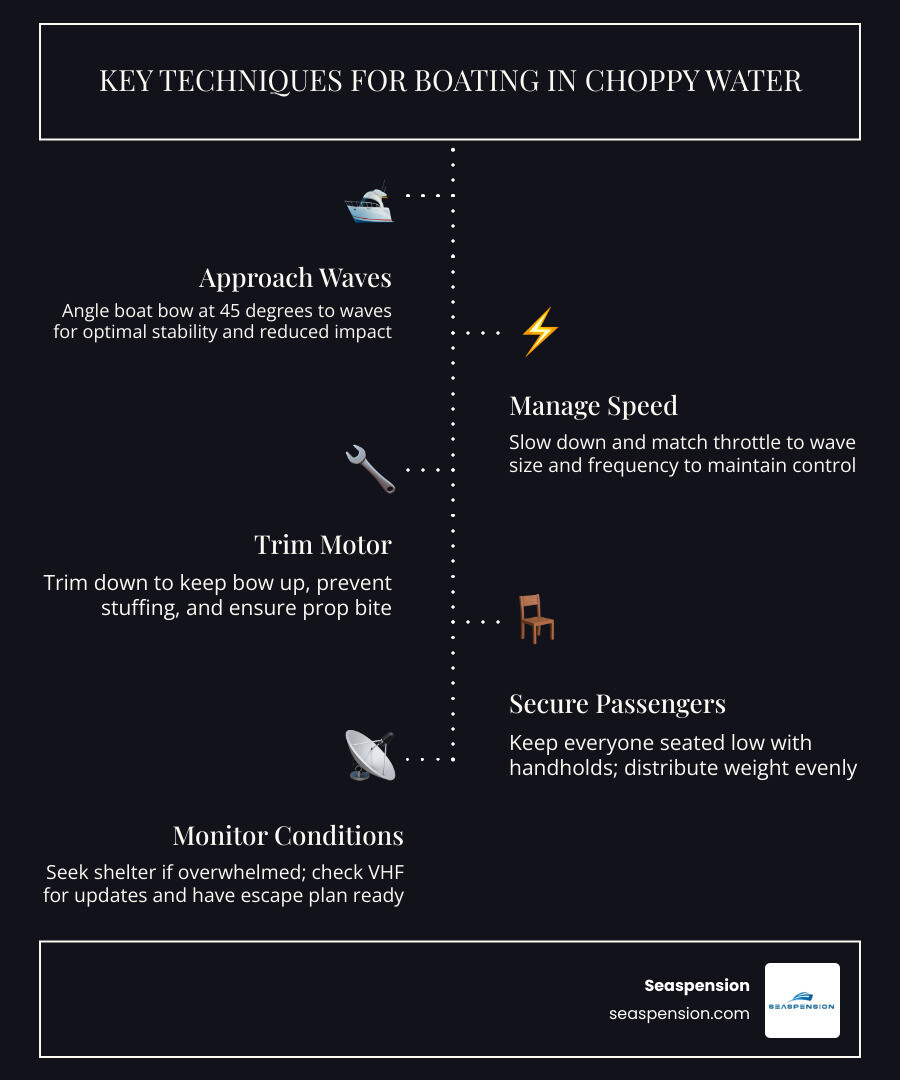
Here's a quick reference for the core techniques:
| Situation | What to Do |
|---|---|
| Approaching waves | Angle bow at 45 degrees to the waves |
| Speed management | Slow down; match speed to wave size and frequency |
| Motor trim | Trim down to keep the bow up and maintain control |
| Passenger safety | Keep everyone seated; secure all loose gear |
| Overwhelmed by conditions | Seek shelter, drop anchor, or head to the nearest launch ramp |
Choppy conditions don't always announce themselves. A calm morning can turn into a rough, wind-driven slog within an hour — especially on larger bodies of water. Waves stack up fast when wind and current oppose each other, and shallow-water bays can produce short, violent chop that hits harder than ocean swells twice the size.
The physical toll is real too. Repeated wave impacts translate directly into your spine, joints, and muscles. After a few hours of rough running, fatigue sets in — and fatigued operators make worse decisions.
This guide covers everything from pre-departure planning to throttle technique to hull behavior, so you can stay in control when conditions deteriorate.
I'm Ian Milligan, owner of SeaSpension, a Florida-based marine technology company focused on reducing the physical impact of boating in choppy water through engineered shock-absorbing seat pedestal systems. I've worked closely with recreational boaters, commercial operators, and enforcement fleets who deal with rough water conditions as a daily reality, not an occasional inconvenience.
Basic Boating in choppy water glossary:
Before we even turn the key, we need to understand that safety in rough water begins at the dock. Experienced boaters are often obsessed with weather forecasts, and for good reason. Conditions on the Great Lakes, the Gulf of Mexico, or the Atlantic coast can shift from a "greasy calm" to a raging tempest in a matter of minutes.
We recommend checking the National Weather Service Marine Forecast and using reliable wind tracking apps every few hours. Look specifically for swell height and wave frequency. Short-period waves (waves close together) usually mean a "bumpy" ride that tests both the hull and your back.
Beyond the forecast, your vessel needs to be mechanically ready. Ensure your bilge pumps are functional and your VHF radio is clear. We always suggest carrying double the fuel you expect to need; fighting through heavy chop consumes significantly more fuel than cruising on flat water. It is also vital to file a float plan with someone on shore so they know when to expect you back. For more detailed readiness steps, check out our tips-on-navigation-through-rough-water.
When the boat starts jumping, anything not tied down becomes a projectile. We’ve seen fishing tournament pros arrive at the ramp with broken rods and shattered electronics because they didn't take five minutes to "batten down the hatches."

Driving in boating in choppy water is an active process. You cannot simply set the throttle and forget it. You need to find a rhythm with the waves.
The most fundamental rule is the 45-degree angle. Heading straight into a wave (90 degrees) often leads to "stuffing the bow" or a bone-jarring vertical drop. Conversely, taking a wave broadside (90 degrees to the side) risks a roll-over. By "tacking" or quartering the waves at a 45-degree angle, you allow the hull to slice through the water while maintaining lateral stability. This technique is explained further in our guide on boats-in-rough-seas.
According to Handling Rough Water Conditions, the goal is to stay on top of the waves. This requires constant throttle adjustment: accelerating slightly to climb the face of a wave and easing off as you crest so you don't "launch" into the trough.
Speed is a double-edged sword. In light chop (1-2 feet), many planning hulls actually perform better at a higher speed, "skipping" across the tops of the waves. However, as the waves grow, you must slow down.
For many powerboats, there is a "fulcrum point"—typically between 2800 and 4000 RPM—where the boat stays on plane but remains responsive enough to maneuver. Staying in this range gives you the "punch" needed to keep the bow up without the dangerous velocity that leads to hard landings. We discuss the importance of maintaining momentum in our article on navigating-winter-waves-how-seaspension-enhances-safety-and-comfort-in-rough-waters.
Trim tabs are perhaps the most misunderstood tool on a boat. In boating in choppy water, they are essential for comfort.
Improper trim can cause the engine to labor or the propeller to "ventilate" (lose grip), which is why mastering these controls is key for rough-boating-conditions.
Not all boats are created equal when the wind picks up. A deep-V hull, common on many offshore center consoles, acts like a scalpel, slicing through waves. However, these hulls can flex under extreme pressure. Modern fiberglass is designed to flex to prevent cracking, but the impact is still felt by the occupants.
Pontoons and tritoons have evolved significantly. While traditional two-log pontoons should always take chop at a 45-degree angle to avoid taking water over the deck, modern tritoons with lifting strakes can often "plane" over chop quite effectively.
Regardless of the hull, the freeboard height (the distance from the waterline to the top of the deck) determines how much water stays out of the boat. You can read more about the physics of these impacts in the-impact-of-rough-sea-conditions-and-the-role-of-seaspension.
A "head sea" (waves coming at you) requires you to keep the bow high enough to avoid "stuffing" but low enough to cut the water. A "following sea" (waves coming from behind) is often more dangerous.
In a following sea, the boat wants to "surf" down the front of a wave. If the bow digs into the wave ahead, the boat can "pitch-pole" or swap ends. The trick here is to stay on the back of a wave, using the throttle to maintain position without overtaking the wave in front. For more on this, Learn How to Boat in Rough Water offers excellent tactical advice.
Even with perfect technique, boating in choppy water is physically demanding. Every time the hull hits a wave, a shockwave travels through the deck, into the seat, and directly into the passenger's spine.
Over time, this leads to significant muscle fatigue and, in many cases, long-term joint and back injury. We call this "the hidden force of boating." When you stand at the helm to "absorb" the shock with your knees, you are actually putting immense stress on your lower back and joints.
We see this most often in commercial and enforcement fleets where operators spend 8+ hours a day on the water. The cumulative effect of these jolts is why many professional boaters eventually upgrade-your-boat-seats-for-ultimate-comfort. Protecting your body is just as important as protecting your hull. You can learn more about how these forces affect the human body in our study on the-hidden-force-of-boating-why-your-body-feels-the-impact-and-how-seaspension-softens-the-blow.
The 45-degree angle (quartering) is almost always the best approach. It provides a balance between the slicing action of the bow and the lateral stability of the hull. Taking waves head-on at 90 degrees is too jarring, and taking them broadside is a safety risk.
In most choppy conditions, you should trim the motor down. This keeps the bow in the water where it can do its job of cutting through the waves. Trimming up can cause the boat to "porpoise" or bounce uncontrollably, and it can cause the propeller to lose its "bite" on the water. For more tips on this, see getting-a-smooth-ride-in-rough-seas-3.
If a Small Craft Advisory is in effect, or if the wave heights exceed the length of your boat's beam, it's usually time to stay at the dock. Never let "get-there-itis" cloud your judgment. If you feel overwhelmed, seek the nearest sheltered cove or launch ramp.
Handling boating in choppy water is a skill that combines preparation, mechanical knowledge, and physical endurance. While we can't control the weather, we can control how we prepare our vessels and how we treat our bodies on the water.
At Seaspension, we focus on that final piece of the puzzle: the physical impact. Our shock-absorbing pedestals use an independently operating hydraulic system to mitigate the jolts that traditional boat seats simply pass through to your spine. Whether you are navigating the choppy waters of Tampa Bay or the swells off the coast of Alaska, reducing that physical toll allows you to stay alert, stay safe, and stay on the water longer.
Boating in choppy water is something every boater will face eventually — and how you handle it makes the difference between a manageable ride and a dangerous one.
Here's a quick reference for the core techniques:
| Situation | What to Do |
|---|---|
| Approaching waves | Angle bow at 45 degrees to the waves |
| Speed management | Slow down; match speed to wave size and frequency |
| Motor trim | Trim down to keep the bow up and maintain control |
| Passenger safety | Keep everyone seated; secure all loose gear |
| Overwhelmed by conditions | Seek shelter, drop anchor, or head to the nearest launch ramp |
Choppy conditions don't always announce themselves. A calm morning can turn into a rough, wind-driven slog within an hour — especially on larger bodies of water. Waves stack up fast when wind and current oppose each other, and shallow-water bays can produce short, violent chop that hits harder than ocean swells twice the size.
The physical toll is real too. Repeated wave impacts translate directly into your spine, joints, and muscles. After a few hours of rough running, fatigue sets in — and fatigued operators make worse decisions.
This guide covers everything from pre-departure planning to throttle technique to hull behavior, so you can stay in control when conditions deteriorate.
I'm Ian Milligan, owner of SeaSpension, a Florida-based marine technology company focused on reducing the physical impact of boating in choppy water through engineered shock-absorbing seat pedestal systems. I've worked closely with recreational boaters, commercial operators, and enforcement fleets who deal with rough water conditions as a daily reality, not an occasional inconvenience.
Basic Boating in choppy water glossary:
Before we even turn the key, we need to understand that safety in rough water begins at the dock. Experienced boaters are often obsessed with weather forecasts, and for good reason. Conditions on the Great Lakes, the Gulf of Mexico, or the Atlantic coast can shift from a "greasy calm" to a raging tempest in a matter of minutes.
We recommend checking the National Weather Service Marine Forecast and using reliable wind tracking apps every few hours. Look specifically for swell height and wave frequency. Short-period waves (waves close together) usually mean a "bumpy" ride that tests both the hull and your back.
Beyond the forecast, your vessel needs to be mechanically ready. Ensure your bilge pumps are functional and your VHF radio is clear. We always suggest carrying double the fuel you expect to need; fighting through heavy chop consumes significantly more fuel than cruising on flat water. It is also vital to file a float plan with someone on shore so they know when to expect you back. For more detailed readiness steps, check out our tips-on-navigation-through-rough-water.
When the boat starts jumping, anything not tied down becomes a projectile. We’ve seen fishing tournament pros arrive at the ramp with broken rods and shattered electronics because they didn't take five minutes to "batten down the hatches."
Driving in boating in choppy water is an active process. You cannot simply set the throttle and forget it. You need to find a rhythm with the waves.
The most fundamental rule is the 45-degree angle. Heading straight into a wave (90 degrees) often leads to "stuffing the bow" or a bone-jarring vertical drop. Conversely, taking a wave broadside (90 degrees to the side) risks a roll-over. By "tacking" or quartering the waves at a 45-degree angle, you allow the hull to slice through the water while maintaining lateral stability. This technique is explained further in our guide on boats-in-rough-seas.
According to Handling Rough Water Conditions, the goal is to stay on top of the waves. This requires constant throttle adjustment: accelerating slightly to climb the face of a wave and easing off as you crest so you don't "launch" into the trough.
Speed is a double-edged sword. In light chop (1-2 feet), many planning hulls actually perform better at a higher speed, "skipping" across the tops of the waves. However, as the waves grow, you must slow down.
For many powerboats, there is a "fulcrum point"—typically between 2800 and 4000 RPM—where the boat stays on plane but remains responsive enough to maneuver. Staying in this range gives you the "punch" needed to keep the bow up without the dangerous velocity that leads to hard landings. We discuss the importance of maintaining momentum in our article on navigating-winter-waves-how-seaspension-enhances-safety-and-comfort-in-rough-waters.
Trim tabs are perhaps the most misunderstood tool on a boat. In boating in choppy water, they are essential for comfort.
Improper trim can cause the engine to labor or the propeller to "ventilate" (lose grip), which is why mastering these controls is key for rough-boating-conditions.
Not all boats are created equal when the wind picks up. A deep-V hull, common on many offshore center consoles, acts like a scalpel, slicing through waves. However, these hulls can flex under extreme pressure. Modern fiberglass is designed to flex to prevent cracking, but the impact is still felt by the occupants.
Pontoons and tritoons have evolved significantly. While traditional two-log pontoons should always take chop at a 45-degree angle to avoid taking water over the deck, modern tritoons with lifting strakes can often "plane" over chop quite effectively.
Regardless of the hull, the freeboard height (the distance from the waterline to the top of the deck) determines how much water stays out of the boat. You can read more about the physics of these impacts in the-impact-of-rough-sea-conditions-and-the-role-of-seaspension.
A "head sea" (waves coming at you) requires you to keep the bow high enough to avoid "stuffing" but low enough to cut the water. A "following sea" (waves coming from behind) is often more dangerous.
In a following sea, the boat wants to "surf" down the front of a wave. If the bow digs into the wave ahead, the boat can "pitch-pole" or swap ends. The trick here is to stay on the back of a wave, using the throttle to maintain position without overtaking the wave in front. For more on this, Learn How to Boat in Rough Water offers excellent tactical advice.
Even with perfect technique, boating in choppy water is physically demanding. Every time the hull hits a wave, a shockwave travels through the deck, into the seat, and directly into the passenger's spine.
Over time, this leads to significant muscle fatigue and, in many cases, long-term joint and back injury. We call this "the hidden force of boating." When you stand at the helm to "absorb" the shock with your knees, you are actually putting immense stress on your lower back and joints.
We see this most often in commercial and enforcement fleets where operators spend 8+ hours a day on the water. The cumulative effect of these jolts is why many professional boaters eventually upgrade-your-boat-seats-for-ultimate-comfort. Protecting your body is just as important as protecting your hull. You can learn more about how these forces affect the human body in our study on the-hidden-force-of-boating-why-your-body-feels-the-impact-and-how-seaspension-softens-the-blow.
The 45-degree angle (quartering) is almost always the best approach. It provides a balance between the slicing action of the bow and the lateral stability of the hull. Taking waves head-on at 90 degrees is too jarring, and taking them broadside is a safety risk.
In most choppy conditions, you should trim the motor down. This keeps the bow in the water where it can do its job of cutting through the waves. Trimming up can cause the boat to "porpoise" or bounce uncontrollably, and it can cause the propeller to lose its "bite" on the water. For more tips on this, see getting-a-smooth-ride-in-rough-seas-3.
If a Small Craft Advisory is in effect, or if the wave heights exceed the length of your boat's beam, it's usually time to stay at the dock. Never let "get-there-itis" cloud your judgment. If you feel overwhelmed, seek the nearest sheltered cove or launch ramp.
Handling boating in choppy water is a skill that combines preparation, mechanical knowledge, and physical endurance. While we can't control the weather, we can control how we prepare our vessels and how we treat our bodies on the water.
At Seaspension, we focus on that final piece of the puzzle: the physical impact. Our shock-absorbing pedestals use an independently operating hydraulic system to mitigate the jolts that traditional boat seats simply pass through to your spine. Whether you are navigating the choppy waters of Tampa Bay or the swells off the coast of Alaska, reducing that physical toll allows you to stay alert, stay safe, and stay on the water longer.


